Sign Up
School Account Sign Up

Lesson ID: 11242
Solve inequalities with variables on both sides and figure out which side wins.




When Both Sides Start Competing
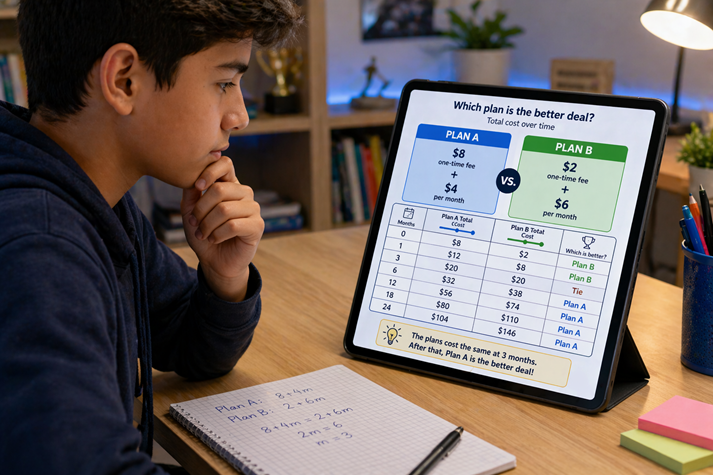
You’re trying to pick the better deal.
Plan A: $10 + $5 per month
Plan B: $20 + $3 per month
At first glance, Plan A looks cheaper… but after a few months, that might change.
To figure that out, you have to compare both sides at the same time.
That means solving an inequality with variables on both sides.
What Makes This Different?
Before, you solved inequalities in which the variable was on only one side.
Now it shows up on both sides.
Example:
3x + 4 < x + 10
Both sides are changing as x changes. Your job is to find when one side is greater than, less than, or equal to the other.
The goal is still simple.
Get x by itself.
The Smart Move: Bring Variables Together
When variables are on both sides, start by moving them to one side.
Here’s the trick.
Move the variables in a way that keeps things simple—usually by keeping the coefficient positive.
That means:
Subtract the smaller x-term from both sides.
Or move terms so you don’t end up dividing by a negative later.
This saves time and avoids mistakes.
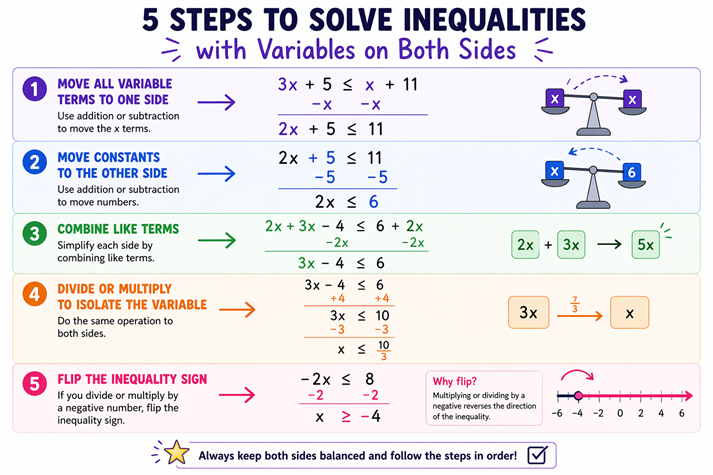
Step-by-Step Game Plan
Follow this order every time.
Move all variable terms to one side
Move constants to the other side
Combine like terms
Divide or multiply to isolate the variable
Flip the inequality sign if you divide or multiply by a negative
Stick to this process, and the problem becomes manageable.
Example 1: Start Strong
Solve.
3x + 4 < x + 10
Step 1: Subtract x.
2x + 4 < 10
Step 2: Subtract 4.
2x < 6
Step 3: Divide by 2.
x < 3
Example 2: Try the Other Direction
Solve.
2x - 5 > 4x - 1
Step 1: Subtract 2x.
-5 > 2x - 1
Step 2: Add 1.
-4 > 2x
Step 3: Divide by 2.
-2 > x
Rewrite.
x < -2
Example 3: Don’t Forget the Flip
Solve.
-2x + 6 > x - 3
Step 1: Subtract x.
-3x + 6 > -3
Step 2: Subtract 6.
-3x > -9
Step 3: Divide by -3 and flip the sign.
x < 3
That flip still matters—even when variables are on both sides.
Example 4: Distribute First
Solve.
6(1 - x) < 3x
Step 1: Distribute.
6 - 6x < 3x
Step 2: Add 6x.
6 < 9x
Step 3: Divide by 9.
2/3 < x
Rewrite.
x > 2/3
What If Things Don’t Work Out?
Sometimes you’ll solve an inequality and get something unexpected.
No Solution
Solve.
2x + 3 < 2x - 5
Subtract 2x.
3 < -5
That’s not true.
So there is no solution.
All Real Numbers
Solve.
4x + 2 > 4x - 6
Subtract 4x.
2 > -6
That’s always true.
So the solution is:
All real numbers.
Every value of x works.
Make Sense of the Answer
Once solved, your answer tells you a range of values.
Example:
x > -4
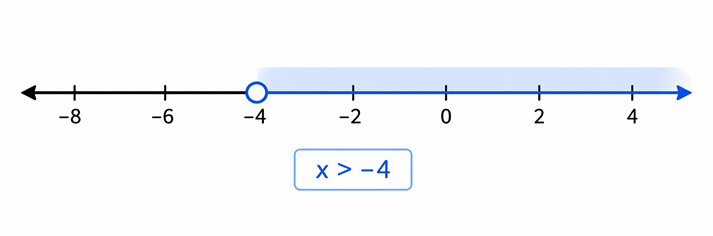
Open circle at -4.
Shade to the right.
Quick Reminders
Move variables first.
Keep both sides balanced.
Choose smart moves to avoid negatives when possible.
Flip the sign only when dividing or multiplying by a negative.
Check if your final statement makes sense.
You’re Ready
You can now:
Solve inequalities with variables on both sides.
Keep your steps organized and efficient.
Recognize when answers don’t exist—or always work.
Connect math to real situations like pricing and planning.
Get Ready to Practice
Now it’s your turn to take both sides, bring them together, and solve step by step until the answer is clear.

Supplies
Additional Resources


 FAVORITE
 Like
Like