Sign Up
School Account Sign Up

Lesson ID: 10906
See how points, lines, and planes build the world around you, then practice spotting and creating them in fun, hands-on activities.




Seeing the World in Points, Lines, and Planes
Imagine standing outside on a clear night, staring up at the stars.
You notice scattered dots of light—but your brain does something amazing. It starts connecting those dots, turning them into pictures: a dipper, a hunter, a bear.

Those tiny specks of light are points, the invisible connections you draw are lines, and the entire night sky is like a giant plane stretching endlessly in every direction.
That’s geometry in action. Geometry takes the building blocks of space—points, lines, and planes—and gives us a language to describe the world around us. Let’s break down these essentials.
Building Blocks of Geometry
Geometry is like the grammar of space—it tells us how shapes, directions, and positions all fit together. To master it, you need to know its simplest building blocks: points, lines, and planes.
Point
A point is a single location in space. It has no length, width, or thickness—it’s just a place.
Imagine a star in the night sky or a tiny dot on your homework paper. In geometry, points are labeled with capital letters, such as A, B, or C.

Line
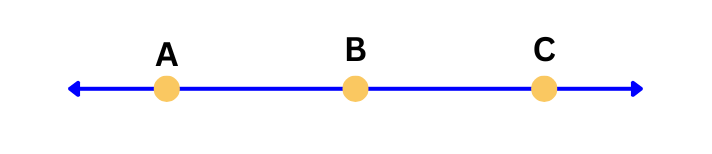
A line is a straight path made of points that extends forever in both directions. It has length, but no thickness.
On paper, we draw it with arrows at both ends to show it never stops. Two points determine exactly one line.
If several points all lie on the same line, we call them collinear. For example, three telephone poles standing perfectly in a row are collinear points.
Plane
A plane is a flat surface that extends forever in all directions. Like a sheet of paper, a floor, or the surface of a lake, it has length and width but no thickness.
Planes are usually labeled with a capital letter or by naming three points that are non-collinear (not all on the same line).
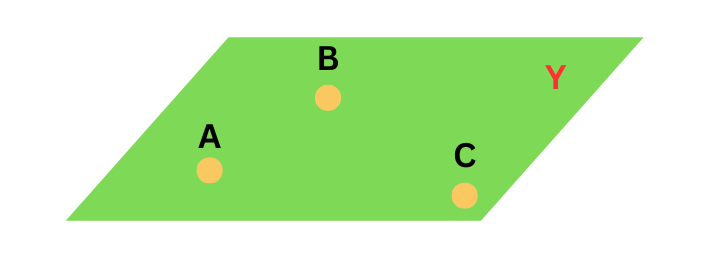
When points or lines all lie on the same plane, we say they are coplanar. For example, every object sitting flat on your desk is coplanar.
Postulates: Geometry’s “Game Rules”
A postulate is a statement in geometry that we accept as true without proof. They’re the basic rules everything else is built on.
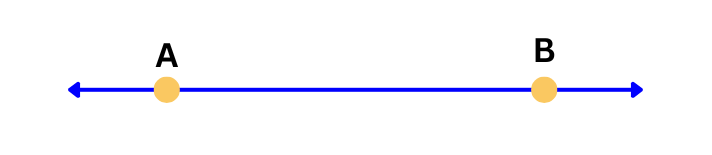
Postulate 1-1: Through any two points, there is exactly one line.
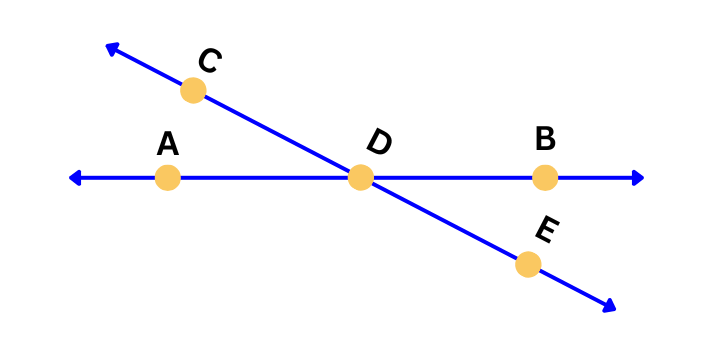
Postulate 1-2: If two lines intersect, they intersect in exactly one point.
Postulate 1-3: If two planes intersect, they intersect in a line.
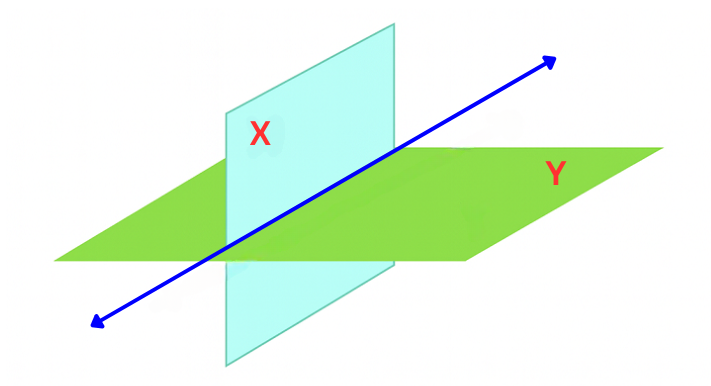
Postulate 1-4: Through any three non-collinear points, there is exactly one plane.
These postulates might sound simple, but they’re the foundation of all geometry—kind of like the “physics” of shapes and space.
Geometry All Around You
Once you start looking for them, points, lines, and planes are everywhere.
The dots of a constellation are points; the imaginary connections between them are lines; and the whole sky is a plane.
The corner of a room is the intersection of two planes forming a line.
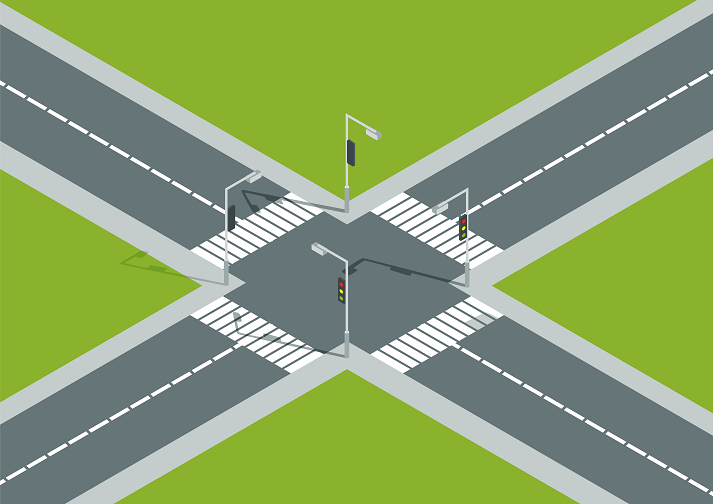
Roads crossing at an intersection are lines that share a point.
A page in a book is a plane, while the words printed on it are points arranged in lines.
Geometry isn’t just for math class—it’s the hidden framework of both nature and design.
Now that you’ve learned how to spot and describe points, lines, planes, and their special relationships, it’s time to practice.
Head to the Got It? section to get hands-on with activities that challenge you to sketch, connect, and identify these geometric ideas for yourself.

Supplies


 FAVORITE
 Like
Like