Sign Up
School Account Sign Up

Lesson ID: 13137
Explore how Native Nations of the Great Plains lived, adapted, and thrived—then create your own map, story, or survival plan!




From Foot Travel to Fast Riders
You may picture Native peoples of the Great Plains racing across open grasslands on horseback. That image is famous for a reason, but it is only part of the story.
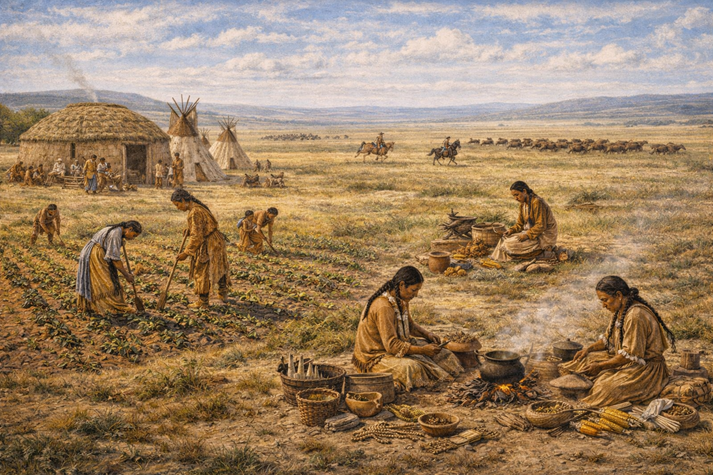
The Plains were home to many Native Nations with diverse languages, traditions, homes, and ways of life. Some farmed. Some followed bison herds. Some did both during different times of the year.
In this lesson, you will learn how people adapted to life on the Great Plains and how horses, bison, trade, language, and survival skills shaped daily life.
A Surprise from Long Ago
Here is a wild history twist: horses once lived in North America, but they disappeared from the continent about 11,000 years ago.
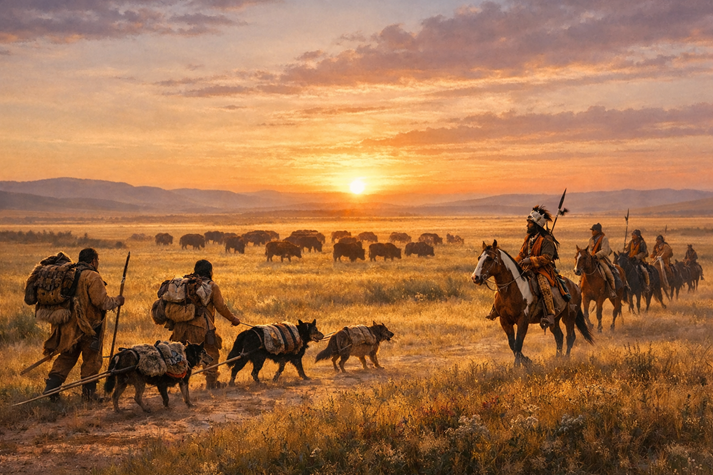
For thousands of years after that, Native people on the Plains traveled without horses. They walked, used dogs to help carry loads, and built strong ways of life that fit the land.
Horses returned much later when Spanish explorers and settlers brought them to the Americas in the 1500s. Over time, some horses spread north through trade, escape, and capture.
Native Nations across the Plains learned how to care for horses, train them, and ride them with amazing skill. This did not happen all at once, and not every Nation used horses in the same way or at the same time.
Still, horses changed travel, hunting, trade, and warfare across much of the Plains.
The Great Plains: A Huge Region, Not One Single Culture
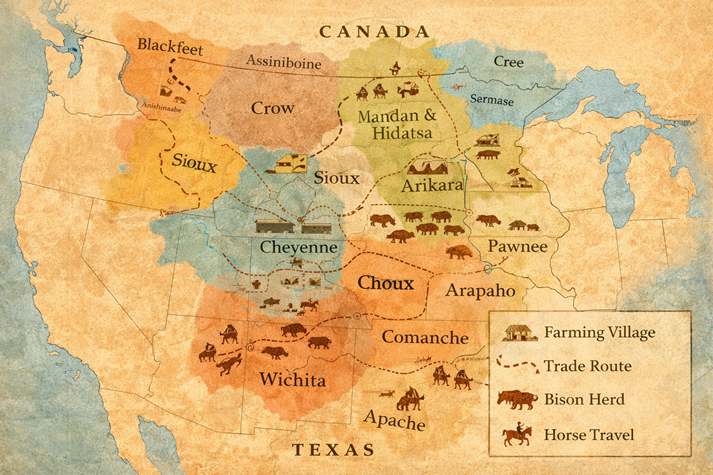
The Great Plains stretch through the middle of North America from parts of Canada down into Texas and from the Mississippi River area toward the Rocky Mountains.
This region includes grasslands, rivers, rolling hills, and areas with fewer trees than the eastern woodlands.
Many Native Nations lived across this large region, including the Lakota, Dakota, Nakota, Cheyenne, Arapaho, Comanche, Kiowa, Crow, Blackfeet, Pawnee, and many others.
These groups were not all the same. They spoke different languages, had different beliefs, and made different choices based on where they lived.
Some Plains communities, especially in areas with better soil and more rainfall, farmed crops such as corn, beans, and squash. These crops are often called the Three Sisters because they grow well together.
Other communities depended more on hunting and gathering, especially in drier parts of the Plains where farming was harder. Some groups lived in villages for part of the year and traveled for seasonal hunts at other times.
That means one important truth belongs right up front: there was no single “Plains Indian” way of life. There were many Plains cultures, and each one deserves to be understood as its own people, not as a movie background with extra horses.
Why Bison Mattered So Much
Bison were central to life for many Plains Nations.
You may hear the word "buffalo" used in older materials, but "bison" is the more accurate name for the animal in North America. Many people still say "buffalo," so you may see both words.
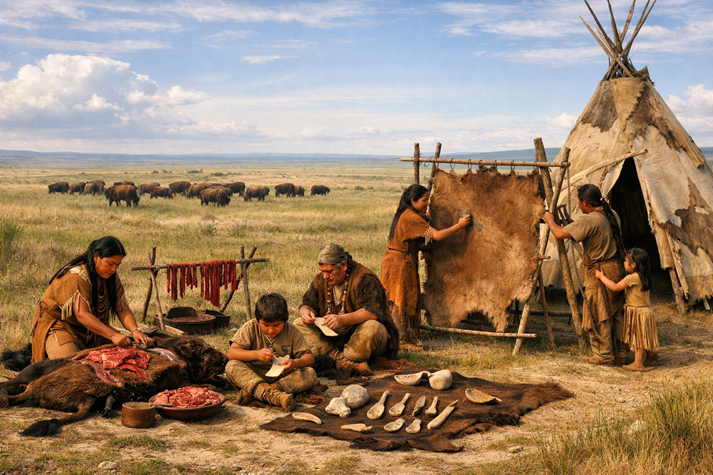
For many Plains communities, bison provided food, clothing, shelter materials, and tools. People used the meat for meals. Hides were made into clothing, blankets, robes, and tipi covers.
Sinew, which is strong tissue from the animal’s body, became bowstrings, thread, and rope. Bones and horns could be shaped into tools, spoons, scrapers, and other useful items. Dried bison dung could even be burned as fuel where firewood was scarce.
This does not mean every person used every part in the same way, but it does show how carefully people used the resources around them.
Bison were not hunted for sport. They were deeply important to survival, and many Plains Nations also held spiritual beliefs that taught respect for animals and the natural world.
Homes, Travel, and Daily Life
Many people associate the Plains with tipis, which were important homes for many mobile Plains communities.
A tipi was practical for life on the move. It could be set up, taken down, and carried to a new location more easily than a heavy permanent structure. Tipis were often made with long poles and animal hides in earlier times, and later with canvas as materials changed.
But not every Plains Nation lived in tipis all the time. Farming communities could also build earth lodges or other more settled homes.
Housing depended on climate, available materials, and whether a group moved often or stayed in one place for longer.
Daily life included much more than hunting. People prepared food, made clothing, cared for children, trained horses, made tools, told stories, created art, traded goods, and held ceremonies.
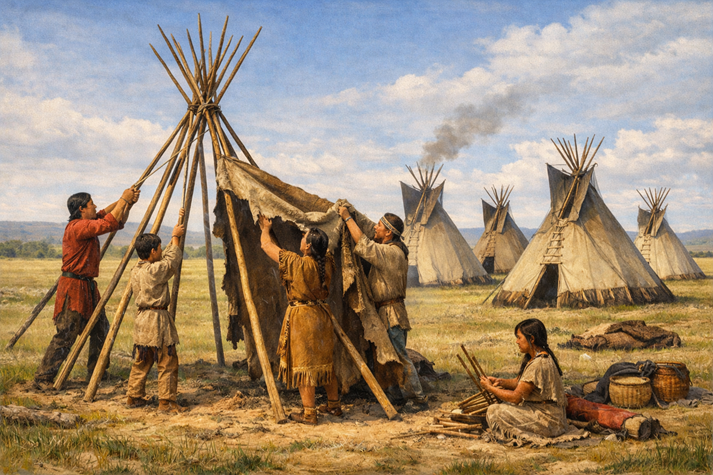
Children learned by watching, practicing, listening, and joining in the community's work. Skills were passed down over time, not dropped out of the sky by a dramatic soundtrack.
How Horses Changed Life on the Plains
Once horses spread across the Plains, they transformed daily life for many Nations.
Hunters could travel farther and move more quickly with bison herds. Families could carry more supplies. Trade over longer distances became easier. In times of conflict, mounted riders could move with speed and power.
Some Nations became especially well known for horsemanship. The Comanche, for example, built a strong horse culture and became widely known for riding skill and mobility.
Other Plains Nations also developed impressive horse traditions. Horses became part of work, travel, trade, and identity.
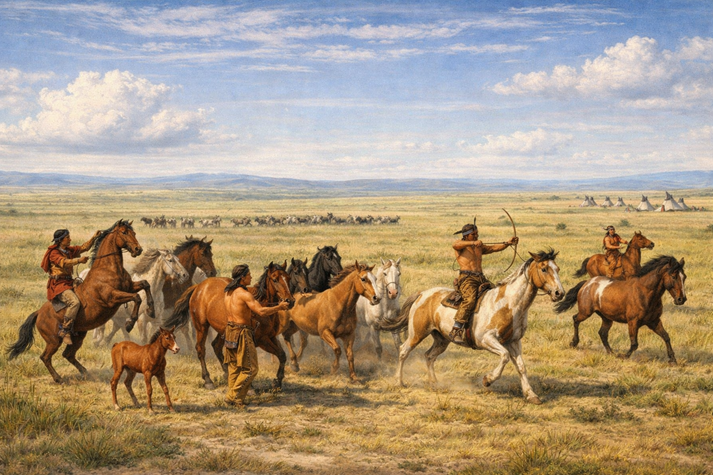
Still, it is important to keep the story balanced. Horses were powerful, but they were not the whole story. Plains cultures were already strong, skilled, and well-adapted before horses arrived.
Horses changed life, but they did not create Plains civilizations from scratch.
Ways People Communicated
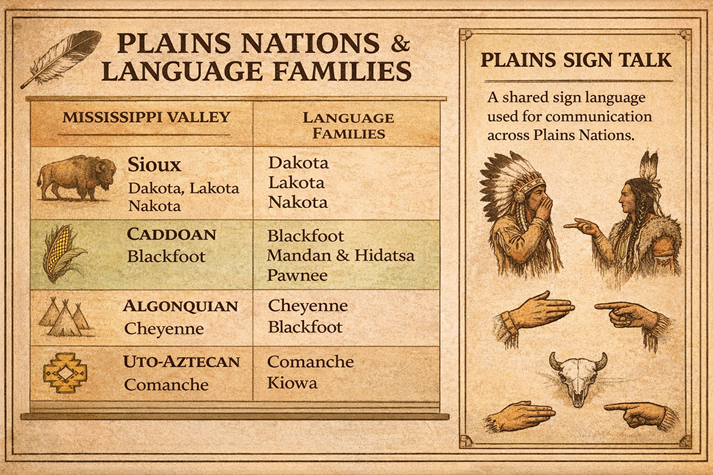
The Plains were home to many languages, not just one. Some Nations spoke languages from the Siouan language family. Others spoke Algonquian, Caddoan, Uto-Aztecan, or other language families.
That rich language variety meant people needed smart ways to communicate across groups.
One important tool was Plains Sign Talk, also called Plains Indian Sign Language in many older sources. It was a shared sign system used by people from different language groups to communicate during trade, travel, diplomacy, and other meetings.
It was not a replacement for tribal languages. It was more like a bridge between them.
A Closer Look at Plains Languages
People across the Great Plains spoke many different languages, and those languages are still alive today. Some examples include:
Even when languages were related, they were not the same. That means people could not always understand each other just by listening. This is one reason Plains Sign Talk became so useful.
Here are a few simple examples to help you see how languages can differ:
The word for “friend” in Lakota is often written as “kola” (for a male friend).
The word for “people” in many Plains languages may sound completely different depending on the Nation.
Spelling can change because many Native languages were traditionally spoken rather than written.
Today, many communities are working to preserve and teach their languages in schools and homes.
Understanding Plains Sign Talk
Plains Sign Talk was a shared system of hand signs used by many Native Nations across the Plains. It allowed people who spoke different languages to communicate clearly.
For example:
A hunter could use signs to describe where bison were moving.
Traders could negotiate without speaking the same language.
Leaders could communicate during meetings or travel.
The signs often showed meaning through movement. A sign for “horse” might involve a motion that represents riding. A sign for “bison” might show the shape of horns.
These signs were not random. They were carefully developed and widely understood across large areas.
Plains Sign Talk worked like a bridge between languages. It did not replace spoken languages. Each Nation still used its own language for daily life, stories, and ceremonies.
Respect for Nature and Spiritual Beliefs
Many Plains Nations taught that people are connected to the land, animals, water, and sky.
Specific beliefs and ceremonies differed from Nation to Nation, so it is not accurate to assume that every group believed the same thing. Still, respect for the natural world was an important part of many Plains cultures.
This respect appeared in daily choices, art, clothing, ceremonies, and storytelling. Decorative beadwork, quillwork, carvings, clothing designs, and painted objects often carried meaning.
Histories could be remembered through oral tradition, winter counts, artwork, and ceremonial practices.
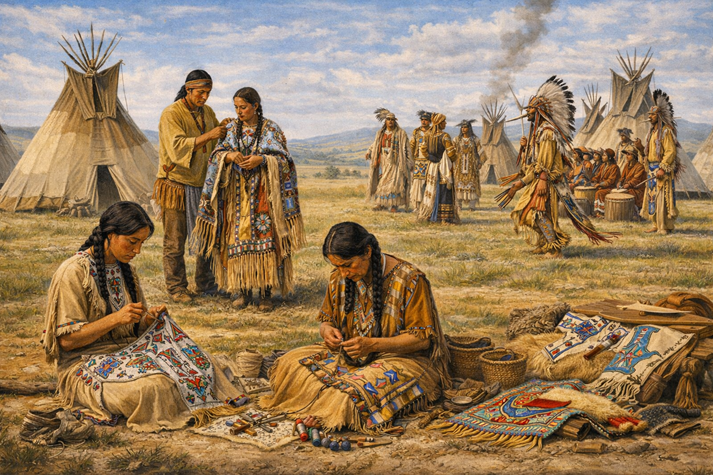
This is another place where old lessons often flatten everything into one giant stereotype pancake. A better approach is to remember that each Nation had its own traditions, leaders, stories, and sacred practices.
What Changed in the 1800s
Life on the Plains changed sharply as the United States expanded westward in the 1800s. Settlers, soldiers, railroads, disease, broken treaties, and forced removals disrupted Native life across the region.
Another major disaster was the mass killing of bison. Commercial hunters killed huge numbers of bison in the late 1800s, and this damaged the food systems, economies, and independence of many Plains Nations.
Native Nations resisted in different ways. Some fought to defend their homelands. Some negotiated. Some adapted while trying to protect their people and traditions.
Many faced terrible violence, including massacres and forced boarding school policies that tried to erase Native languages and cultures.
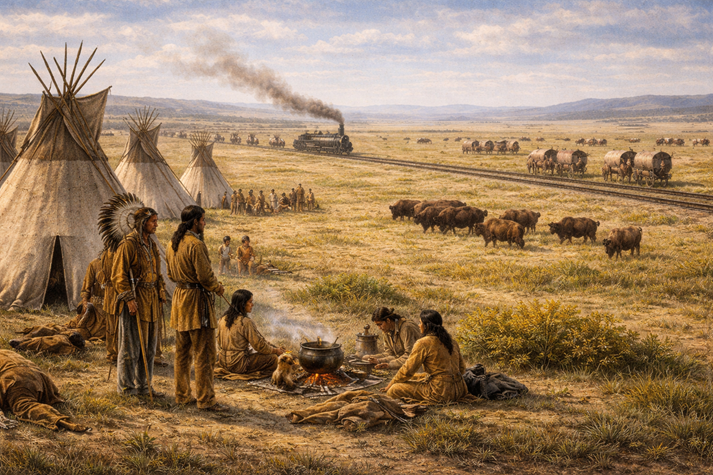
That history matters because the Plains Nations did not disappear. Native people from these Nations are still here today. Their languages, art, governments, traditions, and communities continue.
This lesson is not about a vanished people from a dusty old movie set. It is about real Nations with deep histories and living cultures.
A Better Way to Think About the Plains
So what should you remember most from this section?
The Great Plains were home to many Native Nations, not one single group.
Life on the Plains depended on smart adaptation to climate, land, and resources.
Bison were central to survival for many communities.
Horses changed travel, hunting, and trade, but Plains cultures were already strong before horses spread.
Many languages were spoken across the Plains, and Plains Sign Talk helped people communicate across language groups.
Native Nations of the Plains are living communities with continuing cultures today.
Now that you have learned how Native Nations of the Great Plains lived, adapted, and changed over time, you are ready to sort out the facts, test what you remember, and put your new knowledge to work in the Got It? section.

Supplies
Additional Resources
Suggested Reading


 FAVORITE
 Like
Like