Sign Up
School Account Sign Up

Lesson ID: 13327
Discover your family story, decode relationships, and start building your own family tree.



Who Are You Really Connected To?
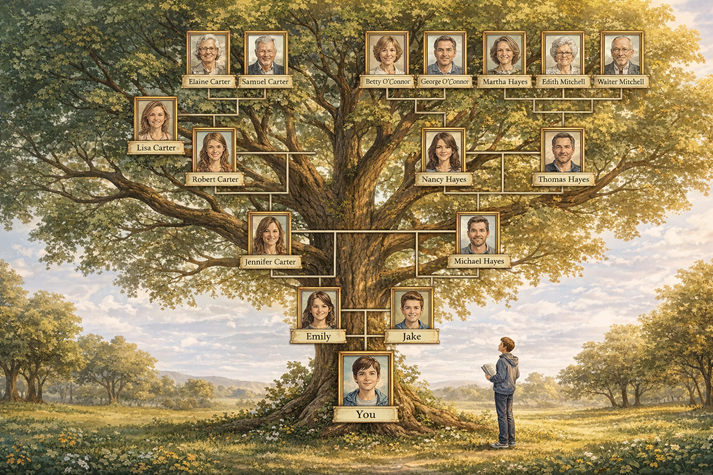
Imagine discovering you have a sibling you never knew existed… and they go to the same school as you.
That actually happened. Two college students found out they were brothers after taking a DNA test. They had grown up separately, but when they finally met, they realized they shared the same interests, the same major, and even the same favorite sports team.
Stories like that aren’t rare anymore. People are uncovering surprising connections, solving family mysteries, and learning where they come from—all through something called genealogy.
What Is Genealogy?
Genealogy is the study of your family’s history. It involves tracing your family lines, learning about your ancestors, and discovering how your family is connected across generations.
Think of it as being part historian and part detective.
You search for clues, piece together information, and build a clearer picture of where you come from. Sometimes you confirm what you already know. Other times, you uncover something completely unexpected—like relatives you’ve never met or stories no one has told before.

People study genealogy for many reasons.
To understand their cultural background
To connect with relatives
To preserve family stories
To answer personal questions about identity
And sometimes? Just pure curiosity.
The Language of Family History
Genealogy has its own vocabulary. Learning these terms makes everything else much easier.
Ancestors and Descendants
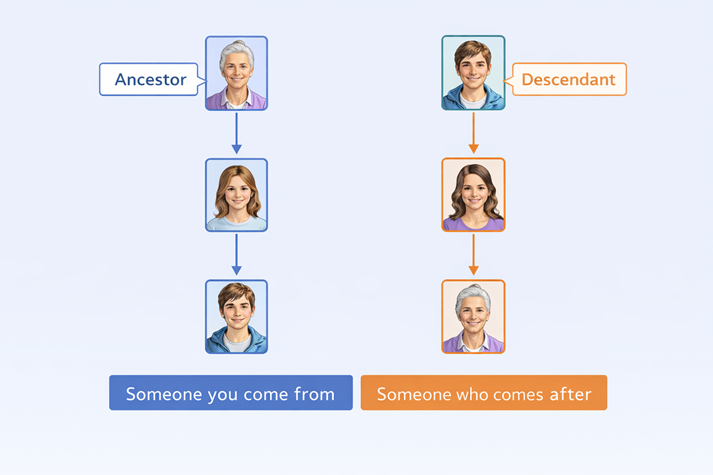
An ancestor is someone you come from—like your grandparents or great-grandparents.
A descendant is someone who comes after—like children, grandchildren, and future generations.
If your great-grandmother lived 100 years ago, she is your ancestor. You are her descendant.
Direct Line vs. Collateral Relatives
Your direct line includes the people directly connected to you: parent ? grandparent ? great-grandparent.
Collateral relatives are still related to you, but not in a straight line—like aunts, uncles, and cousins.
Both matter. Sometimes a cousin’s record can solve a mystery about your direct ancestors.
Generations
A generation is the time between parents and their children—usually about 20–30 years.
When building a family tree, you count generations starting with yourself.
You = first generation
Your parents = second
Your grandparents = third
And so on.
Family Trees (Your Visual Map)
A family tree is a visual way to organize your family history.
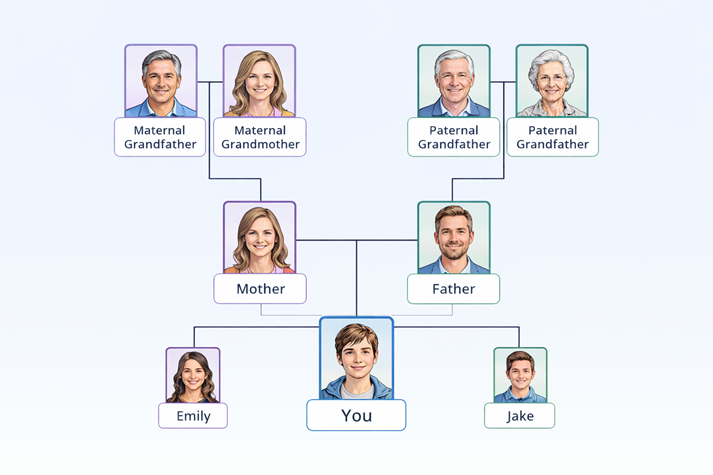
There are two common types.
Pedigree chart: shows your direct ancestors in a structured layout
Fan chart: spreads outward like a semicircle
Both help you see connections clearly and spot missing information.
Understanding Relationships (Without Getting Confused)
Some family terms sound complicated… but they follow simple patterns.
Here’s a quick breakdown.
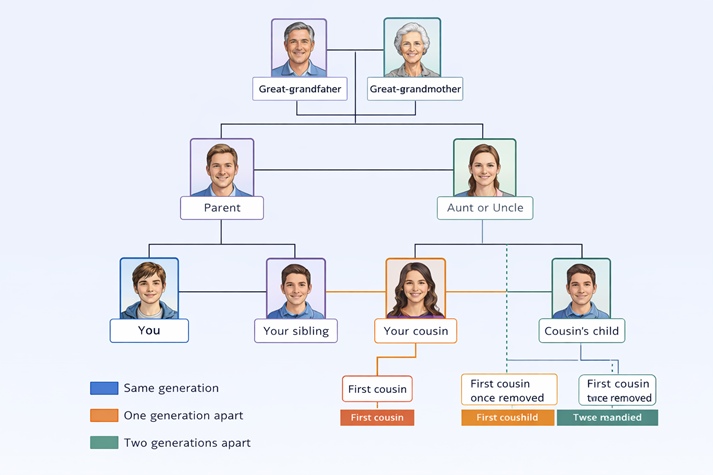
First cousins share the same grandparents.
Second cousins share the same great-grandparents.
“Removed” means a difference in generations.
Example
Your cousin’s child = your first cousin once removed
Your parent’s cousin = also your first cousin once removed
“Removed” just means you’re not in the same generation.
Once you see the pattern, it stops feeling like a puzzle and starts making sense.
Why Genealogy Matters More Than You Think
Genealogy isn’t just about names and dates.
It can:
Reveal family stories that were forgotten
Explain where traditions come from
Connect you to cultures, places, and experiences you didn’t know were part of your story
Help people find relatives, sometimes after decades apart
It can also uncover difficult truths. Not every discovery is easy—but every discovery helps build a more complete picture of the past.
And here’s the interesting part: you don’t have to be an expert to start. Even teenagers have solved real family mysteries using basic research skills and determination.
You’re Already Part of the Story
You don’t need a DNA test or a stack of old records to begin.
You already have a starting point: yourself.
Every name, place, or story you know is a clue. Every question you ask leads you one step closer to understanding your family’s history.
Now that you understand what genealogy is and how family relationships work, it’s time to put that knowledge to use.
Next, you’ll start exploring your own family connections and practice identifying relationships, generations, and key terms—just like a real genealogist.

Supplies
Additional Resources
Suggested Reading


 FAVORITE
 Like
Like