Sign Up
School Account Sign Up

Lesson ID: 10449
If everyone around you said the moon is made of cheese, would you be the one to disagree? Find out what peer pressure is and how to stand up for what you know is true!




In the story, an emperor loved fancy clothes more than almost anything. One day, two swindlers told him they could make a special outfit that only smart people could see. Anyone who could not see the clothes, they said, must be foolish.
There was one big problem.
There were no clothes.
The swindlers only pretended to sew and hold up beautiful fabric. When the emperor looked at the empty space, he saw nothing. Still, he did not want anyone to think he was foolish, so he pretended to see the outfit.
Then his ministers pretended to see it, too.
Finally, the emperor marched through town wearing his “new clothes.” The people in the crowd also saw that he was wearing nothing special at all. Still, no one wanted to be the first person to say it. Everyone worried that speaking up would make them look foolish.
Then a child said what everyone else was thinking:
“He isn’t wearing anything!”
Suddenly, the crowd began to admit the truth.

Think about your answer. Then, continue reading to learn how this story connects to peer pressure.
People sometimes do idiotic or bad things because of something called peer pressure.
It's the feeling that someone is pushing you to make a certain choice or behave a certain way.
Peer pressure can be good or bad.
Good Peer Pressure
Here are some examples of good peer pressure.

Bad Peer Pressure
Peer pressure is bad when you do something that you know is wrong or unwise to go along with the crowd.
The crowd can be several people or just one. It's a group that you want to belong to, even if it's just a friendship with one other person.
Here are some examples of bad peer pressure.
This lesson will focus on bad peer pressure.
You'll learn how to spot it, why it works, and how to fight against it!
How to Spot Bad Peer Pressure
Bad peer pressure can either be spoken or unspoken.
Spoken pressure is when a person asks you to do something or says things to you that push you toward a bad choice.
So, if your friends wanted you to dislike someone you've never met, they might say the following.
"She's a terrible, mean person. Don't ever talk to her!"
"If you talk to her, I won't be your friend anymore!"
"Anyone who's friends with her must be foolish!"
Unspoken pressure is when you feel pressured to do something because you see others doing it, even though they don't say anything to you.
So at the party where everyone is stuffing themselves with sweets, they may not say anything to you, but some kids may do the following.
Look at you like you're strange because you're not doing the same as them.
Leave you out of the group when they join up to talk or play a game.
The funny thing is, a lot of those kids may not even want to eat all those sweets, but they do it because they want to fit in.
Why Peer Pressure Works
The answer is: our brains are wired that way. We're made to want to be part of a group and to learn from what other people know.
But that becomes a big problem when people ignore what they know is true!
Imagine this experiment.
A group of students sits around a table. They are shown one line, and then three other lines labeled A, B, and C. The students are asked which labeled line matches the first line.
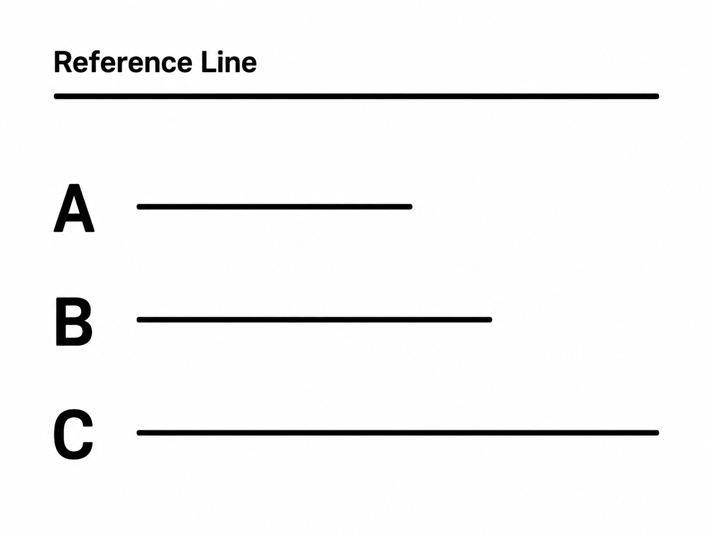
The correct answer is obvious. It is line C.
However, there is a trick. Most of the students are secretly part of the experiment. They are told to give the wrong answer on purpose. One by one, they all say, “A.”
Then the only student who is not part of the trick has to answer.
That student knows the answer is C. The lines are right there. Still, after hearing everyone else say A, many students say A as well.
Why?
They do not suddenly forget how to compare lines. They feel pressure to match the group.
This kind of experiment was inspired by the work of Solomon Asch, a psychologist who studied conformity. Conformity means changing what you say or do so you fit in with a group.
Speak Up!
Now think again about “The Emperor’s New Clothes.”
Everyone knew that the emperor had nothing on. However, because they thought everyone else saw the clothes, and because they did not want to look foolish, they stayed quiet.
Once the child said what everyone knew was true, other people felt brave enough to admit it, too.
That is one way to fight bad peer pressure: speak up respectfully.
You do not have to yell. You do not have to call anyone wrong or foolish. You can simply say what you think in a calm way.
For example, you might say the following.
“I see it differently.”
“I’m not sure that’s a good idea.”
“I don’t think I want to do that.”
“Maybe there’s another way to handle this.”
One respectful voice can help other people feel brave enough to think for themselves, too.
To Sum Up, Here Are Some Tips on How to Handle Peer Pressure.
Here are some tips for standing up to peer pressure.
Pause before you answer.
Peer pressure can make you feel like you have to decide right away. You do not. Take a breath and give yourself a moment to think.
You could say:
“Let me think about that.”
“I need a minute.”
“I’m not sure.”
Name the pressure.
Sometimes it helps to notice what is happening. Are people teasing you? Leaving you out? Trying to make you feel embarrassed? Acting like “everyone” is doing something?
Once you spot the pressure, it is easier to make your own choice.
Say no clearly and calmly.
You do not need a long speech. A short, clear answer works.
You could say:
“No, thanks.”
“I’m not doing that.”
“That’s not for me.”
“I don’t want to.”
Give a reason, if you want to.
You do not always have to explain yourself, but sometimes a reason can help.
You could say:
“My parents would not be okay with that.”
“I don’t want to get in trouble.”
“That could hurt someone.”
“I know I’ll feel bad about it later.”
Suggest something else.
Offering another idea can help move the group away from the bad choice.
You could say:
“Want to play something else instead?”
“Why don’t we go outside?”
“Let’s watch something different.”
“We could invite them to join us instead.”
Get support.
If the pressure keeps happening, talk to your parents or another trusted adult. You do not have to handle every situation alone.

Write in your journal about a time when you experienced peer pressure.
Then, move to the Got It? section to see how much you’ve learned. You’ll also get to create some strong responses to a few peer-pressure situations!

Supplies


 FAVORITE
 Like
Like