Sign Up
School Account Sign Up

Lesson ID: 13128
Follow Alexander the Great as he conquers lands and spreads Greek culture across three continents, leaving a legacy that outlived his empire.




Taming the Untamable
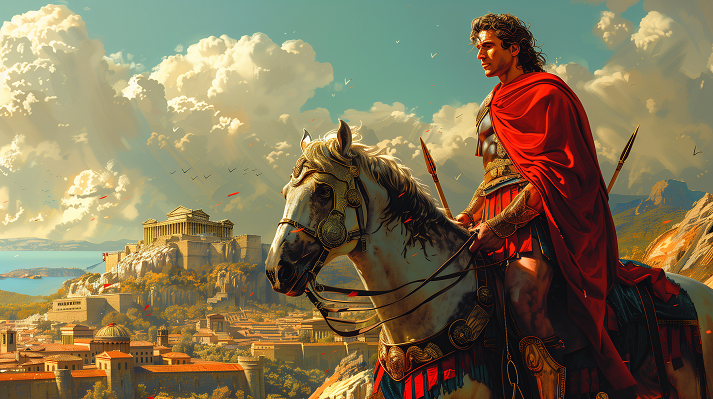
Imagine being a kid who sees a wild, unrideable horse and says, “I’ll take it.” That was Alexander of Macedonia.
At just twelve, he proved everyone wrong by calming and riding the fierce stallion Bucephalus.
That boldness never left him. By twenty, he wasn’t just riding horses—he was leading armies.
A King With a World-Class Teacher
Alexander didn’t grow up learning only how to fight. His father, King Philip II, hired none other than Aristotle—the philosopher whose ideas shaped science, politics, and logic for centuries—to tutor him.
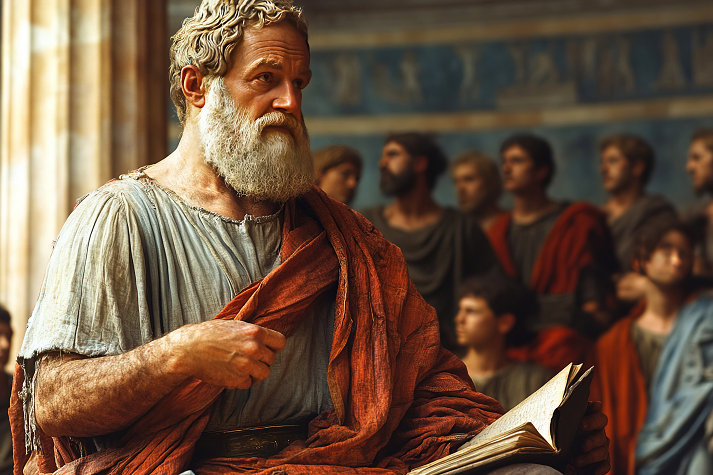
Aristotle sparked Alexander’s love of Greek culture: philosophy, theater, literature, and even the idea that education was as valuable as a sword.
This education would later matter as much as his armies, because Alexander didn’t just conquer—he carried Greek ideas with him.
Conquests that Carried Culture
When Alexander became king in 336 BCE, he faced a giant rival: the Persian Empire. At battles like Issus and Gaugamela, Alexander’s smaller, well-trained army defeated forces several times their size.
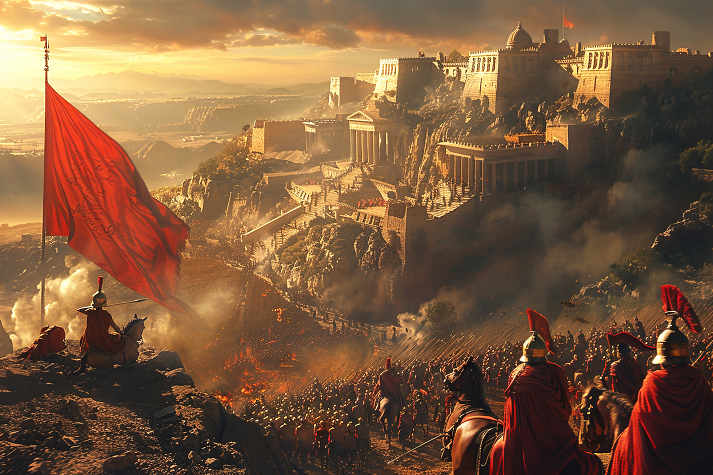
But Alexander wasn’t just thinking about war. With each victory, he built bridges—sometimes literally, often culturally.
In Egypt, he respected local traditions, adopted the title of Pharaoh, and founded a new city: Alexandria. It quickly became a center of trade, science, and learning. Its legendary library (later destroyed) aimed to collect every book in the world.

Similar cities called “Alexandrias” sprang up across his empire, from Greece to India, blending Greek art and architecture with local traditions.
The Hellenistic World
This blending created what historians call the Hellenistic world.
Greek theaters popped up in foreign cities. Statues combined Greek and local gods, like Zeus-Ammon. Greek became the common language of trade and scholarship, meaning someone from Egypt could communicate with someone from Persia or Greece.
Scientists, mathematicians, and philosophers thrived in this interconnected world—think Euclid in geometry, or Archimedes with inventions.
Legacy of a Short Life
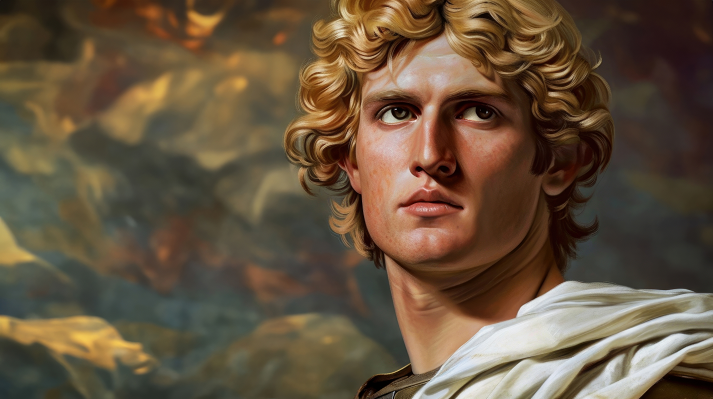
Alexander’s campaigns stretched over 11 years and three continents. He never lost a battle, but his soldiers eventually refused to march farther.
In 323 BCE, he died in Babylon at the age of 33. His empire soon fractured, but his cultural footprint was permanent.
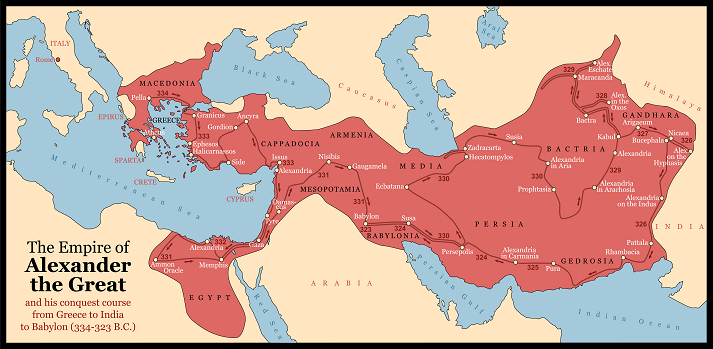
Even after the political empire vanished, Greek ideas about government, theater, art, science, and language spread and mingled with local traditions.
That cultural “aftershock” shaped the Mediterranean and Middle East for centuries, and its ripples still touch your world today.
Next Up: Practice What You Learned
You’ve just marched through Alexander’s life and seen how Greek culture spread across continents. Now, it’s time to test your knowledge and see how well you can connect battles, cities, and cultural exchange.
March on to the Got It? section!

Supplies
Additional Resources
Suggested Reading


 FAVORITE
 Like
Like