Sign Up
School Account Sign Up

Lesson ID: 11457
Meet the plants of rivers and streams! Learn how they grow, why they matter, and what makes each one unique.




Mystery in the Marsh
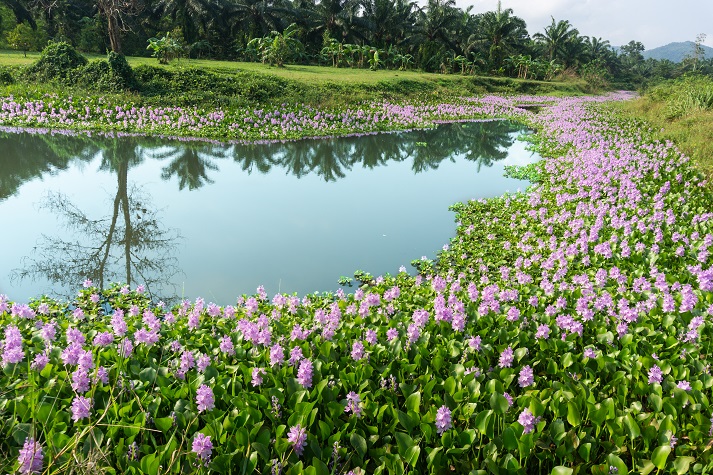
Picture this: a river that looks more like a garden than a waterway! Thick green plants crowd the surface, flowers bloom in the water, and long leaves wave just under the ripples.
Some are beautiful, some are sneaky, and all of them are built to survive in moving water. Get ready to uncover the secrets of the plants that call rivers and streams home!
What Kinds of Plants Live in Rivers and Streams?
Rivers and streams are always on the move, so plants that grow there need special features to survive. Some plants float, some have strong roots, and some grow along the edge where the water isn’t too fast.
Explore some of the most common river plants!
Cattails: The Tall River Watchers
Cattails grow along the banks of rivers, which are the outer edges or slopes of the riverbed. The water there is shallower, and the current is gentler—perfect for plant roots to take hold.
Cattails can grow up to ten feet tall and have long green leaves. Their flowers come in two parts.
The brown, hot-dog-shaped flower is the female part.
The small yellow spike above it is the male part.
Cattails provide shelter for animals and help clean the water by filtering it through their roots.

Water Lilies: Floating and Flowering
Water lilies are famous for their large, colorful flowers and wide, flat lily pads that float on the water’s surface. The roots grow deep into the riverbed, anchoring the plant in place so it doesn’t drift away.
Water lily flowers can be yellow, white, pink, or purple.

Here are a few fascinating facts about lilies.
They grow from bulbs underground.
Their petals and sepals are fused into tepals—and nectar forms at the base.
Some, like the tiger lily, have spots and bright colors that attract pollinators.
White lilies symbolize purity, and tiger lilies stand for majesty and wealth.
Lilies are not dangerous to humans, but they can be toxic to cats.
Water Stargrass: Underwater Stars
This plant grows completely underwater, but its yellow star-shaped flowers rise up and bloom above the surface.
The plant itself can stretch up to six feet long! It bends and waves with the current, and its starry flowers make it easy to spot in the summer.

Water Hyacinth: Beautiful but Bossy
At first glance, water hyacinth looks like a delicate beauty—it floats freely, grows up to three feet tall, and has lavender-colored flowers with a yellow spot on one of the petals. But don’t be fooled.
This plant is an invasive species, which means it spreads quickly and causes problems such as these.
It doubles in size every two weeks.
It grows into thick floating mats that can block boats.
It crowds out other plants and animals.
It slows or even stops river flow.
Even though it’s beautiful, the water hyacinth is considered one of the world’s worst aquatic weeds because of the damage it causes.
Where Do These Plants Grow—and Why?
Most river and stream plants live along the banks, not in the middle of the river. That’s because of the following reasons.
The current is slower near the edges.
The water is shallower, which helps roots reach the ground.
There’s often more sunlight and soil for the plant to grow.
If these plants tried to grow in the middle of a fast river, they’d be swept away!
What’s Next?
Now that you’ve explored the plant life in rivers and streams—from the gentle lily to the fast-spreading hyacinth—you’re ready to test your knowledge and get hands-on.
Head to the Got It? section to dig deeper into what you’ve learned!

Supplies
Additional Resources


 FAVORITE
 Like
Like