Sign Up
School Account Sign Up

Lesson ID: 11240
Solve inequalities fast and figure out exactly how much more you need to reach your goal.




Start Here: Can You Beat the Limit?
You’re playing a game, and the next level unlocks when your score is greater than 500.
Right now, your score is 472.
That’s not just guessing—that’s solving an inequality.

From Comparing to Solving
You already know how to read inequalities. Now it’s time to solve them.
Solving an inequality means finding all the values that make it true.
Here’s a simple example:
x + 4 < 9
This means:
To solve it, isolate x (get x by itself).
The Golden Rule: Keep It Balanced
An inequality works like an equation.
Whatever you do to one side, you must do to the other side to keep things fair.
Example:
x + 4 < 9
Subtract 4 from both sides.
x < 5
Now you know:
x can be any number less than 5 (but not 5 itself).
One-Step Moves Only
This lesson focuses on one-step inequalities. That means you only need to perform one operation to solve it.
There are four types you need to know.
Add or Subtract
Undo addition by subtracting. Undo subtraction by adding.
Example:
d - 3 > -6
Add 3 to both sides.
d > -3
Multiply or Divide
Undo multiplication by dividing. Undo division by multiplying.
Example:
2p > 8
Divide both sides by 2.
p > 4
The One Rule That Changes Everything
There is one big difference between equations and inequalities.
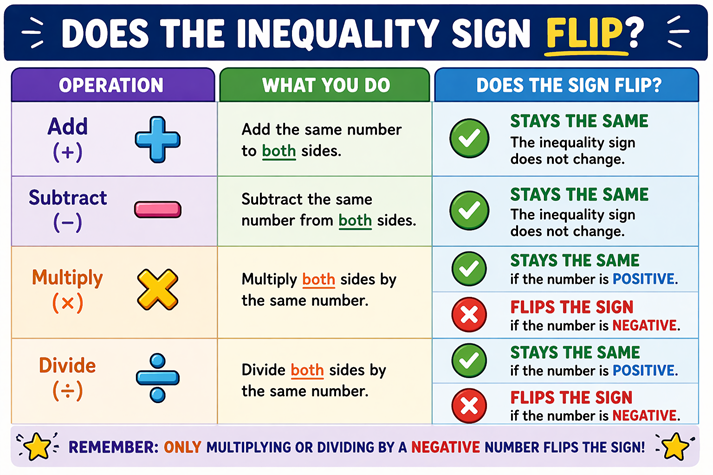
If you multiply or divide by a negative number, you must flip the inequality sign.
Yes, really. It switches direction.
Why Does It Flip?
Negative numbers reverse order.
Example:
-2 is greater than -5
But when you multiply both by -1, the order flips.
2 is less than 5
That’s why the inequality must flip too.
Example With a Flip
-2p > 8
Divide both sides by -2
p < -4
Notice:
The sign changed from > to <
Quick Visual Reminder
Add or subtract — sign stays the same
Multiply or divide by a positive — sign stays the same
Multiply or divide by a negative — flip the sign
One More Example
c + 5 > 1
Subtract 5.
c > -4
That’s it. One step. Clean and simple.
What You Can Do Now
You can:
Solve inequalities using one step.
Keep both sides balanced.
Know when to flip the sign (and when not to).
Understand what your answer actually means.
Get Ready to Practice
You’ve got the rules and the steps. Now it’s time to try solving inequalities on your own and see how quickly you can find the answers.

Supplies
Additional Resources



 FAVORITE
 Like
Like