Sign Up
School Account Sign Up

Lesson ID: 10965
Discover how triangles shape the world around you while learning simple formulas to find their area—no links or videos required!




Triangle Power: The Shape That Rules Geometry
Triangles are everywhere—on rooftops, in bridges, even in slices of pizza!
One secret lies in how easy it is to measure their area. Once you learn the trick, you can find the area of any triangle—no matter how tilted, tall, or tricky it looks.

Step 1: Finding the Easy Way—Base and Height
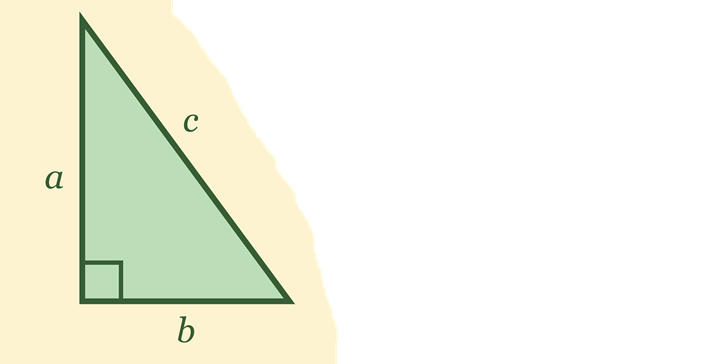
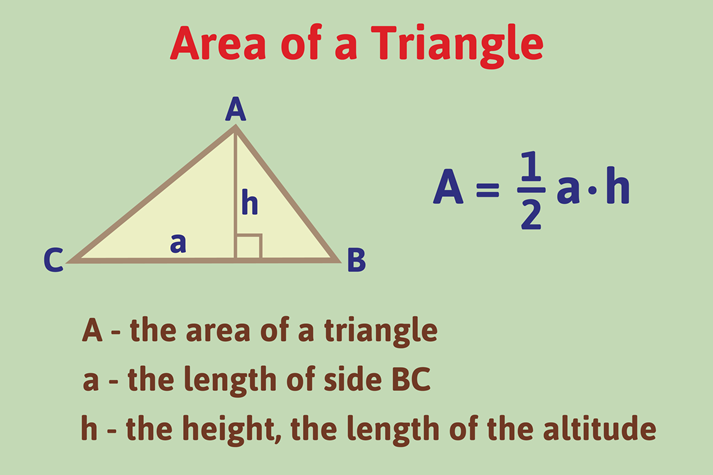
Every triangle has three sides, but you only need two to find its area: the base (b) and the height (h).
The base is any side you choose to “set” the triangle on. The height is the straight-up-and-down distance from that base to the opposite corner.
It’s important that the base and height meet at a right angle—that’s how you know you’re measuring straight up, not diagonally.
Here’s the magic formula:
| Area | = | 1 | x | base | x | height | |
| 2 |
That means you multiply the base by the height, then take half of that product.
Example: A triangle has a base of 20 cm and a height of 12 cm.
| Area | = | 1 | x | 20 cm | x | 12 cm | = | 120 cm2 | |
| 2 |
So the area of the triangle is 120 square centimeters—the amount of flat space inside its sides!
Step 2: No Right Angles? No Problem!
What if your triangle doesn’t have a right angle you can use for height? Don’t panic—there’s a formula for that too!
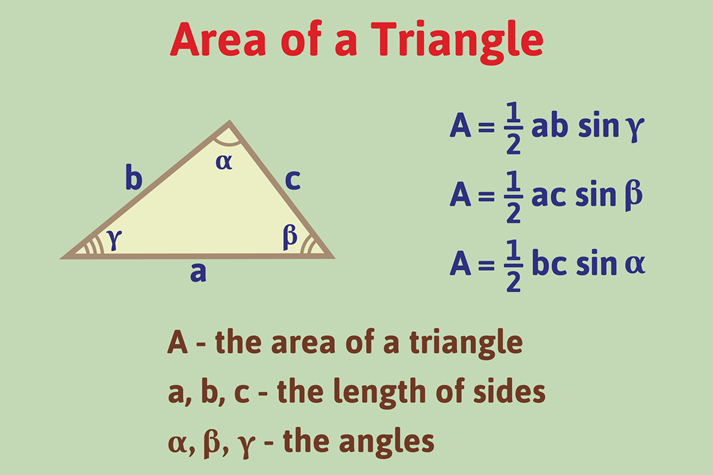
If you know two sides and the angle between them, you can use a bit of trigonometry (a fancy math word for angle magic):
| Area | = | 1 | ab | sin(C) | |||||
| 2 |
Here:
a and b are the lengths of two sides
C is the angle between them
sin(C) is the sine of that angle, which your calculator can find
Example: A triangle has sides 7 cm and 10 cm, with an included angle of 25°.
| Area | = | 1 | x | 7 | x | 10 | x | sin(25°) | |
| 2 |
Using a calculator:
sin(25°) ≈ 0.4226
Area = 14.8 cm2
Even when the triangle tilts, the same rule works!
Step 3: Real-World Triangles
Farmers, engineers, and architects all use these formulas to measure land or build sturdy designs.
For example, a farmer measuring a triangular piece of land with sides 150 m and 231 m and an angle of 123° can find its area like this:
| Area | = | 1 | x | 150 m | x | 231 m | x | sin(123°) | |
| 2 |
Area ≈ 14,530 m2
That’s a lot of grazing space for cows—thanks to triangle math!
Step 4: Why It Works
A triangle is really just half of a rectangle.
If you imagine doubling the triangle along its base, you’d form a rectangle. That’s why we multiply by one-half in the formula—it’s the triangle’s “half-a-rectangle” secret.
Step 5: Review the Key Ideas
The area of a triangle measures the space inside it, in square units.
The basic formula is ½ × base × height.
When the height isn’t known but two sides and the angle between them are, use ½ × a × b × sin(C).
Always measure height at a right angle to the base.
The angle in the sine formula is always between the two known sides.
Your Turn Next!
Now that you know how to find the area of any triangle—from neat right triangles to wild, slanted ones—you’re ready to put that knowledge to the test.
Move on to the Got It? section to practice calculating the area of triangles like a geometry pro!

Supplies



 FAVORITE
 Like
Like