Sign Up
School Account Sign Up

Lesson ID: 10947
Discover how absolute value measures distance from zero. Practice solving problems and explore real-world examples like elevators, temperatures, and number lines.




The Distance That Always Stays Positive
Imagine standing on a long sidewalk with a giant number line painted on it. The center of the sidewalk is labeled 0. If you walk 6 steps to the right, you land on +6. If you walk 6 steps to the left, you land on -6.
Here is the interesting part: both locations are exactly the same distance from zero.
You are still 6 steps away.
Math has a special idea for describing this distance. It is called absolute value.
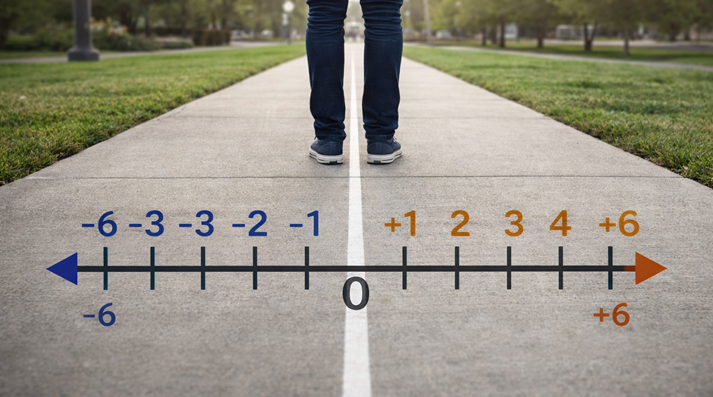
Absolute value tells you how far a number is from zero on a number line. It only measures distance, not direction. That means the result is always positive or zero. It can never be negative.
For example:
|6| = 6
|-6| = 6
Both numbers are 6 units away from zero, so they have the same absolute value.
This rule works for any number.
|-9| = 9
|3| = 3
|0| = 0
Absolute value symbols look like two vertical bars placed side by side around a number or expression. They look like this:
| |
When you see these bars, the goal is simple: find the distance from zero.
Absolute Value and Number Lines
A number line makes absolute value easy to see.
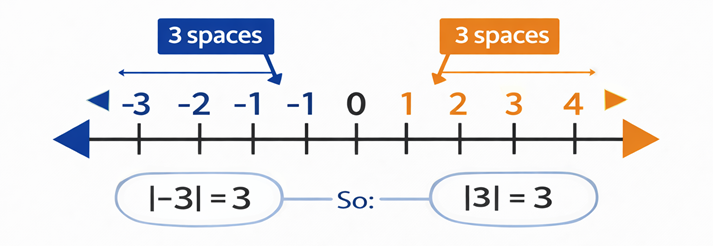
Picture the numbers -3, -2, -1, 0, 1, 2, and 3 on a number line.
The number -3 is three spaces away from zero.
The number 3 is also three spaces away from zero.
So:
|-3| = 3
|3| = 3
Even though the numbers sit on opposite sides of zero, their distance from zero is the same.
Another interesting pattern appears when subtraction is inside the bars.
|8 - 3| = 5
|3 - 8| = 5
The first expression equals 5. The second equals -5, but the absolute value turns it into 5 because distance cannot be negative.
Absolute Value Inside Equations
Absolute value also appears inside algebra equations. When that happens, the equation can have more than one answer.
Look at this example:
|x - 2| + 6 = 10
Step 1: Isolate the absolute value expression.
Subtract 6 from both sides.
|x - 2| = 4
Step 2: Remember what absolute value means. The distance from zero is 4. That can happen in two ways.
The inside could equal 4.
or
The inside could equal -4.
So you create two equations:
x - 2 = 4
x - 2 = -4
Step 3: Solve both equations.
x - 2 = 4
x = 6
x - 2 = -4
x = -2
Both answers work because the distance from 2 to 6 is 4, and the distance from 2 to ?2 is also 4.
So the solutions are:
x = 6 or x = -2
When Absolute Value Equations Have No Solution
Sometimes an absolute value equation has no solution at all.
Consider this example:
|x + 5| = -7
Absolute value represents distance from zero. Distance cannot be negative. That means the expression on the left side can never equal -7.
Because this situation is impossible, the equation has no solution.
Any equation in which an absolute value equals a negative number has no solution.

Two Absolute Values in One Equation
Occasionally, both sides of an equation contain absolute values.
Example:
|x + 6| = |2x - 3|
To solve it, compare the expressions inside the bars.
First possibility:
x + 6 = 2x - 3
Second possibility:
x + 6 = -(2x - 3)
Solving both equations produces two possible answers.
x = 9
x = -1
Both values make the original equation true.

Key Ideas to Remember
Absolute value tells the distance from zero.
Absolute values are always positive or zero.
Absolute value equations often have two solutions.
If an absolute value equals a negative number, there is no solution.
You now understand what absolute value means and how it works in equations.
Next, it is time to test that understanding with some practice problems in the Got It? section.

Supplies


 FAVORITE
 Like
Like