Sign Up
School Account Sign Up

Lesson ID: 10042
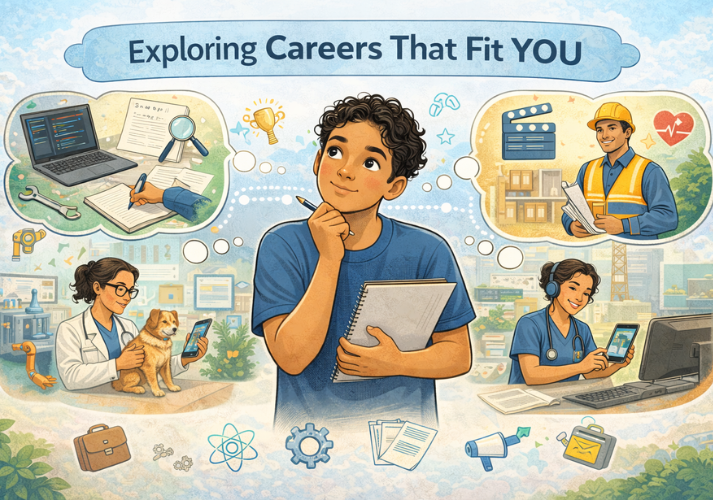
Explore careers that actually fit you by connecting your interests, skills, and real-world jobs.




Your Future, Your Choice
Imagine waking up every weekday knowing exactly what your day will look like… and dreading it.
Now flip that.
Imagine waking up excited because what you’re about to do actually interests you.
That difference? It comes down to career choice.
Doing something you dislike for 8 hours a day, 40 hours a week, for years, compared with doing something you enjoy—that contrast is not just a thought experiment. It’s real life for a lot of people.
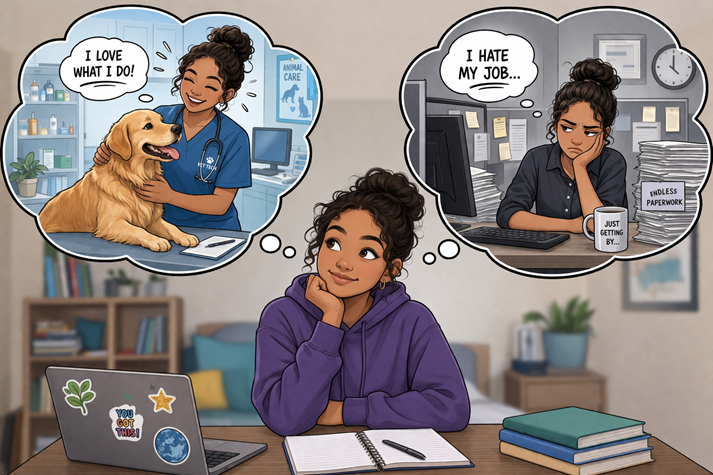
A career isn’t just “a job.” It’s something you spend a large part of your life doing. It often requires training, builds skills over time, and shapes how you spend your days.
So the real question is not just: What job could you get?
It’s: What kind of work actually fits who you are?
What a Career Is (and Why It Matters)
A career is a long-term path made up of jobs, experiences, and skills in a specific field. Some careers require college degrees. Others require certifications, training programs, or hands-on experience.
There isn’t one “right” path—but there is a better fit for you.
Choosing a career that matches your interests, strengths, and values can affect:
Your daily mood and motivation
Your long-term goals
Your sense of purpose
That’s why guessing isn’t a great strategy. Instead, careers are often explored using something called career clusters.
The 17 Career Clusters: Your Map of Possibilities
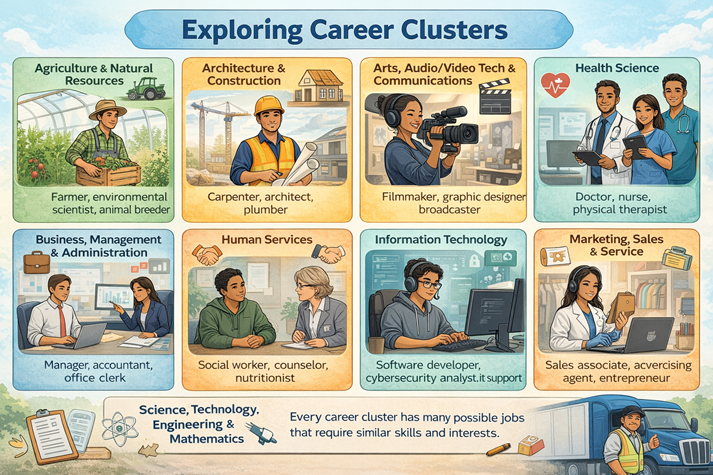
Every career falls into one of 17 career clusters. Think of these clusters as categories that group similar jobs based on skills and interests.
Here are the 17 career clusters.
Agriculture, Food, and Natural Resources
Architecture and Construction
Arts, Audio/Video Technology, and Communications
Business, Management & Administration
Education and Training
Energy
Finance
Government & Public Administration
Health Science
Hospitality & Tourism
Human Services
Information Technology
Law, Public Safety, Corrections & Security
Manufacturing
Marketing, Sales & Service
Science, Technology, Engineering, and Mathematics
Transportation, Distribution & Logistics
Each cluster includes many different careers. For example:
Health Science includes doctors, physical therapists, and medical researchers
Information Technology includes software developers, cybersecurity analysts, and data specialists
Marketing, Sales & Service includes advertising, retail, and brand management roles
How Careers Connect to Real Life
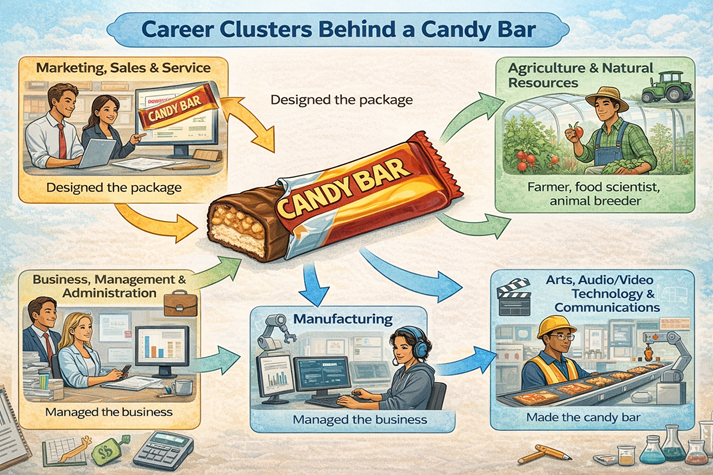
Every product or service you use involves multiple career clusters.
Take something simple like a candy bar.
Someone designed the wrapper. ? Arts, Audio/Video Technology, and Communications
Someone created and tested the ingredients. ? Health Science or Manufacturing
Someone promoted and sold it. ? Marketing, Sales & Service
Someone managed the business operations. ? Business, Management & Administration
One item. Multiple careers. Multiple paths.
This means you don’t have to limit yourself to one idea—you have options.
Start Thinking About You
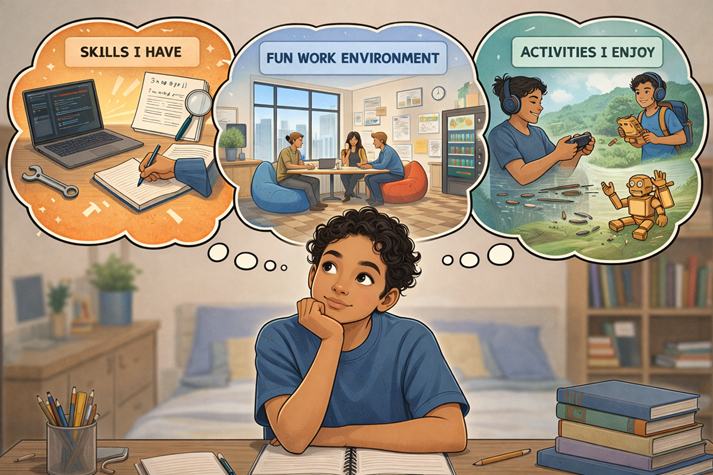
At this point, the goal is not to pick your forever career. The goal is to start noticing patterns.
What activities hold your attention?
What skills come naturally to you?
What kind of work environment sounds appealing?
Career clusters help organize those answers into real-world possibilities.
Now that you understand what careers are and how the 17 career clusters organize them, it’s time to put that knowledge to work.
In the Got It? section, you’ll match real-world scenarios to the correct career clusters and start thinking more deeply about where your interests might fit.

Supplies


 FAVORITE
 Like
Like