Sign Up
School Account Sign Up

Lesson ID: 13542
Scratch beneath the gold! Explore the Gilded Age’s inventions, millionaires, workers, immigrants, reforms, and modern connections.




The Shine and the Scratches
Imagine walking into a room and seeing a frame that looks like solid gold. It shines. It sparkles. It practically announces, “I am expensive.” Then someone scratches the surface and reveals plain wood underneath.
That is the basic idea behind the Gilded Age.
To gild something means to cover it with a thin layer of gold. The object may look valuable on the outside, but the gold does not go all the way through.
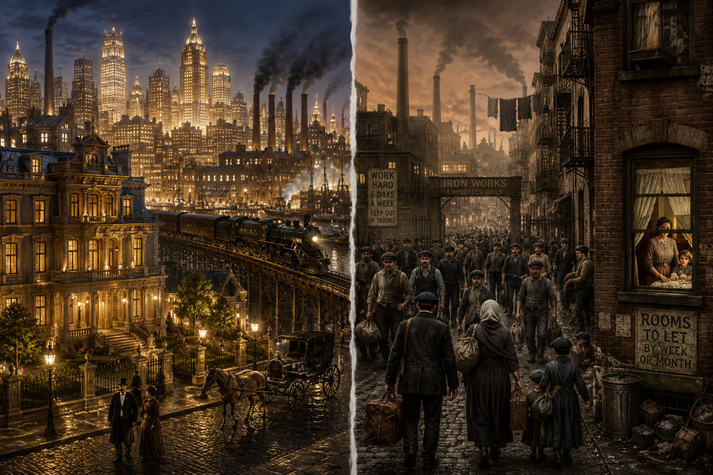
In the late 1800s, the United States looked dazzling in many ways. Railroads stretched across the country. Factories produced steel, oil, textiles, and consumer goods at incredible speed.
Cities grew. Electric lights began changing night into business hours. Immigrants arrived with hopes of building safer, more stable lives. Some business leaders became richer than almost anyone in history.
Under that shine, though, the picture looked more complicated. Many workers faced long hours, dangerous jobs, low wages, crowded housing, and little legal protection.
Political corruption shaped some government decisions. A small number of industrial leaders controlled enormous portions of major industries.
The United States was growing fast, but the benefits of that growth were not shared equally.
That contrast is why this era still matters. The Gilded Age was not simply “good” or “bad.” It was a time of invention, opportunity, exploitation, ambition, conflict, and reform all tangled together like earbuds in a backpack.
By the end of this lesson, you will understand what made the Gilded Age shine, what made it unfair, and why people still compare it to the world you live in today.
A Name With a Joke Hidden Inside
The term Gilded Age came from the 1873 novel The Gilded Age: A Tale of Today, written by Mark Twain and Charles Dudley Warner. The book mocked greed, political corruption, and the get-rich-quick attitude that followed the Civil War.
The title became famous because it captured the mood of the era so well. This was not a “Golden Age,” a phrase that suggests deep, lasting prosperity for many people. It was “gilded,” meaning the nation’s wealth and progress often masked serious problems beneath the surface.
Historians usually use the term Gilded Age to describe the period from the 1870s through about 1900. It began after Reconstruction and led into the Progressive Era, a period when reformers pushed for laws to address problems created by rapid industrial growth.
A quick way to remember it:
The Gilded Age looked rich on the outside, but many people experienced hardship, inequality, and limited power underneath the shine.

The Machine Behind the Money
The Gilded Age happened because the United States industrialized quickly. Industrialization means a society shifts from relying mostly on farming and hand production to relying more on factories, machines, large-scale transportation, and mass production.
Several major changes powered this transformation.
Railroads connected farms, mines, factories, cities, and ports. Before railroads, moving goods across long distances took much more time and money.
Railroads allowed companies to ship raw materials to factories and finished products to customers across the country. They also helped people move west, connected regional markets, and created demand for steel, coal, timber, and labor.
Steel became one of the most important materials of the age. Stronger and cheaper steel made it possible to build longer rail lines, taller buildings, stronger bridges, bigger factories, and more powerful machines.
Oil changed daily life and business. Before electric lighting became widespread, kerosene refined from oil lit many homes and cities. Later, oil became even more important for transportation and manufacturing.
Electricity began transforming cities, factories, communication, and entertainment. It did not reach everyone at once, but it helped create the modern world by powering lights, streetcars, machines, and new inventions.
Factories increased production. Machines and assembly-line work allowed companies to make more goods faster. This helped lower prices for some products, but it also changed the lives of workers who often performed repetitive tasks for long hours.
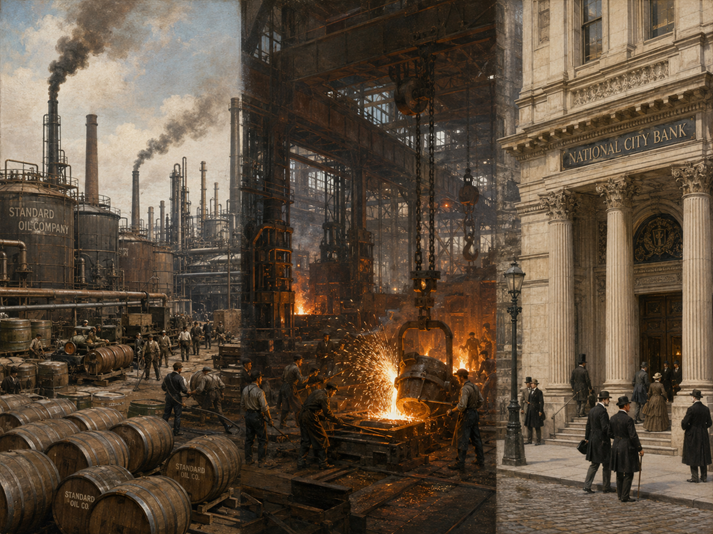
This new industrial world created major opportunities. It also created new problems. When a company could grow large enough to control railroads, prices, supplies, workers, and competitors, the question became clear:
Robber Barons or Captains of Industry?
The most famous business leaders of the Gilded Age are often called robber barons. That nickname suggests they built fortunes by taking advantage of workers, crushing competitors, influencing politics, or using unfair business tactics.
Some people use a different term: captains of industry. That phrase suggests these leaders organized businesses, took risks, created jobs, lowered prices, expanded production, and helped build the modern economy.
Both labels reveal part of the story. The challenge is to avoid turning history into a cartoon with heroes on one side and villains on the other. The truth is more interesting and more uncomfortable.
Many industrial leaders created products and systems that changed American life. They also gained so much power that ordinary workers, small businesses, consumers, and even the government struggled to challenge them.
John D. Rockefeller and Oil
John D. Rockefeller built Standard Oil into the most powerful oil company in the United States. His company bought competitors, negotiated favorable shipping rates with railroads, improved efficiency, and lowered production costs.
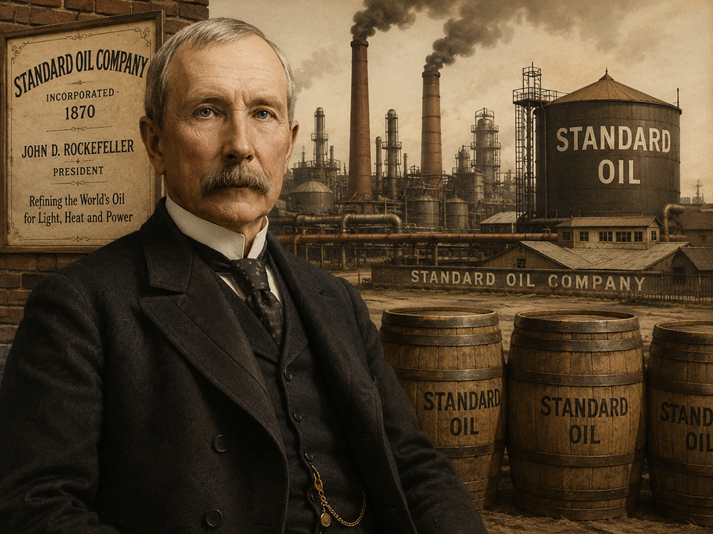
By around 1880, Standard Oil controlled roughly 90 percent or more of U.S. oil refining.
That kind of control is called a monopoly. A monopoly happens when one company controls most or all of a market. With little competition, a monopoly can often influence prices, wages, supplies, and consumer choices.
Rockefeller’s defenders argued that Standard Oil made oil cheaper and more available. His critics argued that the company used unfair tactics to crush rivals and control the market. Both points help explain why Rockefeller remains one of the most debated figures of the Gilded Age.
J. P. Morgan and Finance
J. P. Morgan became one of the most powerful bankers in the country. He reorganized railroads, invested in major corporations, and helped create U.S. Steel, one of the largest companies in the world at the time.
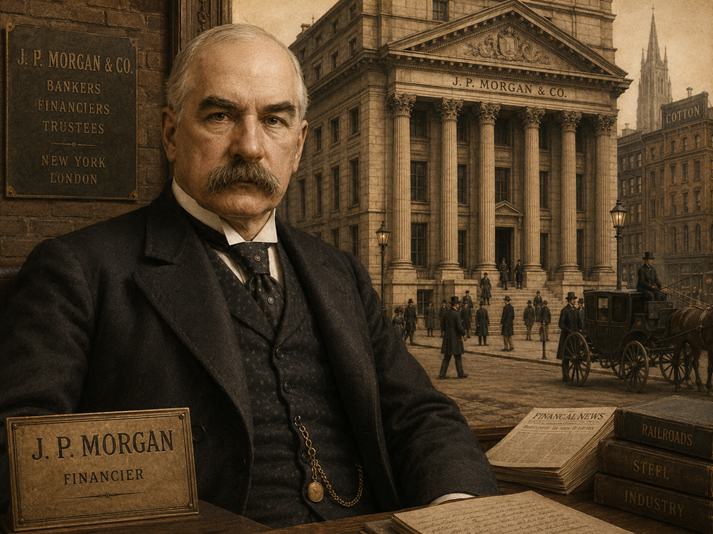
Morgan’s influence became especially clear during financial crises. In the Panic of 1907, a major banking crisis threatened the economy. Morgan helped organize private bankers to stabilize parts of the financial system.
That action showed how powerful he was, but it also raised a big question:
Andrew Carnegie and Steel
Andrew Carnegie’s story is often described as “rags to riches.” He was born in Scotland in 1835 and came to the United States with his family as a child.
He worked in a cotton mill, became a telegraph messenger, moved into the railroad business, and eventually built Carnegie Steel into a massive company.
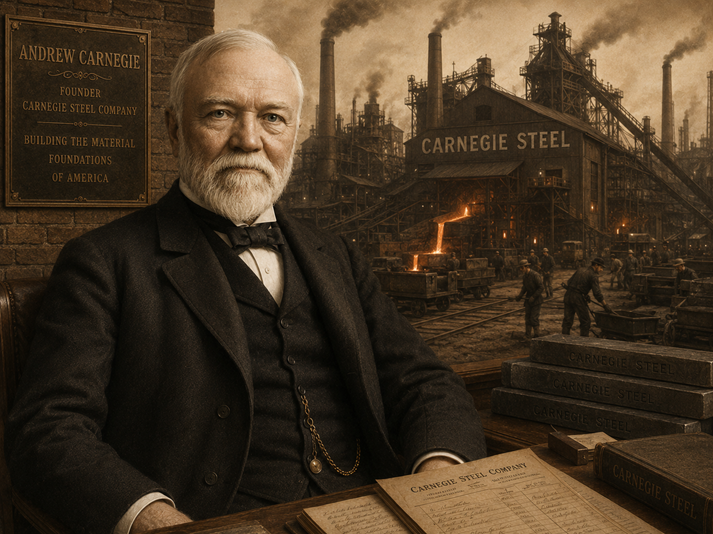
Carnegie used vertical integration, which means one company controls multiple steps in the production process. Instead of owning only steel mills, a company might also control mines, railroads, and ships needed to produce and move steel.
This could make production faster and cheaper, but it also made the company extremely powerful.
Carnegie later sold his steel company to J. P. Morgan and gave away large parts of his fortune to support libraries, education, and cultural institutions. At the same time, his company was connected to harsh working conditions and major labor conflicts, including the Homestead Strike of 1892.
Carnegie’s life shows one of the hardest questions of the Gilded Age:
Life Below the Gold Layer
The Gilded Age created national wealth, but many Americans did not experience that wealth directly. For working-class families, daily life often meant long hours, unstable income, and difficult living conditions.
Many factory workers labored ten to twelve hours a day, six days a week. Some jobs were dangerous because machines lacked modern safety protections. If workers were injured, they usually had few options for support.
Child labor also remained common in many industries, especially among poor families who needed every possible wage.
Cities grew quickly as people moved for work. Housing often struggled to keep up. In crowded urban neighborhoods, many families lived in tenements, which were apartment buildings that often had poor ventilation, limited sanitation, and cramped rooms.
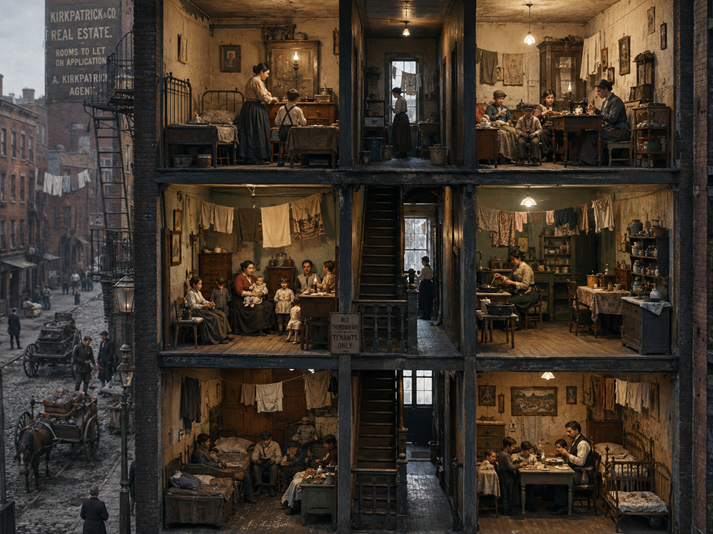
A tenement was not automatically a terrible place, but many working-class tenements became symbols of how hard city life could be for people with limited money and few choices.
Labor unions grew because workers wanted better wages, shorter hours, and safer conditions. Business owners often opposed unions, and strikes sometimes turned violent.
During this period, the country wrestled with a question that still matters:
Immigration and the Promise of America
The Statue of Liberty was completed in 1886, right in the middle of the Gilded Age. For many immigrants entering New York Harbor, it became a symbol of hope, freedom, and possibility.
Beginning in 1892, Ellis Island became the main federal immigration station in New York Harbor. Millions of immigrants passed through it. They came from many places, including Ireland, Germany, Italy, Russia, Poland, Greece, China, and other parts of Europe and Asia.
Some fled poverty, violence, famine, political unrest, or religious persecution. Others came for jobs, land, education, or the chance to build a different future.
The promise was real, but it was not simple.
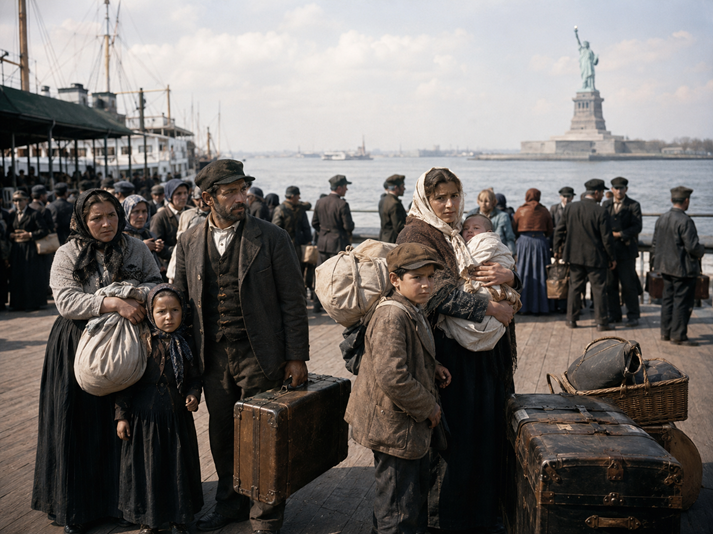
Many immigrants found work in factories, mines, railroads, construction, domestic service, restaurants, shops, and garment production. They helped build the industrial economy.
They also faced low wages, crowded housing, language barriers, discrimination, and pressure to give up parts of their culture in order to “fit in.”
During the Gilded Age, immigration helped power the country’s growth. It also exposed a contradiction. The United States presented itself as a land of opportunity, but many newcomers had to fight hard for fair treatment and basic security upon arrival.
The Other Side of Progress
The Gilded Age improved American life in some major ways.
More goods became available.
Railroads connected the nation.
Cities expanded.
New technologies changed communication, transportation, work, and entertainment.
Some people moved into the middle class.
Public libraries, museums, universities, and cultural institutions expanded, often funded by donations from wealthy industrialists.
At the same time, the era exposed serious problems.
A small group of wealthy people gained enormous economic power.
Many workers lacked safe conditions, fair pay, and bargaining power.
Some politicians accepted bribes or favors from business interests.
Monopolies limited competition.
Immigrants and racial minorities often faced discrimination.
Native American nations continued to lose land, sovereignty, and resources as the United States expanded westward.
Women had limited political rights and fewer legal protections than men, though many became powerful voices in labor, settlement house work, journalism, education, and reform.
African Americans faced segregation, racial violence, voter suppression, and economic exclusion, especially as Reconstruction ended and Jim Crow laws expanded in the South.
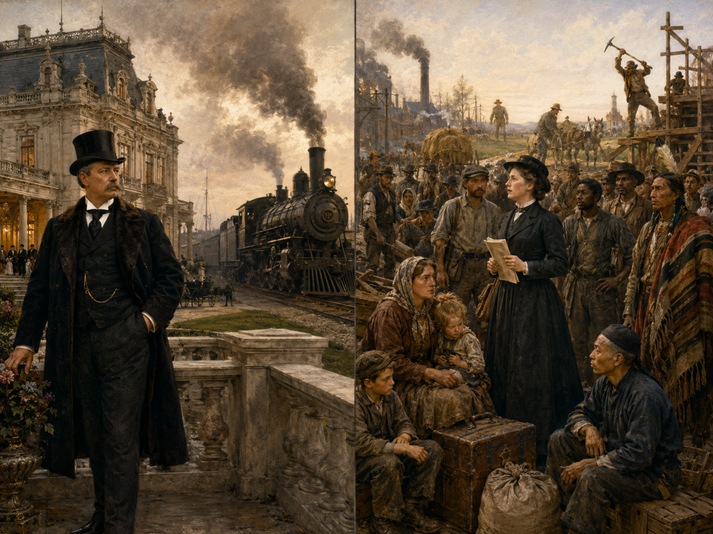
This is why the Gilded Age cannot be understood only through mansions, railroads, and famous millionaires. A complete view must include workers, immigrants, farmers, women reformers, Black Americans, Native nations, Chinese immigrants, political activists, and families trying to survive rapid change.
The shine was real. So were the scratches.
Reform: When People Pushed Back
The problems of the Gilded Age did not go unanswered. Workers organized unions and strikes. Journalists investigated corruption and unsafe conditions. Farmers joined political movements to challenge railroad rates and banking policies.
Reformers pushed for better housing, sanitation, education, food safety, and labor laws.
These efforts helped lead into the Progressive Era in the early 1900s. Progressive reformers believed the government should play a stronger role in solving problems caused by industrialization.
One major reform was antitrust laws. Antitrust laws are designed to prevent companies from unfairly limiting competition.
The Sherman Antitrust Act of 1890 gave the federal government a tool to challenge monopolies and trusts, though it took time for the law to be used aggressively.
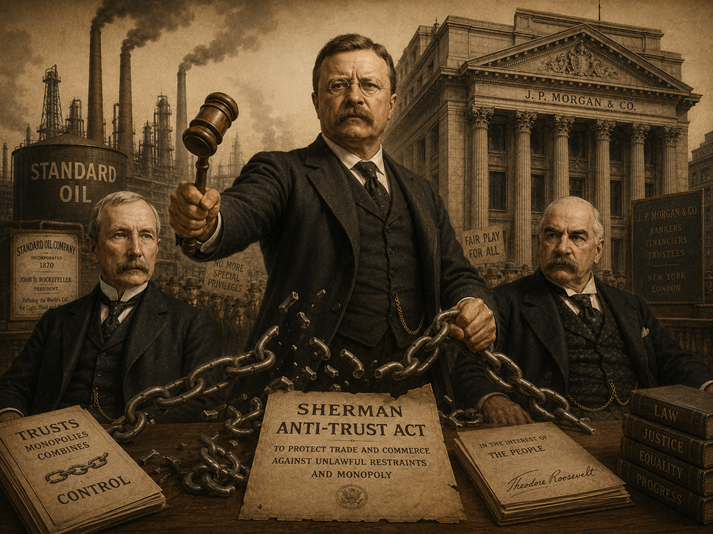
President Theodore Roosevelt became famous for trust-busting, or using federal power to challenge some large corporations.
He did not believe every big business was automatically bad. Instead, he argued that powerful corporations needed public oversight when their actions harmed consumers, workers, or fair competition.
That idea became one of the major legacies of the Gilded Age:
Innovation can create wealth, but society still has to decide how power should be limited, shared, and regulated.
Is There a New Gilded Age?
Some historians, economists, and writers argue that the United States has entered a “new Gilded Age.” They do not mean the present is exactly the same as the 1880s. History does not copy and paste itself. It does, however, rhyme.
During the original Gilded Age, railroads were the great networks that connected the country. Companies that controlled rail lines could shape who moved goods, how fast products traveled, and what businesses paid to reach customers.
Today, digital networks play a similar role. Internet providers, search engines, online marketplaces, social media platforms, app stores, payment systems, and artificial intelligence tools shape how people communicate, shop, learn, work, advertise, and access information.
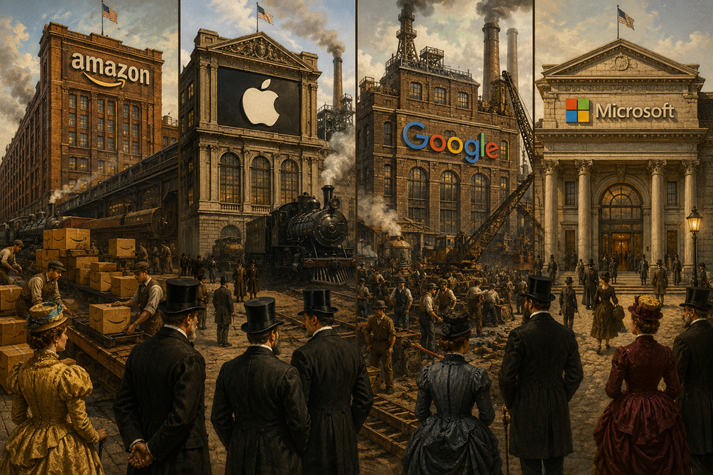
In 2020, several of the most valuable U.S. brands were technology or internet-based companies, including Amazon, Apple, Google, and Microsoft.
That older chart already showed a major trend: some of the most powerful companies in the modern economy are built on digital platforms, data, software, online advertising, devices, cloud computing, and network effects.
A network effect happens when a product or service becomes more valuable as more people use it. For example, a social media platform becomes more useful when your friends, family, classmates, favorite creators, and organizations all use it. That can make it difficult for smaller competitors to catch up.
Modern technology companies have created useful tools, connected people, expanded access to information, supported small businesses, and changed daily life. At the same time, critics raise concerns about privacy, competition, misinformation, data collection, artificial intelligence, working conditions, and the power of a few companies to shape public life.
One example is net neutrality, the principle that internet service providers should treat all online traffic equally, rather than block, slow, or charge extra for certain content. The debate continues because the internet functions like a modern railroad: it is a pathway that many people and businesses need to participate in the economy.
This does not mean today’s technology leaders are exactly the same as Rockefeller, Morgan, or Carnegie. It means the same basic question has returned in a new form:
The Big Idea to Carry Forward
The Gilded Age was a turning point in American history because it showed both the promise and the danger of rapid economic change.
Industrialization helped create a modern nation. It connected people and markets, produced new goods, created jobs, and encouraged invention.
It also concentrated wealth, weakened competition, exposed workers to dangerous conditions, and left many families struggling beneath the surface of national prosperity.
To understand the Gilded Age, avoid the easy answer. It was not just an age of greedy millionaires. It was not just an age of amazing invention. It was both.
The real lesson is sharper than that:
Progress is not only about what a society builds. It is also about who benefits, who pays the cost, and who gets a voice in making the rules.
Now that you have uncovered the shine and the scratches of the Gilded Age, you are ready to test what you know and practice spotting the difference between appearance and reality.

Supplies


 FAVORITE
 Like
Like