Sign Up
School Account Sign Up

Lesson ID: 13443
Discover how to find the “big idea” behind every story and turn it into something creative. Learn to think like an author or director by uncovering the main idea and storyboarding your own version.





The main idea is that the woman pictured has won a prize.
The main idea is the most important part of a story or essay. It is the part that all the details in the story or essay relate to in some way.
In this lesson, you'll learn the storyboard method of prewriting and practice this skill by developing main ideas.
Main Ideas: Seeing the Forest, Not Just the Trees
Before you can storyboard or write, you have to find the main idea — the big point the author wants the reader to understand. Think of it as the “why” behind everything you just read.

If you focus only on details, you might miss the forest because you’re staring at the trees. The main idea is the forest — the big picture. The details are the trees — the things that make up that bigger meaning.
Look at how this works.
From Details to Big Ideas
Imagine you’re reading an article about a forest creek. It describes how otters swim in it, bears fish in it, and beavers want to build a dam. You could summarize all of that — those are details.
There’s a conflict over who gets to use the creek.
A summary includes everything important that happens.A main idea tells what all those things mean together.
Finding the Main Idea: A Step-by-Step Process
Read and take notes. As you read, jot down what happens or what’s explained in each paragraph.
Summarize sections. Write short sentences that capture the main points of each part.
Look for patterns. What do those summaries have in common? What are they all pointing toward?
Combine them. When you can link them into one clear thought, you’ve found the main idea.
For example, in a passage about how your brain grows when you learn new things:
One paragraph says your brain gets stronger with effort.
Another says practicing helps your brain work faster.
Another says that challenge makes your brain grow even more.
Together, they point to one main idea:
Learning and practicing new things strengthens your brain.
What Makes a Strong Main Idea
A good main idea isn’t vague like “learning is good.” It should be:
Specific: It expresses a clear opinion or concept.
Provable: You can support it with evidence or reasoning.
Assertive: It takes a stand — it’s what the writer wants the reader to understand or believe.
For example:
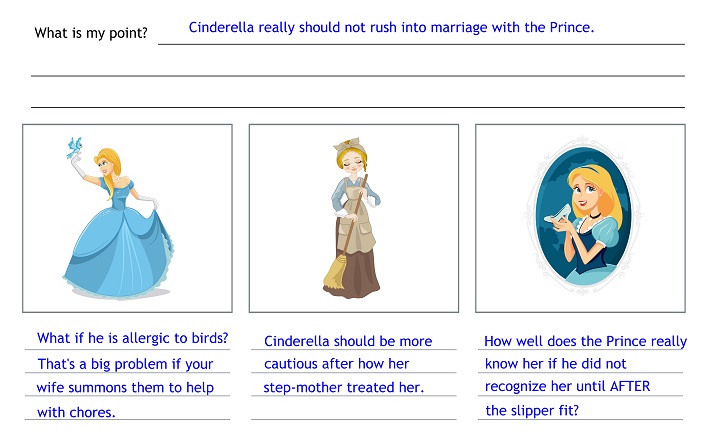
That’s a main idea.
It’s clear, arguable, and it can be supported with details — like how quickly they met, or that he didn’t even recognize her until the shoe fit.
Connecting Main Ideas to Storyboarding

Once you’ve identified your main idea, you can use it as the foundation of a storyboard — a visual plan for your writing.
Each panel or section of the storyboard shows one key point or example that supports your main idea.
You can draw, write bullet points, or both.
Think of storyboarding as building your essay in pictures before you build it in words.
Use the Storyboard Template, found under Downloadable Resources, to sketch your first version — jot your main idea at the top and fill each box with a supporting detail or example.
If you’re ready for a deeper challenge, try the Five-Paragraph Storyboard Template (Downloadable Resources) to map out an introduction, three supporting paragraphs, and a conclusion.

You’re almost a Main Idea Master! In the Got It? section, you’ll get to practice finding main ideas and turning them into storyboards.
Remember — don’t get lost in the trees. Step back and find the forest.

Supplies




 FAVORITE
 Like
Like