Sign Up
School Account Sign Up

Lesson ID: 13276
Marie Curie was the first woman to win a Nobel Prize and the only person ever to win one in two different sciences. But she was almost overlooked. Why? Discover the genius that was Marie Curie!




Not to protect the documents but to protect yourself from radiation!
In this lesson, you will learn about the genius of Marie Curie and her contributions to science.
Not to protect the documents, but to protect yourself from radiation.
In this lesson, you will learn about the genius of Marie Curie and her contributions to science.
Marie Curie achieved an incredible amount in her lifetime. Her groundbreaking discoveries earned her two Nobel Prizes and changed the way scientists understand the world.
Marie Curie was born in Warsaw, Poland, where she showed strong academic ability from a young age. At the time, women were not allowed to attend university in her country, so she secretly studied through an underground school called the Floating University.
She later moved to Paris, where she studied physics and mathematics at the Sorbonne, often living in extreme poverty while completing her education.
While in Paris, she met Pierre Curie, and the two became both research partners and spouses. Together, they began studying radiation, building on earlier discoveries by scientist Henri Becquerel.
Marie discovered that radiation came from within atoms, challenging existing scientific beliefs.
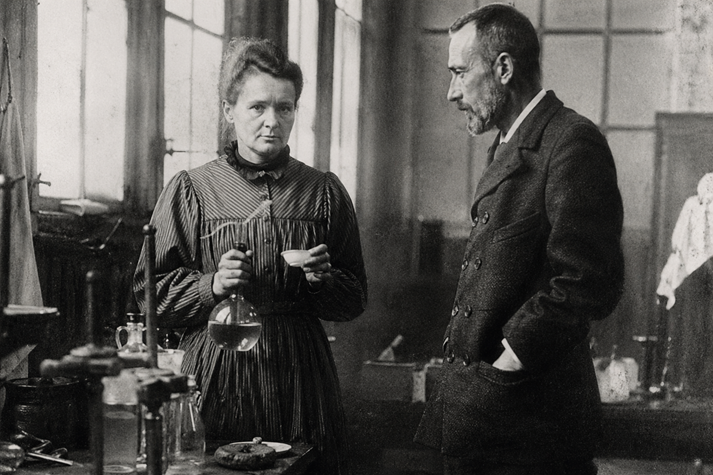
Through careful research, Marie and Pierre identified two new elements: polonium, named after her homeland, and radium. They also developed the term “radioactivity.”
Extracting these elements required years of physically demanding work with raw materials.
In 1903, Marie Curie became the first woman to win a Nobel Prize when she shared the award in physics with Pierre Curie and Henri Becquerel. After Pierre’s tragic death in 1906, Marie continued her work and became the first female professor at the Sorbonne.
In 1911, she won a second Nobel Prize, this time in chemistry, for her work with radium and polonium. She remains the only person to win Nobel Prizes in two different scientific fields.
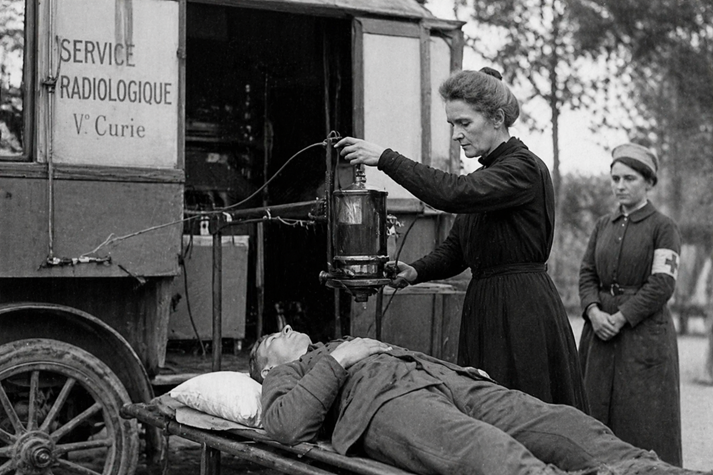
During World War I, Marie applied her knowledge to develop mobile X-ray units, helping doctors treat wounded soldiers. Her research later contributed to advances in cancer treatment.
Marie Curie died in 1934 from a disease likely caused by prolonged exposure to radiation. Even today, her notebooks and belongings remain radioactive.
Those details could definitely make strong trivia questions.
Move to the Got It? section to review what you learned about her accomplishments.

Supplies
Suggested Reading


 FAVORITE
 Like
Like