Sign Up
School Account Sign Up

Lesson ID: 12916
Discover how temperature changes affect how much solute can dissolve—and how to read a solubility curve like a scientist.




What Happens When Solids Go Beyond Their Limit?
Solubility isn’t just about dissolving—it’s about limits. And when those limits are pushed, things get interesting.
Welcome to the world of solubility curves, where temperature, saturation, and chemistry collide.
Understanding Solubility Curves
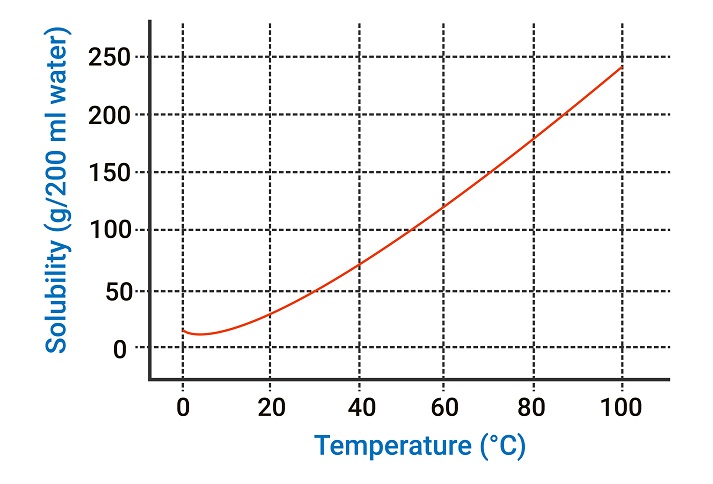
Solubility curves help us visualize how much of a substance (the solute) can dissolve in a liquid (the solvent) at different temperatures.
But before you can read these graphs, you need to understand the three types of solutions they describe. The way a solute behaves in a solvent—whether it dissolves, settles, or suddenly crystallizes—depends on how saturated the solution is.
Saturated, Unsaturated, and Supersaturated
An unsaturated solution can still dissolve more solute. Think of a warm cup of tea with only one spoonful of sugar—you could easily add more.
A saturated solution has dissolved the maximum amount of solute it can hold at that temperature. Any extra will settle at the bottom.
A supersaturated solution holds more solute than it should be able to—thanks to added heat and careful cooling. It’s unstable, and even a small disturbance—like bumping the container or dropping in a small crystal—can trigger rapid crystallization.
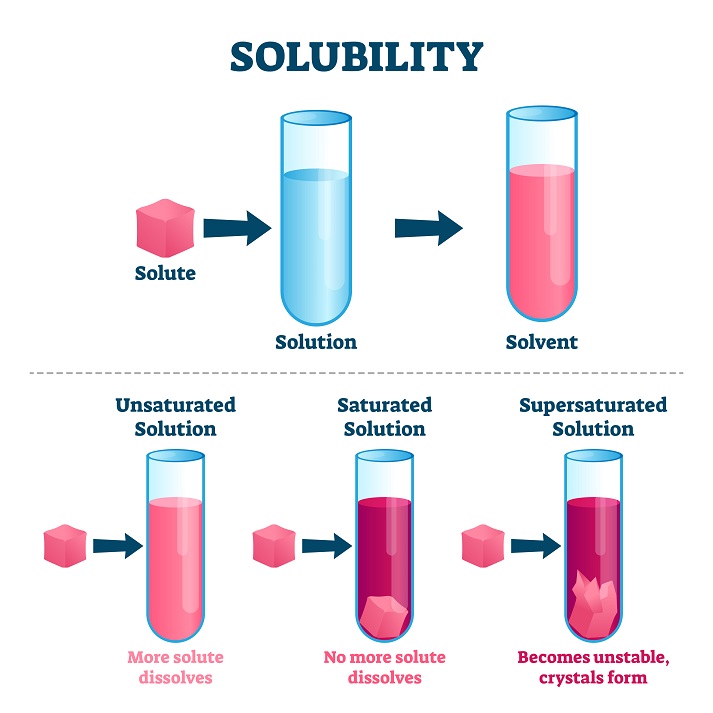
In a supersaturated solution, the extra dissolved solute is looking for a reason to return to solid form.
When a seed crystal is introduced, it provides a structure that attracts the solute particles. These particles stick to it, grow into a visible solid, and release heat as they do.
This process continues until the solution stabilizes again—becoming saturated once more, with the excess solute now crystallized out.
Reading the Solubility Curve
Solubility curves help chemists visualize how temperature affects how much solute can dissolve in a solvent—usually water.
X-axis: Temperature (°C)
Y-axis: Solubility (grams per 100g of water)
Each line represents a specific substance.
Most solids, like Na?HAsO? or Ba(NO?)?, show a strong increase in solubility with temperature. This means the hotter the water, the more solute it can hold.
Some, like NaCl, hardly change with temperature, staying fairly consistent across the curve.
Others, such as Ce?(SO?)?·9H?O, show a decrease in solubility as temperature rises—these are rare but important, especially in environmental and industrial chemistry.
Refer to the graph image below.

Na?SO? increases and then slightly decreases—its curve isn’t linear.
Na?HAsO? rises dramatically, showing high temperature dependence.
Each curve gives clues about how temperature impacts different chemical interactions.
Real-World Applications
Understanding these curves allows scientists to do the following.
Design cooling crystallization processes in industry.
Predict precipitation in solutions.
Maximize drug solubility in pharmaceutical development.
Solve environmental challenges related to mineral solubility.
Head to the Got It? section to interpret solubility curves, answer some tricky questions, and even create your own.
See how well you can follow the rise and fall of solubility across temperatures!

Supplies
Additional Resources


 FAVORITE
 Like
Like