Sign Up
School Account Sign Up

Lesson ID: 12881
Hook your reader fast and finish strong with introductions and conclusions that actually work.




First Impressions… and Last Words
Think about the last video, movie, or story you stopped watching halfway through.
Chances are, it didn’t grab your attention at the start… or it didn’t feel worth finishing.
Writing works the same way.
Your introduction is your first impression.
Your conclusion is your last chance to leave your reader thinking.
If either one is weak, your whole essay feels incomplete—even if your body paragraphs are strong.
Now it’s time to learn how to start strong and finish even stronger.
The Big Picture: Your Essay as a Shape
Before diving into sentences, look at how your essay is built.
There are two helpful ways to think about structure.
The Hourglass Essay
The Circle Essay
Both structures help your writing feel complete and connected.

Part 1: How to Hook Your Reader
A hook is your opening sentence. Its job is simple:
Make the reader want to keep going.
If your hook is boring, your reader may stop reading before you even get to your point.
Types of Hooks That Actually Work
Weak: Do you want to learn about teamwork?
Strong: What would happen if no one on a team worked together?
The second one makes the reader think.
Example: More than half of people say they communicate more online than in person.
This makes the reader pause and think.
Weak: I had a strange experience.
Strong: “Run!” someone shouted as I sprinted down the street, trying to escape the chaos behind me.
This feels immediate and interesting.
Example: The room was silent except for the ticking clock as everyone waited for the results.
This creates a clear image.

Part 2: Build the Rest of Your Introduction
A strong introduction does more than hook the reader. It also prepares them.
After your hook, you should:
Example structure:
Hook ? Background ? Claim
Example:
Hook: What would happen if no one worked together on a team?
Background: In many stories, characters face challenges that are too big to solve alone.
Claim: These situations show that teamwork is necessary for success.
Now the reader knows what to expect.
Part 3: How to Write a Strong Conclusion
Your conclusion is your final impression.
It should:
But it should NOT:
Two Powerful Ways to End Your Essay
Example: Teamwork doesn’t just help characters succeed—it’s a skill people use every day to solve real problems.
This connects your idea to a bigger picture.
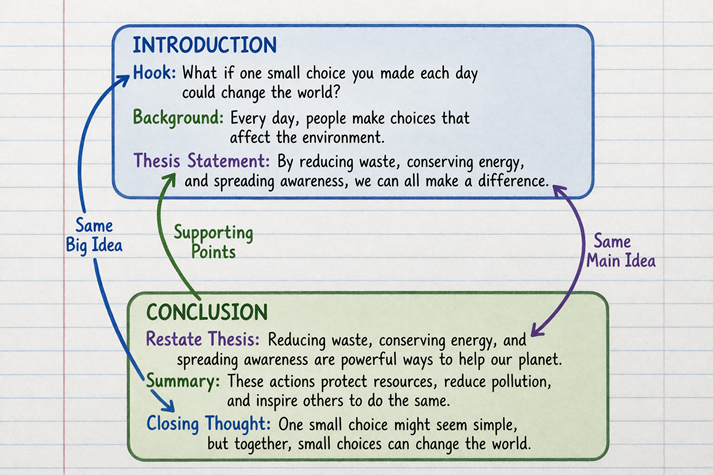
If your hook was a question, the conclusion: Without teamwork, that question becomes much harder to answer.
If your hook was a scene, the conclusion: In the end, moments like that show why working together matters.
This makes your essay feel complete.
Common Mistakes to Avoid
Watch out for these:
Starting too basic: “My essay is about…” doesn’t grab attention.
Ending too suddenly: If your essay just stops, it feels unfinished.
Repeating instead of wrapping up: Your conclusion should feel fresh, not copied.
From First Sentence to Final Thought
A strong essay:
When your beginning and ending work together, your writing feels complete, polished, and worth reading.
You now know how to grab attention at the start and leave a lasting impression at the end.
Next, it’s time to try different hooks and conclusions to see which ones truly keep a reader engaged.

Supplies
Additional Resources



 FAVORITE
 Like
Like