Sign Up
School Account Sign Up

Lesson ID: 12879
Turn your ideas into a clear plan so your essay actually makes sense from start to finish.




When Ideas Are a Mess… Writing Falls Apart
Imagine trying to follow a recipe where the steps are completely out of order. Add the eggs after baking. Mix ingredients after serving.
It wouldn’t work.
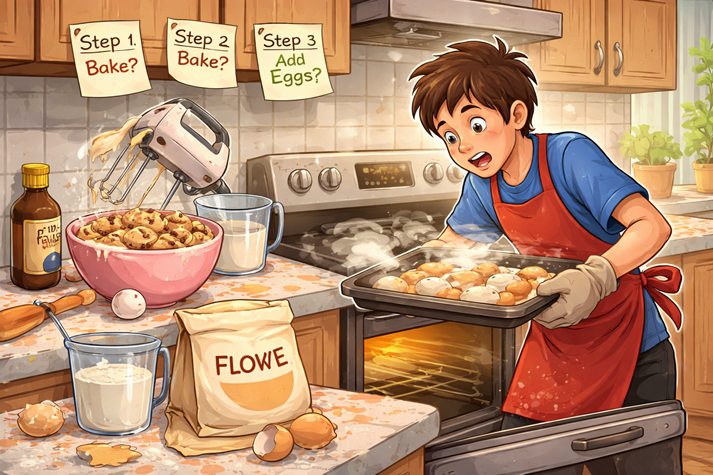
The same thing happens in writing. Even strong ideas can fall apart if they’re not organized clearly.
Good writers don’t just have ideas—they organize them so everything makes sense to the reader.
Now it’s time to turn your claim into a clear, structured plan.
Step 1: What Does “Organizing Ideas” Really Mean?
You already have a claim. That’s your main idea—the point you want to prove.
Now you need to answer this question:
To do that, your essay needs three key parts.
Think of it like building something.
If one part is missing, the whole thing becomes shaky.

Step 2: Meet the Cluster Map
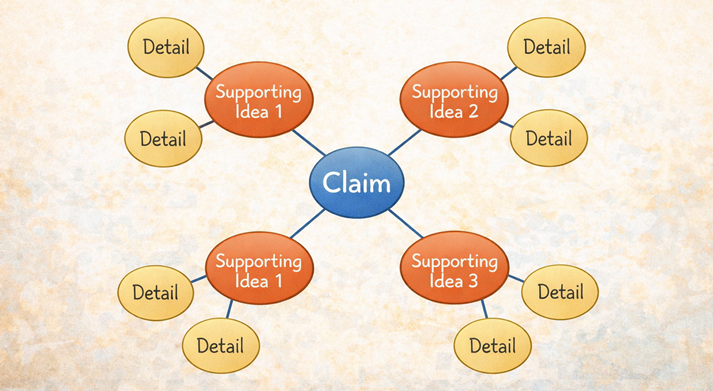
One of the easiest ways to organize ideas is by using a cluster map.
A cluster map is also called:
No matter the name, the goal is the same: take your ideas and show how they connect.
Here’s how it works.
Step 3: Build Your Cluster Map
Follow these steps to create your own.
These details can include:
Each supporting idea should have at least two or three strong details.
Step 4: Turn Your Map into a Plan
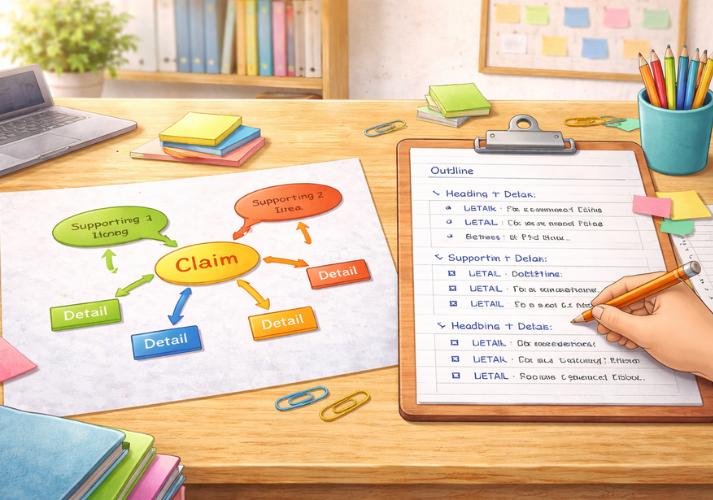
Your cluster map is more than just a brainstorm—it’s your essay plan.
Here’s how it connects to your writing.
That means if your cluster map is messy, your essay will be messy.
But if your map is clear, your writing becomes much easier.
Step 5: Keep Your Ideas Balanced
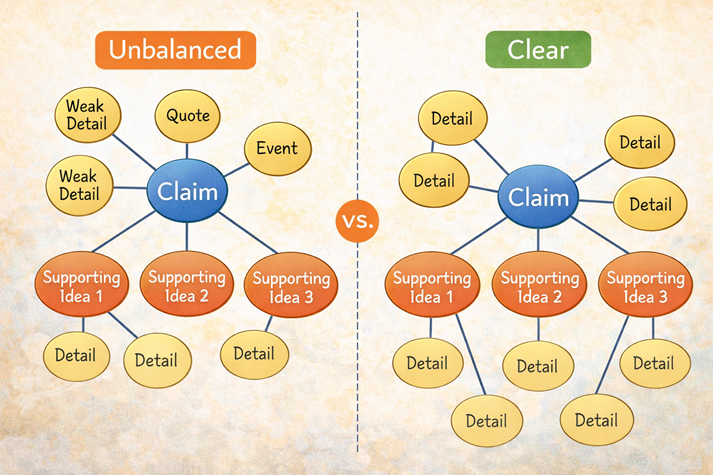
Not all ideas are equal, and that’s okay—but your essay should still feel balanced.
Watch out for these common issues.
Too few details: If a supporting idea has only one detail, it may not be strong enough.
Too many details in one section: If one idea has five details and another has one, your essay may feel uneven.
Unclear connections: Every detail should clearly support the idea it’s connected to.
Ask yourself:
If the answer is “not really,” it probably doesn’t belong.
Step 6: Make Your Ideas Easy to Follow
Organization isn’t just about what you include—it’s also about order.
Before you start writing, decide:
You can:
There’s no single “correct” order—but it should always feel logical.

Wrap-Up: From Ideas to Structure
Right now, you’ve taken a claim and turned it into a clear plan with:
That’s a huge step. Many writers skip this and end up stuck later.
Next, it’s time to put your organizing skills to the test and see how well your ideas hold together.

Supplies
Additional Resources


 FAVORITE
 Like
Like