Sign Up
School Account Sign Up

Lesson ID: 12822
Crack the code of big numbers! Learn to read, write, and compare huge numbers like a math pro.




Big Numbers Are Everywhere!
Think about this: the moon is about 238,857 miles away from Earth. That’s a HUGE number!
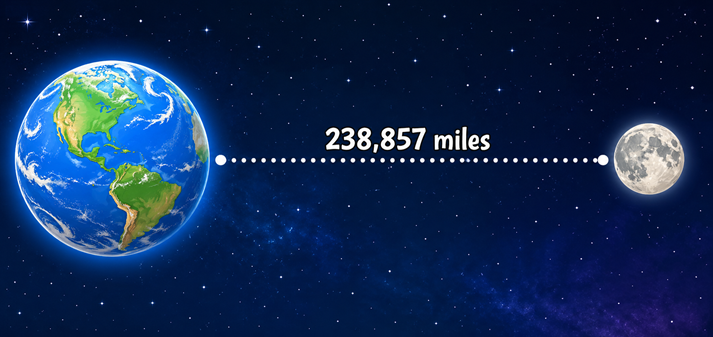
Big numbers help describe real things in the world. They tell how far, how many, or how much. And guess what? You can read them!
How Big Numbers Work
Big numbers may look tricky, but they follow a simple pattern.
Numbers are grouped into parts called periods.
Each period has up to three digits. Each period also has a name.
Here are the first few periods.
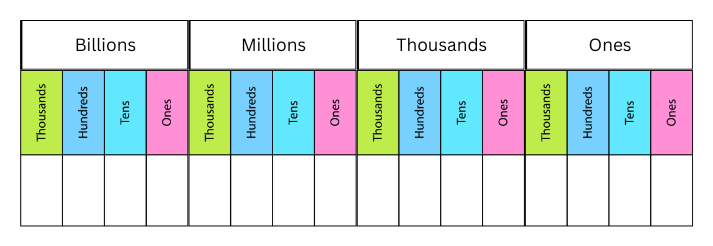
Commas help separate these periods so numbers are easier to read.
Look at this number.
92520000
That looks messy! Add commas to make it clearer.
92,520,000
Now the number is split into groups of three digits.
92 | 520 | 000
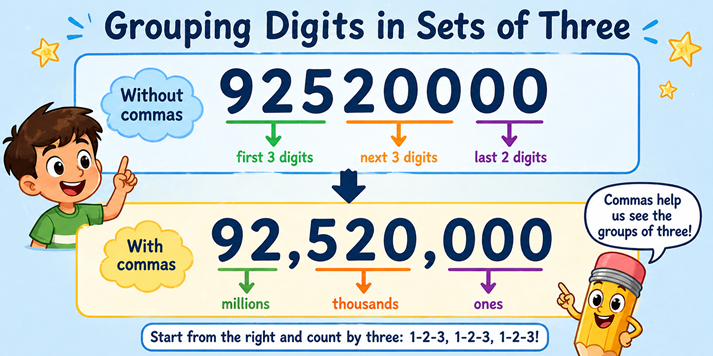
How to Read Big Numbers
Reading big numbers is like reading smaller numbers, just in steps.
Step 1: Start at the left.
Step 2: Read the first group.
Step 3: Say the period name.
Step 4: Move to the next group.
Let’s try it.
92,520,000
Put it all together.
Ninety-two million, five hundred twenty thousand
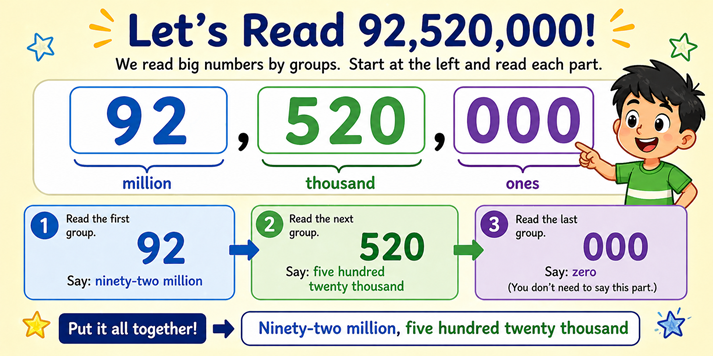
Comparing Big Numbers
Sometimes you need to know which number is bigger.
To compare numbers:
Look at how many digits each number has. More digits means a bigger number.
If they have the same number of digits, compare from left to right.
Example:
45,321 and 452,100
The second number has more digits, so it is larger.
Example:
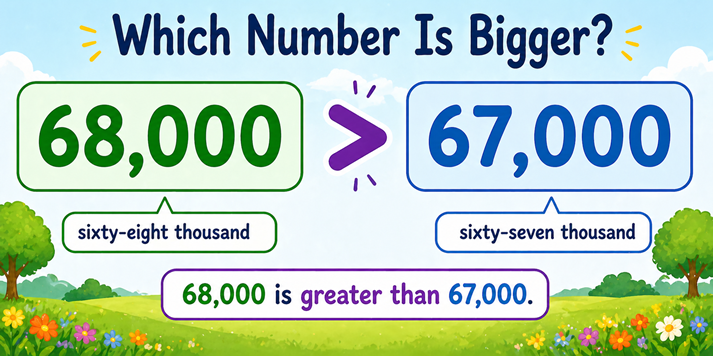
67,000 and 68,000
Both have the same number of digits. Compare the left side:
68,000 is greater than 67,000.
You Can Do This!
Big numbers might look scary at first, but they follow simple rules. When you break them into parts, they become easy to read and compare.
Now it’s time to try reading and comparing big numbers on your own.

Supplies


 FAVORITE
 Like
Like