Sign Up
School Account Sign Up

Lesson ID: 12493
How do we know how old something is? Learn how scientists use atoms—and how different views interpret the same evidence—to explore the earth’s past.




Dating Without a Calendar?
Rocks don’t carry ID cards, and fossils don’t come stamped with a birthday.
They turn to atoms.
Radioactive dating lets scientists estimate the age of materials based on how unstable atoms break down over time.
Whether you're examining a fossil, a wooden tool, or a volcanic rock, this process provides clues about the past—clues that are invisible to the eye but measurable through science.
What Is Radioactive Dating?
Radioactive dating (also called radiometric dating) is a method that uses the predictable decay of unstable atoms to estimate the age of materials.
It works because certain elements naturally decay into other elements at a steady, known rate. This process is known as radioactive decay, and the time it takes for half of a sample to decay is referred to as its half-life.
The method is used to estimate the ages of the following.
Once-living materials (like bones, wood, and cloth) that use carbon-14
Non-living materials (like rocks and meteorites) that use other isotopes, such as uranium-238 and potassium-40
Understanding Half-Life
The half-life of an isotope is the amount of time it takes for half of the radioactive atoms in a sample to decay.
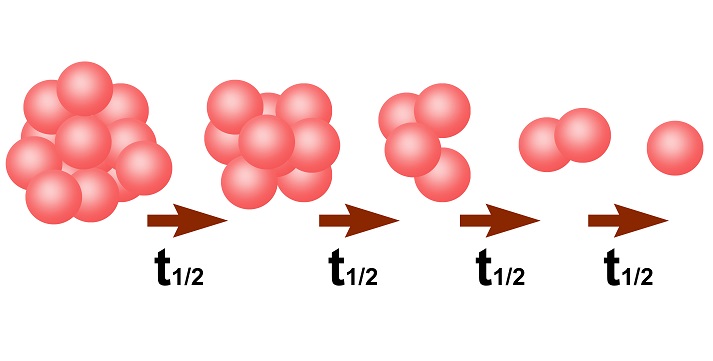
Here are some examples.
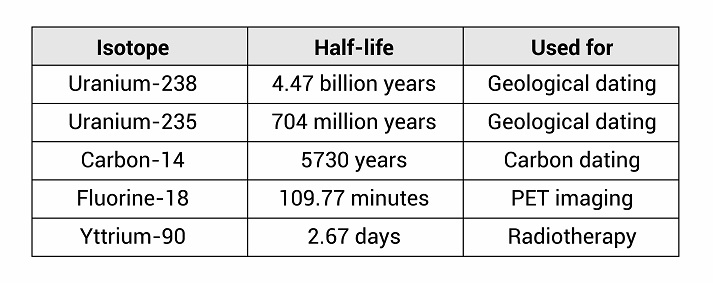
Carbon-14 has a half-life of about 5,730 years.
Uranium-238 has a half-life of 4.5 billion years.
Scientists don't usually measure the entire decay process. Instead, they calculate how many half-lives have passed by measuring how much of the original radioactive isotope is left in the sample compared to how much of the decay product is present.
Example: Carbon-14 Dating
Carbon-14 is constantly being created in the atmosphere and absorbed by living organisms. When an organism dies, it stops absorbing carbon, and the C-14 begins to decay.
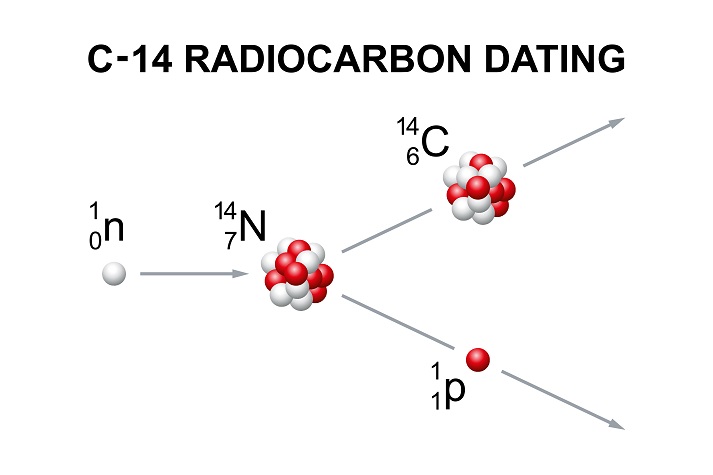
Say a living tree has a carbon-14 count rate of 200 counts per minute. If a wooden artifact made from that tree now has only 50 counts per minute, then the following is true.
After 1 half-life, the count drops from 200 to 100.
After 2 half-lives, it drops from 100 to 50.
The artifact is approximately 2 half-lives old, or 11,460 years old (2 × 5,730 years).
Example: Dating Rocks With Uranium
Rocks that formed from molten material (like lava) may start with only uranium atoms. Over time, uranium-238 decays into lead-206.
If scientists find a sample with 1 uranium atom for every 3 lead atoms, they know the following.
The sample is 2 half-lives old.
Uranium's half-life is 4.5 billion years.
So the rock is approximately 9 billion years old.
A Tool With Limits
Radioactive dating is not perfect. It works best under specific criteria.
The material hasn't been contaminated.
The decay rate is well-known.
There's enough isotope left to measure.
Different materials require different isotopes, and the accuracy can decrease over very long or very short timeframes.
Modern Challenges: Fossil Fuels & Atmospheric Change
Carbon-14 dating has been widely used for materials up to about 60,000 years old. However, the method has recently encountered challenges due to the emissions of fossil fuels.

Here's why.
Fossil fuels are so old that they contain no carbon-14.
Burning them releases massive amounts of carbon-12 into the atmosphere.
This skews the natural balance of carbon-12 to carbon-14 in the air.
The result? New materials could appear older than they are, based on their low carbon-14 levels.
This effect is known as the Suess Effect, and it has prompted scientists to explore other isotopes, such as carbon-13, which is stable and less affected by pollution, as a check for modern contamination.
Variability and Debate
New research suggests that radiocarbon dates can vary depending on environmental conditions, such as climate, which may affect the amount of carbon-14 that organisms absorbed while alive.
Some calibration curves used to "translate" radioactive decay into calendar years may be off by decades, especially in specific regions.
That's why scientists use multiple dating methods, cross-check findings, and regularly recalibrate their data using updated global information.
Radioactive dating is a powerful tool that helps scientists construct a timeline of the earth's past by measuring the decay of radioactive atoms over time.

Some scientists use this data to support models in which the earth is billions of years old, while others interpret the same evidence differently, suggesting a younger age for the earth.
For example, some researchers who hold a young-earth view suggest that decay rates may have been different in the past, or that assumptions built into the dating process—like starting conditions or environmental consistency—may not always be reliable.
Others believe the data can still fit a shorter timeline depending on how it is interpreted.
It's essential to understand how the method works so you can think critically about the evidence and the assumptions behind it. Whether you accept the standard geological timeline or not, radioactive dating gives insight into how atoms behave and how scientists measure changes in our world over time.
Now, review your understanding of how radioactive dating works and its applications in the Got It? section.

Supplies
Additional Resources


 FAVORITE
 Like
Like