Sign Up
School Account Sign Up

Lesson ID: 12277
Why do many cultures wear black as a sign of mourning? Can an 18-year-old rule the world's biggest empire? Learn about the amazing 63-year reign of popular Queen Victoria, and bring her back to life!




Read the poem below.
The above poem is a mnemonic way to recall all the kings and queens of Great Britain.
This lesson explores the life of one of the people mentioned in the poem: Victoria.
Every nation has a form of government and a way of choosing its leaders. Many governments today use some democracy.
In a democracy, the people who live in a country have a big say in choosing their leaders and deciding when they step down from their positions.
For many centuries, though, one of the most common forms of government was monarchy — rule by a king or queen.
There are still several monarchies in the world today. Some of them, like Saudi Arabia, Swaziland, and Oman, have a vital leadership role for the king. However, most modern-day governments with monarchs have found ways to limit the power of their king or queen.
One such country is the United Kingdom. This government is a constitutional monarchy.
A constitution is an agreement about a form of government. In a constitutional monarchy, the king or queen cannot make independent laws, but they support the rest of the government. They also serve as an important national symbol for their people.
Explore the Timeline of English Monarchs
For more than 1,000 years, different royal families have ruled England and, later, the United Kingdom. A royal family that rules for several generations is called a dynasty or royal house.
Use the timeline image to explore eight important royal houses.
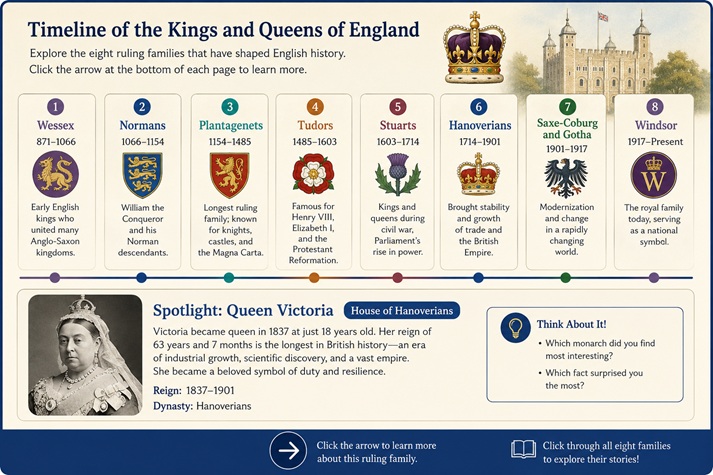
Wessex: 871–1066
The House of Wessex included early English kings who helped unite several smaller kingdoms. Alfred the Great is one of its best-known rulers.
Normans: 1066–1154
William the Conqueror became king after winning the Battle of Hastings in 1066. The Normans built castles, introduced new laws, and changed how England was governed.
Plantagenets: 1154–1485
The Plantagenets ruled for more than 300 years. This period included King John, who agreed to the Magna Carta, and conflicts such as the Hundred Years’ War and the Wars of the Roses.
Tudors: 1485–1603
The Tudor monarchs included Henry VIII and Elizabeth I. Their reigns brought major religious, political, and cultural changes to England.
Stuarts: 1603–1714
The Stuart period included conflict between the monarchy and Parliament. Charles I was removed from power, and England briefly had no king or queen.
Hanoverians: 1714–1901
The Hanoverian monarchs included four kings named George, William IV, and Queen Victoria. Britain experienced rapid industrial growth, scientific discoveries, and the expansion of its empire during this period.
Saxe-Coburg and Gotha: 1901–1917
Queen Victoria’s son, Edward VII, was the first British monarch from this royal house. The family name was changed during World War I.
Windsor: 1917–Present
The House of Windsor includes George V, Edward VIII, George VI, Elizabeth II, and Charles III. Today, the monarch serves mainly as a national symbol and performs ceremonial duties.
Queen Victoria Spotlight
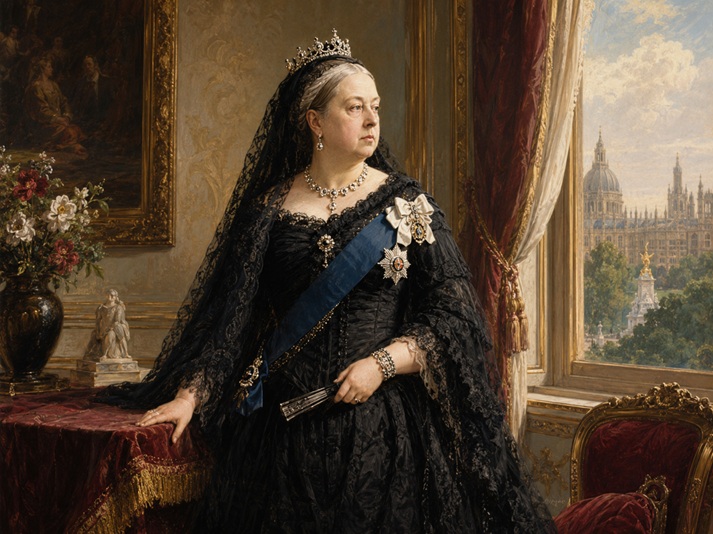
Victoria became queen in 1837 when she was 18 years old. She ruled for more than 63 years, and her reign became known as the Victorian era.
During her reign, Britain experienced enormous changes in transportation, industry, communication, science, and daily life. Railroads expanded, factories grew, and inventions such as the telephone and electric light began changing the world.
Victoria became one of Britain’s most recognizable monarchs. She remained queen until her death in 1901.
Study the timeline and think about these questions:
Pay particular attention to Queen Victoria and the House of Hanover.
Head to the Got It? section to take a closer look at the life and reign of Queen Victoria.

Supplies



 FAVORITE
 Like
Like