Sign Up
School Account Sign Up

Lesson ID: 11686
Discover how buildings combine purpose, strength, and style. Learn to analyze architecture and design your own creative building ideas.




Why Buildings Are More Than Just Buildings
Look around right now.
A house, a school, a stadium, a hospital, a skyscraper, a bridge: these structures shape how people live, work, and move through the world. Some buildings exist simply to do a job. Others leave people staring upward in amazement.
Architecture is the art and science of designing buildings. It blends creativity with engineering to create spaces that are safe, useful, and meaningful.
When architecture works well, it does more than shelter people. It influences emotions, communicates ideas, and sometimes becomes a symbol for an entire city or culture.
You interact with architecture every day. The classroom where learning happens, the store where groceries are bought, and the home where families gather were all carefully designed by someone who chose materials, shapes, structure, and appearance.
Understanding architecture begins with learning how to look at buildings more carefully.

Seeing Buildings Like an Architect
Architects think about three main ideas when designing or analyzing a building.
Function
Function means the purpose of the building. What is it designed to do?
A school must provide spaces for learning. A hospital must allow doctors and nurses to treat patients safely and efficiently. A warehouse must store goods as efficiently as possible.
Some buildings focus almost entirely on function. A simple storage warehouse may look plain because its main goals are efficiency and cost control.
Other buildings combine function with visual impact. A skyscraper such as the Burj Khalifa in Dubai still contains offices and living spaces, but its dramatic height and design also create a powerful visual statement.

When studying architecture, ask:
Structure
Structure refers to how a building stands up and stays stable.
Every building must handle gravity, wind, and other forces. Architects and engineers use materials like steel, stone, concrete, glass, and wood to create structures that are strong enough to last for decades or even centuries.
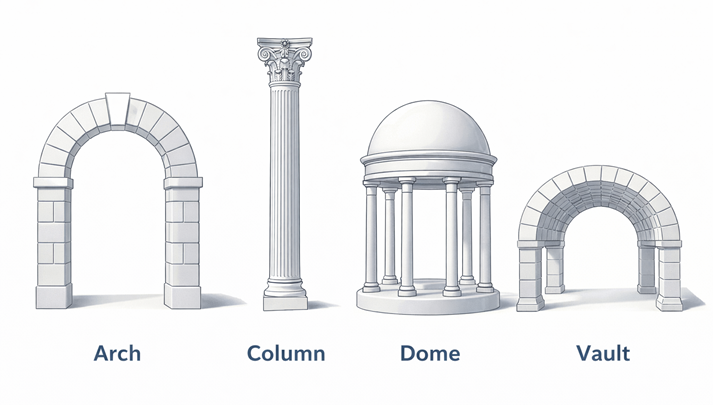
Structural elements often become part of the building’s visual identity. For example:
An arch is a curved structure that spans an opening and supports weight from the sides.
A column is a vertical support made of three parts: a base, a long shaft, and a capital at the top.
A dome is a rounded roof structure that spreads weight evenly across walls or columns.
A vault is an arched ceiling or roof that covers large spaces.
These structural ideas appear in famous buildings across the world. The dome of the Pantheon in Rome has stood for nearly two thousand years, while the massive dome of Florence Cathedral changed engineering forever when it was built during the Renaissance.
When studying architecture, ask:
Beauty
Architecture is also an art form. Architects carefully consider how buildings look and how people experience them.
Beauty in architecture can come from many elements:
Some buildings aim to blend into their environment. Others intentionally stand out and capture attention. Great architecture often balances usefulness with visual impact.
When studying architecture, ask:
How to Recognize Great Architecture
Architects and critics often use several questions to evaluate a building. A building is often considered successful if it:
Architecture has shaped history for thousands of years.
Ancient Egyptian builders created massive stone monuments. Greek architects designed temples such as the Parthenon that continue to influence modern design. Renaissance architects developed new techniques for domes and large public buildings.
Modern architects experiment with glass, steel, and new technologies to reshape city skylines.
Despite these changes across time, one idea remains constant: architecture combines creativity, science, and human needs.
Architecture Is Everywhere
Many people think art only exists inside museums. Architecture proves that idea wrong.
Every city street is filled with artistic design. Schools, houses, libraries, skyscrapers, stadiums, and bridges all reflect the choices of architects and engineers.
The next time you walk through your town, look closely at the buildings around you. Some may be simple and practical. Others may include dramatic shapes, towers, domes, or intricate decorations.
Each building tells a story about the people who designed it and the community that built it.

Understanding architecture starts with noticing how buildings function, how they stand, and how they create beauty. Now it is time to practice seeing buildings through an architect's eyes by analyzing the structures around you.

Supplies


 FAVORITE
 Like
Like