Sign Up
School Account Sign Up

Lesson ID: 11642
Viruses may not be alive, but they’re powerful. Explore their structure, shapes, and sneaky strategies for invading cells!




The Ultimate Microscopic Hacker
If a virus were the size of a marble, a bacterium would be a basketball—and one of your cells would be bigger than your bedroom.
But don’t let their tiny size fool you. Viruses are the robot hackers of the microbiology world, sneaking into cells, hijacking the machinery, and forcing the cell to make more viruses.
They don’t eat, they don’t breathe, and they can’t reproduce without help.
You’re about to find out.
What Is a Virus?
Viruses are tiny particles that blur the line between living and nonliving.
On their own, they can’t grow, move, or reproduce. They have no nucleus, no organelles, and no ability to make energy or use nutrients.
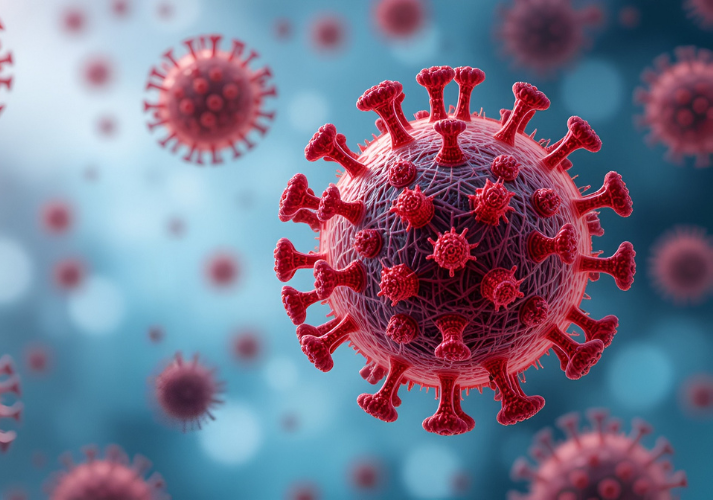
What they do have is genetic material—either DNA or RNA—wrapped in a protein shell called a capsid.
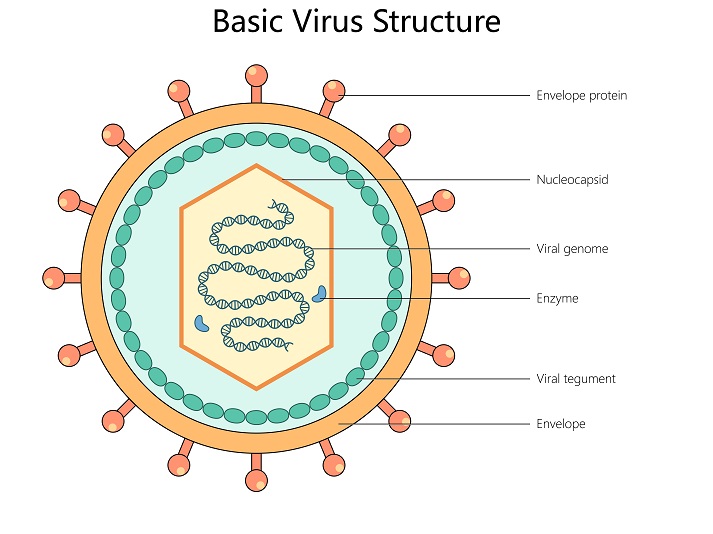
Structure of a Virus
Every virus is made up of two main parts.
Nucleic Acid – This is the virus’s genetic material, which contains instructions for making copies of itself. A virus has either DNA or RNA—never both.
Capsid – This is a protective protein shell that surrounds the genetic material. It gives the virus its shape and helps it attach to host cells.
Some viruses also have the following.
An Envelope – A layer of membrane stolen from the host cell. It surrounds the capsid and helps the virus sneak into new cells.
Surface Proteins – These proteins on the capsid or envelope act like keys that fit into specific locks (receptors) on a host cell’s surface.
Shapes of Viruses
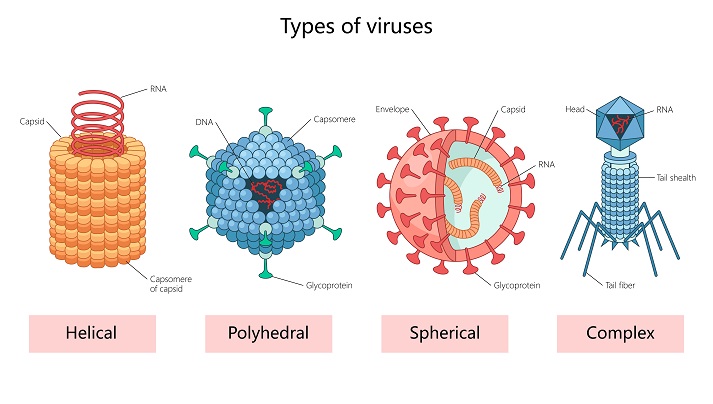
Viruses come in a variety of fascinating shapes.
Helical – A spiral shape, like a coiled spring.
Icosahedral (Polyhedral) – A many-sided shape with triangular faces, like a crystal.
Spherical (Enveloped) – A round appearance caused by a flexible outer membrane.
Complex – Often seen in bacteriophages, with a head, tail, and legs used to inject DNA into bacteria.
Even with all these structural differences, viruses are incredibly small. The largest virus is still smaller than the smallest bacterium, and some viruses are 1,000 times smaller than human cells.
How Small Is a Virus?
Even the largest virus is still much smaller than the smallest bacterium. Some viruses are so tiny that a thousand of them could line up across one of your skin cells!
Take a look at this size comparison chart.

This diagram illustrates the relative size of a flu virus compared to other entities, such as bacteria, human cells, and an egg. Notice that viruses are smaller than mitochondria, proteins, and most other parts of a cell.
You’d need a powerful electron microscope to see them!

This size difference is one of the reasons viruses can sneak into cells so easily—and why studying them requires tools far more powerful than an everyday microscope.
How Do Viruses Reproduce?
Viruses can’t make copies of themselves without help. Instead, they find a host cell and hack into it.
They attach to the host’s surface using their surface proteins.
Some inject their genetic material through a tail-like sheath (like bacteriophages).
Others trick the host cell into “swallowing” them by mimicking standard cell signals—a process called endocytosis.
Enveloped viruses can even fuse directly with the cell membrane to slip inside.
Once inside, the virus takes over the host’s machinery to make more viral parts, which are then assembled into new viruses. Eventually, the host cell often bursts, releasing a flood of new invaders.
Are Viruses Alive?
It depends on how you define “life.” Viruses do have two traits of living things: they contain genetic material, and they can reproduce (with help).
But they don’t meet these other requirements of life.
They’re not made of cells.
They don’t use energy.
They don’t grow or respond to stimuli in the traditional sense.
Because of this, most scientists consider viruses to be nonliving infectious agents. They behave more like cleverly designed machines than living organisms.
Time to Dig In
Now that you've met the virus—what it looks like, how it works, and why it's so tricky—it’s time to put your knowledge to the test.
See what you remember and what kind of viral creations you can come up with in the Got It? section.

Supplies
Additional Resources





 FAVORITE
 Like
Like