Sign Up
School Account Sign Up

Lesson ID: 11008
What do blueberries, marbles, and you all have in common? Atoms! Discover what they're made of, how small they are, and why they matter.




Atoms, Blueberries, and Football Stadiums?
Imagine holding a grapefruit. Now, imagine that grapefruit is made entirely of atoms.
But here’s the wild part: if you blew up every atom in that grapefruit to the size of a blueberry, the grapefruit itself would be the size of the earth.
Atoms are so tiny that it's almost impossible to wrap your brain around them. But let’s try anyway—because inside those teeny-tiny atoms is an entire world waiting to be discovered.
Get ready to shrink down, zoom in, and uncover the invisible universe inside everything, including you.
What Is an Atom?
Atoms are the building blocks of all matter. That means everything you see, touch, eat, smell, or wear is made of atoms.
Even you—your brain, your bones, your burps—are built from trillions of these tiny particles.
Atoms are too small to be seen, even with super-powerful microscopes. In fact, a single pea is covered in millions of atoms—and you’d still need a microscope stronger than anything in your school lab just to almost see one.
Let’s break it down.
The Atom's Tiny Parts
At the heart of every atom is a super-small center called the nucleus. Think of it as the atom’s control center. Inside the nucleus are two types of particles.
Protons – They have a positive charge (think “P for proton, P for positive”).
Neutrons – They have no charge—they’re neutral (“N for neutron, N for neutral”).
Spinning around the nucleus—fast and far away—are the electrons, which have a negative charge. They don’t hang out close to the nucleus; they zip around it like bees buzzing around a hive.
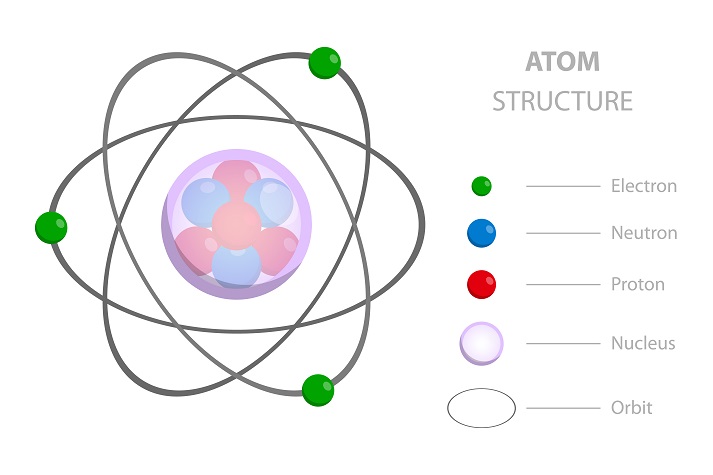
Let’s put this into a fun scale:
If the atom were the size of a football stadium ...
... the nucleus in the middle would be a tiny marble ...
... and the electrons would be zooming around the outer edges of the stadium!
Between the nucleus and the electrons is mostly empty space. Seriously—if atoms were people at a concert, they’d be super spread out.
Wait…How Dense Is the Nucleus?
Now get this: nearly all of an atom’s mass is packed into that tiny nucleus. That means it's incredibly dense.
Imagine stuffing all the people on the planet—over 6 billion of us—into a one-foot cube. That’s how tightly packed the mass inside a nucleus is.
That’s bananas.
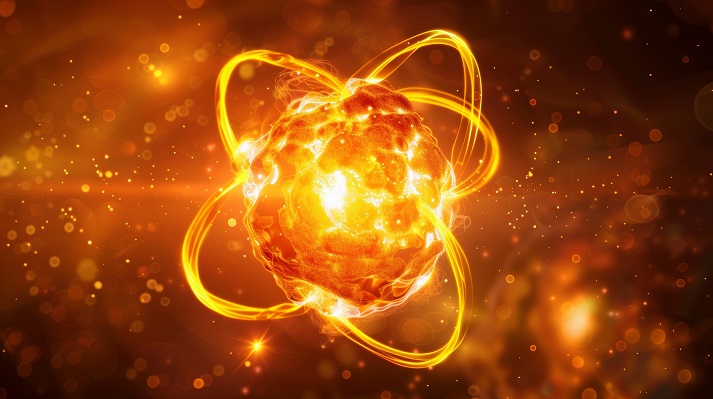
Quick Recap: What You Know Now
Everything is made of atoms.
Atoms are super small—millions of times smaller than a pea.
Each atom has a nucleus made of protons and neutrons.
Electrons orbit the nucleus and have a negative charge.
The atom is mostly empty space, and the nucleus is wildly dense.
Coming Up Next: See What You Remember!
Now that you’ve gotten up close and personal with the tiniest building blocks of matter, it’s time to put your new knowledge to the test.
Head to the Got It? section to explore activities and practice questions that help you review everything you’ve just learned.
Let’s go!

Supplies
Additional Resources


 FAVORITE
 Like
Like