Sign Up
School Account Sign Up

Lesson ID: 10879
Learn how to choose strong evidence that actually proves your point and makes your writing more convincing.




Not All Evidence Is Created Equal
Imagine trying to win an argument by saying, “Trust me, it’s true.” That might work on a close friend—but in writing, it falls apart instantly.
Now imagine backing up your claim with a strong example, a specific detail, or a powerful quote. Suddenly, your argument feels real, believable, and hard to ignore.

That difference comes down to one skill: choosing the right evidence.
Pick the wrong evidence, and your argument weakens.
Pick the right evidence, and everything clicks.
Let’s break down how to do it.
What Counts as Evidence?
Evidence is anything you use to support your point.
In writing, this often includes:
Quotes from a text.
Specific details or events.
Data or facts.
Descriptions of actions or dialogue.
But here’s the key: not all evidence is useful.
Just because something comes from the text doesn’t mean it helps your argument.
Good writers don’t just find evidence—they choose it carefully.
Strong vs. Weak Evidence
Let’s look at the difference.
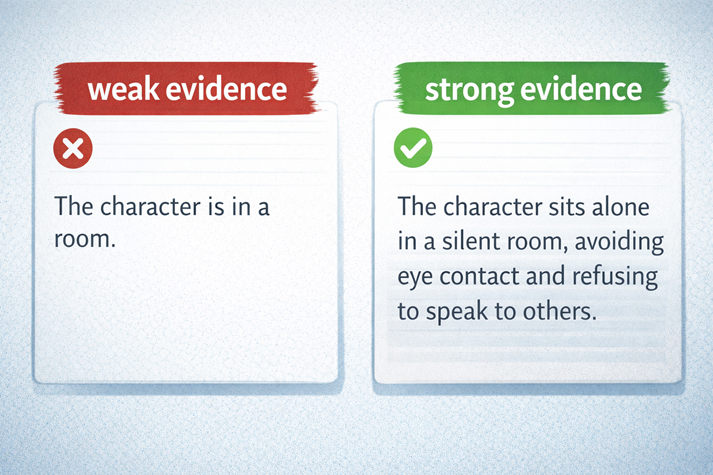
Claim: The character feels isolated.
Weak evidence: The character is in a room.
Stronger evidence: The character sits alone in a silent room, avoids eye contact, and refuses to speak to others.
The second example works better because it clearly supports the idea of isolation. It provides details that directly support the claim.
Strong evidence should:
Clearly connect to your point.
Be specific (not general or vague).
Add something meaningful to your argument.
Be a “Detective” Reader
Think of yourself like a detective. Your job isn’t to collect everything—it’s to find the best clues.
When you read, look for moments that reveal:
Character behavior or choices.
Changes in mood or tone.
Important dialogue.
Repeated ideas or patterns.
These are often the strongest pieces of evidence because they show something important happening.

Make Sure It Actually Fits
One of the most common mistakes is choosing evidence that doesn’t fully match the claim.
Example
Claim: The character is brave.
Evidence: The character talks to a friend.
That doesn’t prove bravery.
Better evidence would show the character taking a risk, facing fear, or making a difficult choice.
Before using any evidence, ask:
If the connection isn’t clear, the evidence won’t help.
Use Evidence Smoothly
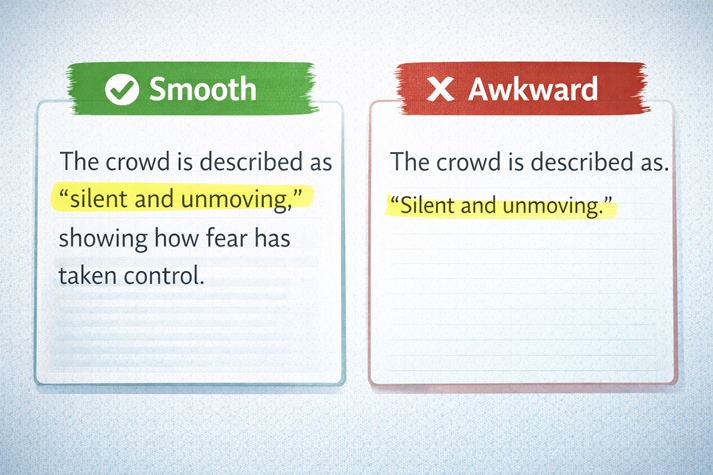
Don’t just drop a quote into your paragraph and hope for the best.
Weak use: The crowd is “silent and unmoving.”
Stronger use: The crowd is described as “silent and unmoving,” showing how fear has taken control.
Blend your evidence into your sentence so it feels natural and connected.
Quality Over Quantity
More evidence does not automatically make a argument stronger.
One strong, well-explained example is more effective than three weak or unrelated ones.
Think of it this way.
Weak evidence = noise
Strong evidence = proof
Your goal is not to include more—it’s to include better.
A Quick Reality Check
Even strong evidence won’t work if you don’t explain it—but choosing the right evidence makes your explanation easier and more powerful.
When your evidence clearly supports your point, your argument almost builds itself.
That’s the goal.
Now that you know how to spot strong evidence, avoid weak examples, and choose details that actually support your ideas, it’s time to test your skills and start selecting evidence like a pro.

Supplies
Additional Resources


 FAVORITE
 Like
Like