Sign Up
School Account Sign Up

Lesson ID: 10860
Turn poems into stories! Explore narrative poetry, break down a famous baseball poem, and write your own story in verse.




Stories Are Everywhere… Even in Poems
Think about the last story that grabbed your attention. Maybe it came from a movie, a video game, a book, or even a story someone told you.
Stories pull you in because something happens. Characters face challenges, events build suspense, and everything leads to a big moment.
Now imagine telling that same kind of story—but in a poem.
That is exactly what narrative poetry does.
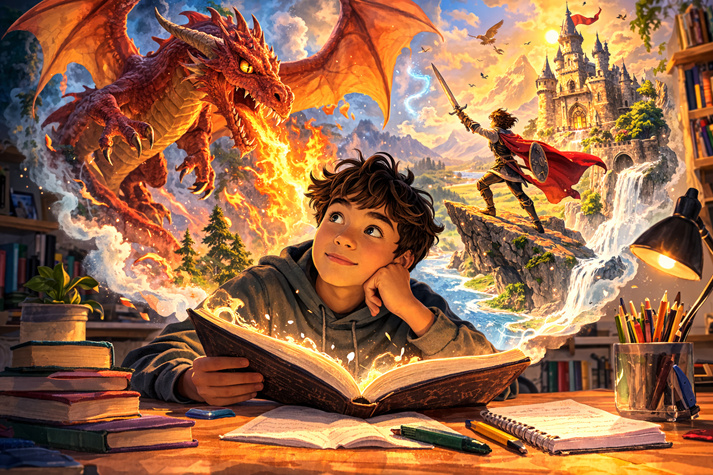
A narrative poem tells a story using poetic language. Just like a short story or novel, it includes characters, events, and a clear sequence of actions. The difference is that the story is written in verse rather than regular paragraphs.
Narrative poems have been popular for hundreds of years. Some are short and simple, while others are long enough to fill an entire book.
One of the most famous examples is a baseball poem from the 1800s called Casey at the Bat. Even today, people still read it because the story and suspense feel just like watching the final moments of a close game.
What Makes a Narrative Poem a Story?
Because narrative poems tell stories, they include many of the same elements found in regular narratives.
Plot
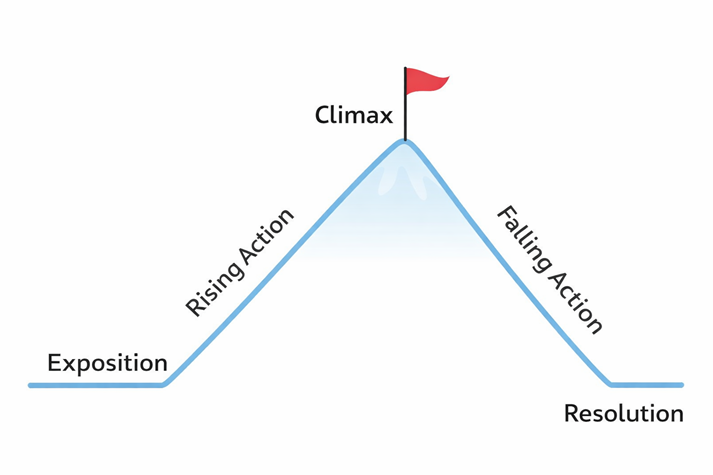
The plot is the sequence of events that happen in a story. Most plots follow a pattern that builds excitement before resolving the story.
The main parts of a plot are:
Exposition
This is the beginning of the story. You learn important background information, such as the setting, the characters, and what is happening at the start.
Rising Action
This section includes the events that build tension or conflict. Problems appear, challenges grow, and the story becomes more exciting.
Climax
This is the turning point of the story. It is often the most intense or dramatic moment. The main character’s situation changes in an important way.
Falling Action
After the climax, the conflict begins to settle. Events move toward the ending.
Resolution
The story wraps up. Problems are solved, and the outcome becomes clear.
Stories often follow this shape because it keeps readers interested from beginning to end. The rising action and falling action usually include several events that move the story forward.
Setting
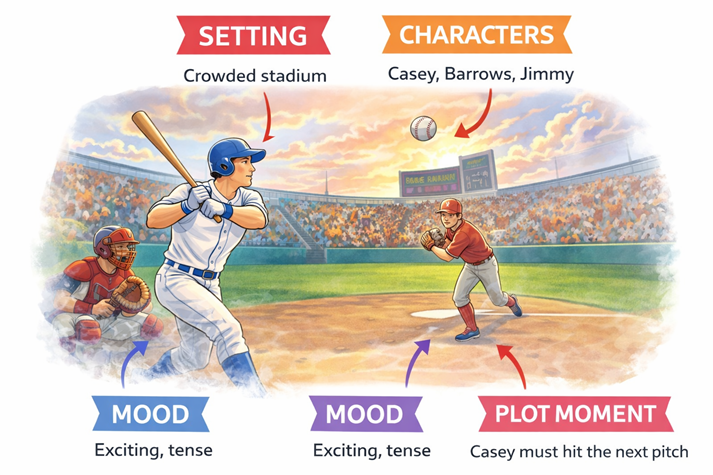
The setting tells you where and when the story takes place. A narrative poem might happen in a quiet town, a crowded stadium, a faraway kingdom, or even in space. The setting helps create the story's atmosphere.
Characters
Characters are the people, animals, or creatures who take part in the story. Authors reveal characters in two main ways.
Direct characterization happens when the author tells you what a character is like.
Indirect characterization happens when you learn about a character by watching their actions, thoughts, and dialogue.
Mood
Mood is the feeling the story creates for the reader. Some narrative poems feel exciting or suspenseful, while others feel funny, sad, or mysterious. Writers build mood through word choice, imagery, and descriptions.
Tone
Tone shows the author’s attitude toward the topic or subject. A tone might feel serious, playful, hopeful, or dramatic depending on how the writer presents the story.
Point of View
Point of view explains who is telling the story. Some narrative poems use the first-person point of view, where the narrator uses words like I or me. Others use the third-person point of view, where the narrator describes what happens to characters using words like he, she, or they.
Types of Narrative Poems
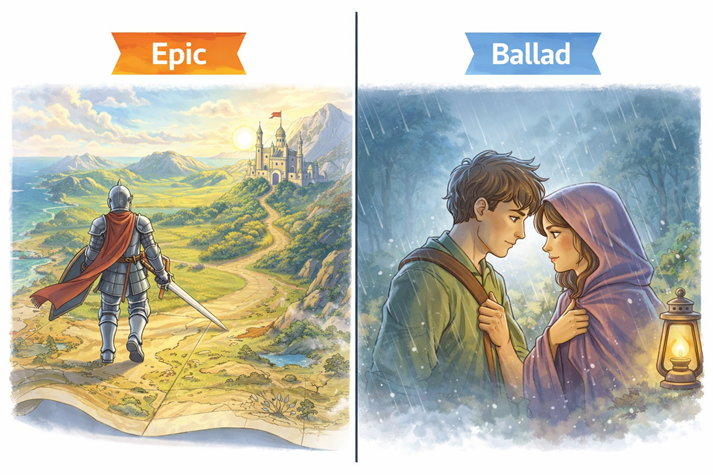
Narrative poems come in several forms. Two of the most common are epics and ballads.
Epics are long narrative poems that often tell the story of heroes, adventures, and major events. These poems may follow a character on a long journey or describe events that affect an entire community or culture.
Ballads are shorter narrative poems that usually focus on a dramatic event or moment in someone’s life. Ballads often use short stanzas and a steady rhythm, making them easy to read aloud or remember.
Many narrative poems also use meter, which is a regular pattern of beats in each line. Some rhyme, while others do not. The rhythm of the poem helps create a sense of movement as the story unfolds.
Stories That Live Inside Poems
When a poem includes characters, a setting, and a plot that builds toward an important moment, it becomes more than just lines of verse. It becomes a full story told in a creative and powerful way.
In the Got It? section, you will explore a famous narrative poem and practice identifying the story elements you just learned.

Supplies



 FAVORITE
 Like
Like