Sign Up
School Account Sign Up

Lesson ID: 10836
Learn how to hook your reader fast and write introductions that make people actually want to keep reading.




Hook Your Reader Before They Even Start Reading
Think about the last time you started a movie, show, or even a social media video. Within the first few seconds, you probably decided whether to keep watching or scroll away.
Writing works the same way. If your first paragraph doesn’t grab attention, your reader is already halfway out the door.

A strong introduction is your one shot to make a reader curious, interested, and ready to keep going. It sets the tone, gives direction, and tells your reader, “This is worth your time.”
So how do you actually do that?
What Makes an Introduction Work?
A strong introduction does three important jobs.
Miss one of these, and your introduction feels incomplete. Nail all three, and your essay starts strong.
Let’s break each part down.
Start Strong: The Hook
Your hook is the first sentence (or two) of your introduction. Its job is simple: make your reader want to keep reading.
There are several effective ways to hook your reader.
Start with a surprising fact or statistic.
Example: The average person makes over 30,000 decisions every day, yet many of those choices are influenced by forces they don’t even notice.
Ask a thought-provoking question.
Example: What would life look like if every person were forced to be exactly the same?
Use a powerful or relevant quote.
Example: “Power tends to corrupt, and absolute power corrupts absolutely.”
Begin with a bold or relatable statement.
Example: Everyone wants freedom—until it threatens their sense of control.
Each of these approaches works because it creates curiosity. Your reader starts asking questions, and that curiosity pulls them forward.

Stay Focused on Your Topic
A hook should be interesting and connect to your topic. Random or overly dramatic openings might grab attention, but they confuse your reader if they don’t lead into your main idea.
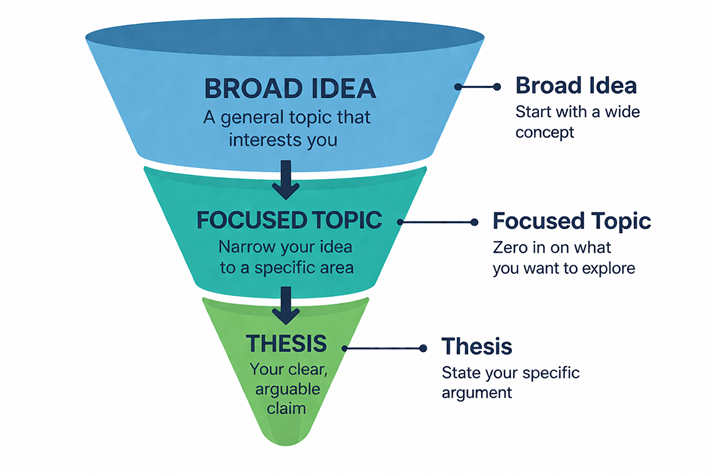
After your hook, you begin narrowing your focus. Move from a general idea to your specific topic.
For example:
Hook: Everyone wants to belong.
Follow-up: That desire can shape decisions, relationships, and even identity.
Lead-in: In Kurt Vonnegut’s story “Harrison Bergeron,” the idea of forced equality reveals how dangerous that desire can become.
This progression helps your reader understand exactly what your essay will discuss.
Find Your Writing Voice
Your voice is how your personality comes through in your writing. It shows up in your word choice, sentence structure, and tone.
You don’t need to sound overly formal or robotic to sound “smart.” Strong writing sounds clear, confident, and intentional.
Compare these.
Weak voice: This essay will talk about power and stuff that happens in the story.
Strong voice: The story reveals how the desire for power can push individuals to challenge authority, even at great risk.
The second example sounds more precise and confident. That’s your goal.
Write a Clear Thesis Statement
Your thesis statement is the most important sentence in your introduction. It tells your reader exactly what you will argue or prove.
A strong thesis has three components.
Example of a weak thesis:
This essay is about equality in a story.
Example of a strong thesis:
In “Harrison Bergeron,” Vonnegut uses exaggerated government control to show that forced equality can destroy individuality and freedom.
The strong version makes a clear claim and sets up the direction for the entire essay.
Putting It All Together
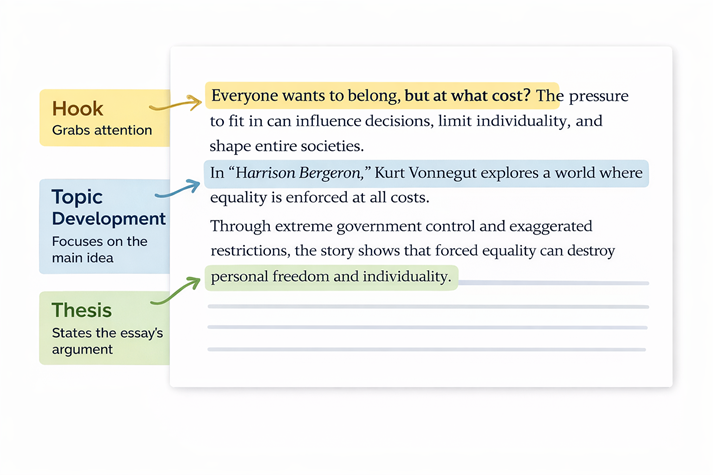
Here’s how a full introduction might look when all the pieces work together.
Everyone wants to belong, but at what cost? The pressure to fit in can influence decisions, limit individuality, and shape entire societies. In “Harrison Bergeron,” Kurt Vonnegut explores a world where equality is enforced at all costs. Through extreme government control and exaggerated restrictions, the story shows that forced equality can destroy personal freedom and individuality.
Notice how it:
One Smart Strategy Before You Move On
Many strong writers don’t finalize their introduction first. After writing the full essay, they go back and adjust the introduction to better match their ideas.
Your introduction is a starting point—but it should also reflect your final argument.
You’ve now learned how to hook your reader, guide them into your topic, and clearly state your argument. Up next, put these skills into action and start building your own introduction step by step.

Supplies
Additional Resources



 FAVORITE
 Like
Like