Sign Up
School Account Sign Up

Lesson ID: 10832
Turn your ideas into strong arguments by learning how to write body paragraphs that actually prove your point.




Build Your Argument Like It Actually Matters
Imagine trying to convince someone of something—but instead of giving reasons, you just repeat your opinion louder and louder. That might work in a movie argument scene, but in writing, it falls apart fast.

Readers don’t care how strongly you feel. They care how well you prove it.
That’s where body paragraphs come in. This is where your argument either stands strong… or collapses.
What Are Body Paragraphs Really Doing?
Your introduction makes a promise. Your body paragraphs prove it.
Each body paragraph should take one part of your main idea and fully support it. Think of each paragraph as one solid piece of evidence in your overall case.
A strong body paragraph does three things.
Miss one of these, and your paragraph feels incomplete.
Meet the P.I.E. Method
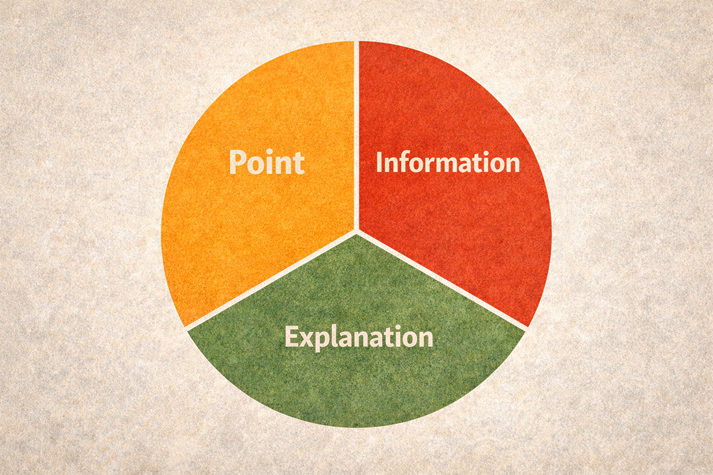
An easy way to remember how to structure a body paragraph is the P.I.E. method.
Point
Information
Explanation
Yes, like pie—but instead of dessert, it builds your argument.
Let’s break it down.
Point: Say Something Worth Proving
Start your paragraph with a clear, specific claim that connects to your main argument.
Weak point: The author uses symbolism in the story.
Stronger point: The author uses light and dark symbolism to show how hope slowly turns into despair.
The stronger version actually says something meaningful and gives you something to prove.
Your point should:
Be specific (not vague).
Connect to your main argument.
Set up what the paragraph will show.
Information: Bring in the Evidence
Now, back up your point with actual evidence. This could be:
A quote
A detail from a scene
A specific example
Weak use of evidence: “This shows things are bad.”
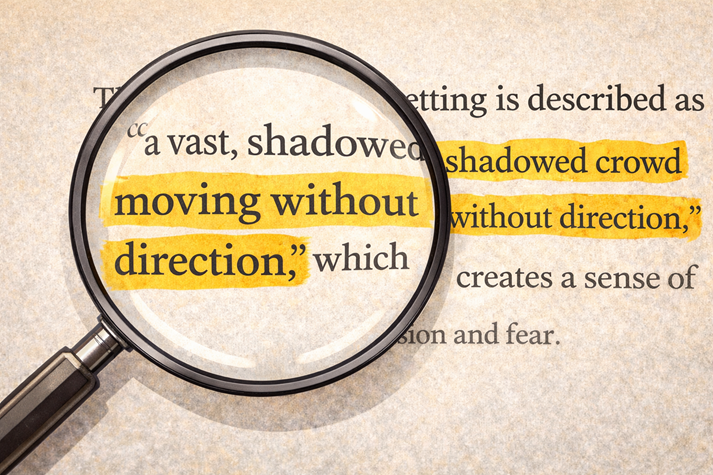
Stronger use of evidence: The setting is described as “a vast, shadowed crowd moving without direction,” which creates a sense of confusion and fear.
Specific details make your argument believable.
When using evidence:
Choose details that clearly support your point.
Blend them into your sentence (don’t just drop a quote in).
Keep it relevant—no random details.
Explanation: Do the Thinking for Your Reader
This is where many writers fall short.
After you give evidence, you must explain it. Don’t assume your reader will figure it out.
Weak explanation: This is important.
Stronger explanation: The description of the crowd as “shadowed” suggests uncertainty and fear, reinforcing the idea that the situation has become unstable and dangerous.
Your explanation should:
Break down what the evidence shows.
Connect back to your point.
Push your argument forward.
If your paragraph only has a point and a quote, it’s not analysis—it’s just reporting.
Put It All Together
Here’s what a full body paragraph might look like.
The author uses light and dark symbolism to show how hope fades into despair. Early in the story, scenes are filled with brightness and movement, suggesting optimism. However, later descriptions shift to “shadowed streets” and “dimmed light,” creating a darker mood. This change reflects how the characters’ situation becomes more uncertain and tense, showing that the initial sense of hope cannot last.
Notice how:
The first sentence makes a clear point.
The middle includes specific evidence.
The explanation connects everything back to the idea.
That’s a complete, effective paragraph.
Level Up Your Analysis
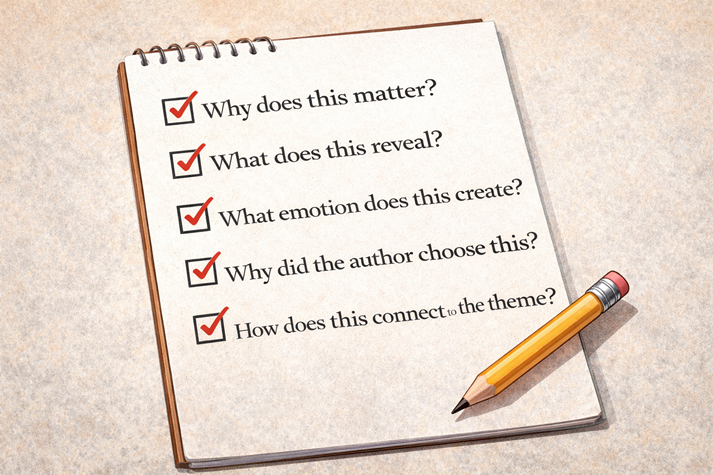
If you’re not sure what to say in your explanation, ask yourself:
These questions help you move beyond basic answers and into deeper thinking.
One Common Mistake to Avoid
Don’t rely on emotion alone to convince your reader.
In everyday life, people often try to persuade using feelings, hype, or dramatic language. That might grab attention, but it doesn’t prove anything.
Strong writing depends on clear reasoning and solid evidence—not just sounding convincing.
Your goal is not just to say something—it’s to prove it.
Now that you know how to build a strong body paragraph using clear points, strong evidence, and meaningful explanation, it’s time to put those skills to work and start building your own argument step by step.

Supplies
Additional Resources





 FAVORITE
 Like
Like