Sign Up
School Account Sign Up

Lesson ID: 10125
Does the 6 in 60 have the same value as the 6 in 600 or 6000? Explore place value with educational videos and online math problems, use a place value chart with candy, read a book, and even write one!




Imagine finding $5 in your backpack. Pretty exciting, right?
Now imagine finding $50.
Suddenly, that little 5 became much more powerful!

That is what place value is all about.
The value of a digit depends on where it is placed in a number.
Take a look at these numbers:
5
50
500
Even though each number uses the digit 5, the value changes each time.
In 5, the 5 means five ones.
In 50, the 5 means five tens.
In 500, the 5 means five hundreds.
Each time the digit moves one place to the left, its value becomes 10 times greater.
This happens because the number system used every day is called the base-ten system.
In a base-ten system, each place value is worth 10 times more than the place to its right.
Here is a quick review of place values:
Ones = 1
Tens = 10
Hundreds = 100
Thousands = 1,000
Ten Thousands = 10,000
Hundred Thousands = 100,000
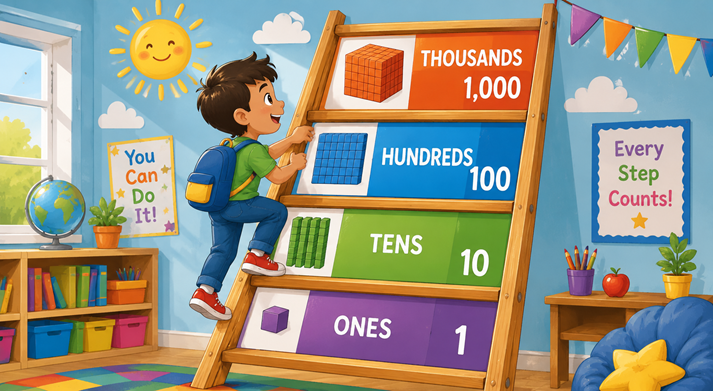
You can think of place values like climbing a ladder. Every step to the left makes the number 10 times bigger.
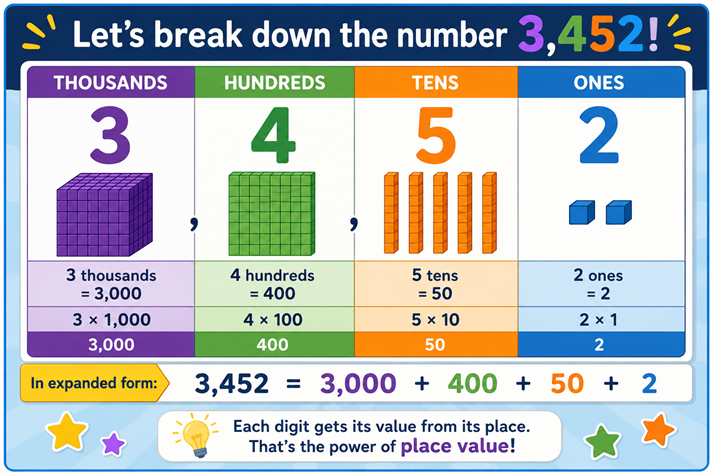
Look at the number 3,452.
Each digit has a different value depending on its place.
The 2 is in the ones place, so its value is 2.
The 5 is in the tens place, so its value is 50.
The 4 is in the hundreds place, so its value is 400.
The 3 is in the thousands place, so its value is 3,000.
Even though the digits are small, their positions make a huge difference.
Now look carefully at the digit 7 in these numbers:
7
70
700
7,000
Notice the pattern?
7 x 1 = 7
7 x 10 = 70
7 x 100 = 700
7 x 1,000 = 7,000
Every time the 7 moves one place to the left, it becomes 10 times greater.
Every time the 7 moves one place to the right, it becomes 10 times smaller.
That relationship between digits helps mathematicians compare numbers quickly.
Suppose you see these two numbers:
200 and 20
How many groups of 20 make 200?
20 + 20 + 20 + 20 + 20 + 20 + 20 + 20 + 20 + 20 = 200
It takes 10 groups of 20 to make 200.
That means 200 is 10 times greater than 20.
The digit 2 moved one place to the left, so its value became 10 times larger.
This pattern works with every digit and every place value.
Try another example.
Look at the number 25,378.
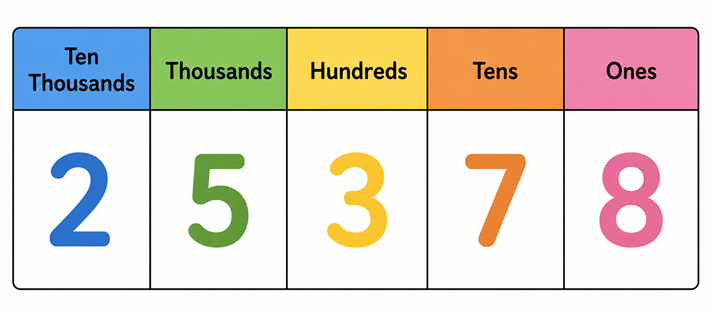
The digit 3 is in the hundreds place, so its value is 300.
If the 3 moved one place to the left, it would move into the thousands place.
That would make its value 3,000.
And 3,000 is 10 times greater than 300.
Understanding place value helps with:
reading large numbers
comparing numbers
rounding numbers
adding and subtracting
multiplying and dividing
Place value is one of the most important building blocks in math. Once you understand it, much larger numbers become much easier to work with.
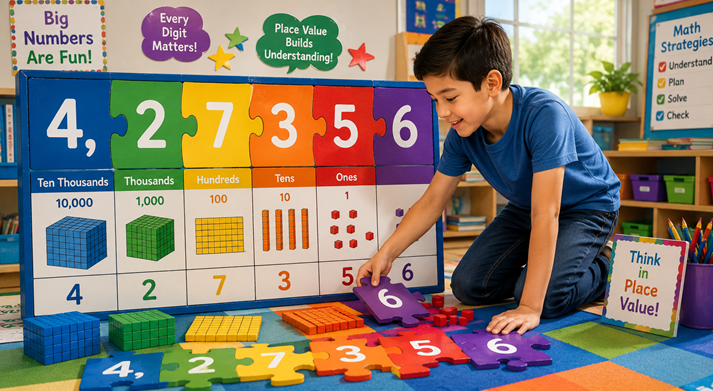
Now that you know how digits change value depending on their position, it is time to practice reading numbers, identifying place values, and comparing how digits grow as they move across the place value chart.

Supplies
Additional Resources
Suggested Reading


 FAVORITE
 Like
Like