Sign Up
School Account Sign Up

Lesson ID: 13836
March across continents with Alexander the Great and discover how strategy, leadership, and culture helped one young king reshape the ancient world.




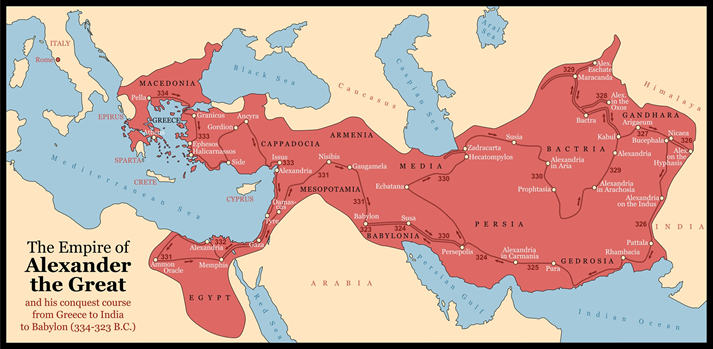
That is exactly what Alexander the Great did. In just over a decade, he led an army from Greece across Egypt, the Middle East, and deep into Asia. His empire stretched thousands of miles and connected cultures that had never interacted before.
Even today, more than 2,000 years later, historians still debate a big question: what actually made Alexander “great”?
Understanding Alexander’s story reveals how leadership, strategy, and cultural exchange shaped the ancient world.
From Prince to King
Alexander was born in 356 B.C. in the kingdom of Macedonia, just north of the Greek city-states. His father, King Philip II, had already begun transforming Macedonia into a powerful military state.

Philip wanted his son to be more than just a warrior, so he hired one of the most famous thinkers in history to educate him: Aristotle.
Aristotle had studied under Plato, who had studied under Socrates. That meant Alexander’s teacher carried the intellectual traditions of the famous Athenian Golden Age.
Under Aristotle’s guidance, Alexander studied philosophy, literature, science, politics, and geography. This education shaped how he thought about leadership.
Aristotle taught that a ruler could justify ruling others only if he possessed wisdom, discipline, and intelligence greater than those of the average citizen.
Alexander took that idea seriously. He wanted to prove himself not just as a king, but as someone capable of accomplishing extraordinary things.

Taking the Throne
In 336 B.C., when Alexander was only twenty years old, his father was assassinated. Suddenly, the young prince became king.
Many leaders might have struggled to secure power at such a young age. Alexander acted quickly and decisively. Within a year, he crushed rebellions in Greece and forced the Greek city-states to recognize him as their leader.
Once Greece was secure, Alexander turned his attention east. His goal was ambitious: to defeat the powerful Persian Empire, the largest empire in the world at that time.
The Persian Empire stretched across modern-day Turkey, Egypt, Iran, and much of the Middle East. Compared to Persia’s enormous resources, Alexander’s army looked small. Yet he believed strategy, discipline, and speed could overcome size.
Creative Warfare
Alexander’s success did not come from luck alone. He constantly used creative strategies that surprised his enemies.
One example happened during the famous Battle of Gaugamela in 331 B.C. The Persian king, Darius III, commanded a massive army that greatly outnumbered the Macedonians. Instead of attacking directly, Alexander used a clever maneuver known today as the “false gap.”
During the battle, part of the Macedonian army slowly shifted toward the right side of the battlefield. To the Persians, this movement looked like a mistake that opened a weak spot in the Macedonian line.
Darius took the bait.
He sent elite Persian soldiers, known as the Immortals, to attack what appeared to be the exposed center. Once those troops became fully engaged, Alexander suddenly struck where the Persian army was now vulnerable.
Leading his powerful Companion cavalry, he charged straight toward Darius and the Persian command center.
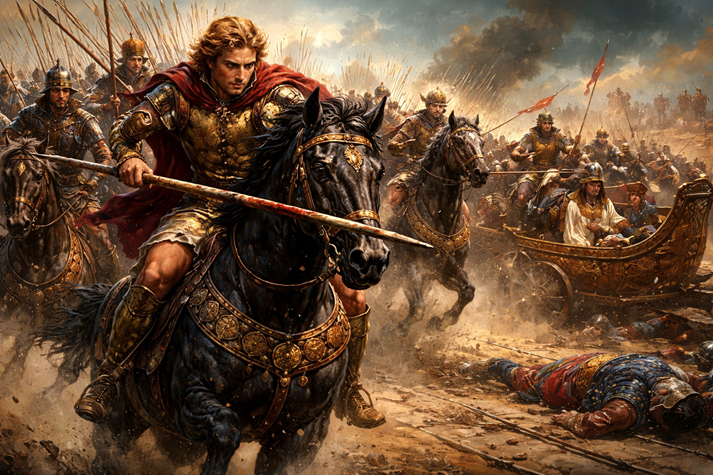
The surprise attack caused chaos. Seeing his position threatened, Darius fled the battlefield. Without their king, the Persian army collapsed.
The tactic worked because Alexander understood psychology as well as strategy. By creating the illusion of weakness, he lured the enemy into making the wrong move.
Breaking the Impossible
Alexander also solved military problems in ways other commanders had never attempted.
One famous example occurred at the island city of Tyre. Tyre sat just off the coast and had strong defensive walls. Because Alexander had a small navy, attacking directly by sea was difficult.
Instead of giving up, he ordered his army to build a massive stone causeway from the mainland to the island. The project allowed his siege towers and soldiers to reach the city walls.
After months of effort, Tyre fell.
This kind of determination became one of Alexander’s trademarks. When obstacles appeared, he found unconventional solutions.
A Rapidly Expanding Empire
Over the next decade, Alexander marched farther east than any Greek army before him. His campaigns moved through Egypt, Mesopotamia, Persia, and Central Asia before reaching the Indus River in modern-day Pakistan and India.
The distance he covered was enormous. His empire eventually stretched from Greece and Egypt all the way to South Asia.
Even more surprising is how quickly this happened. Most of these conquests occurred between 334 B.C. and 323 B.C., less than a single generation.

Despite constant battles and long travel distances, Alexander rarely lost control of his army. His soldiers respected his leadership because he fought alongside them and shared many of the same dangers.
A Different Kind of Ruler
Alexander did not simply conquer lands and ignore the people living there. Instead, he often tried to blend cultures within his empire.
Historians describe this approach as cosmopolitan. A cosmopolitan leader embraces and engages with diverse cultures rather than rejecting them.
Alexander adopted certain customs from the regions he conquered. He married women from different parts of his empire, including Roxana from Central Asia and two Persian nobles, Stateira II and Parysatis II.
He also encouraged his soldiers to marry local women.
This practice helped connect cultures throughout the empire. Greek language and ideas spread eastward, while Persian and Asian traditions influenced Greek settlers. The result was a blending of cultures that historians call the Hellenistic world.
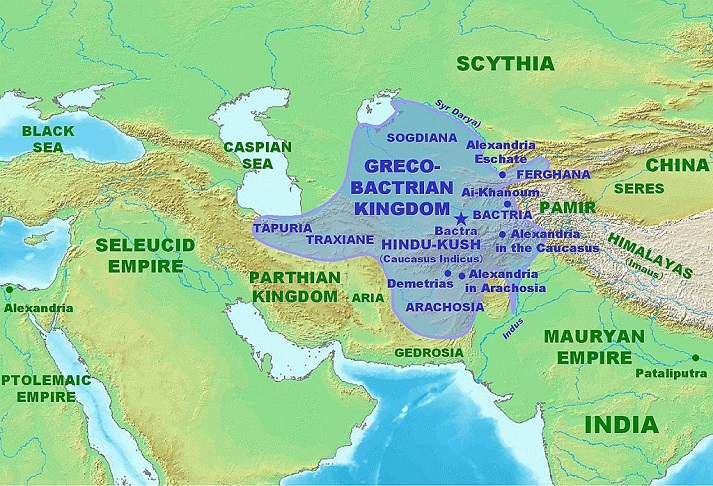
Even after Alexander’s death, these cultural connections continued shaping societies across the eastern Mediterranean and Asia.
Luck, Skill, or Both?
Alexander died in Babylon in 323 B.C. at only thirty-two years old. Historians still debate the exact cause of his death, but illness is the most widely accepted explanation.
By that time, he had created one of the largest empires the ancient world had ever seen.
Some people argue that Alexander succeeded because he was lucky. Others point to his intelligence, education, leadership, and bold tactics. The truth probably lies somewhere in between.

Alexander’s story shows how strategy, ambition, and cultural exchange can reshape the world.
Next, it is time to test your understanding of Alexander’s journey and the choices that helped him build such a remarkable empire.


 FAVORITE
 Like
Like