Sign Up
School Account Sign Up

Lesson ID: 13821
How much do you know about Europe? Where is it? How big is it? How many countries does it have? What are the cultures and religions of its people? Take a tour of Europe!




Europe has one large country that occupies two continents, and one tiny country that lies inside a city!
Keep reading to found out!
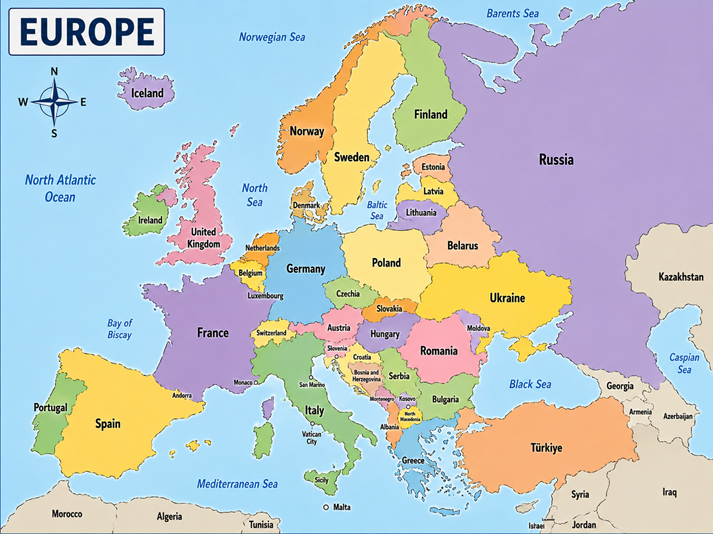
Europe is a continent full of beautiful mountains, deep forests, ancient and modern cities, and a diverse collection of countries, cultures, and peoples!
Location
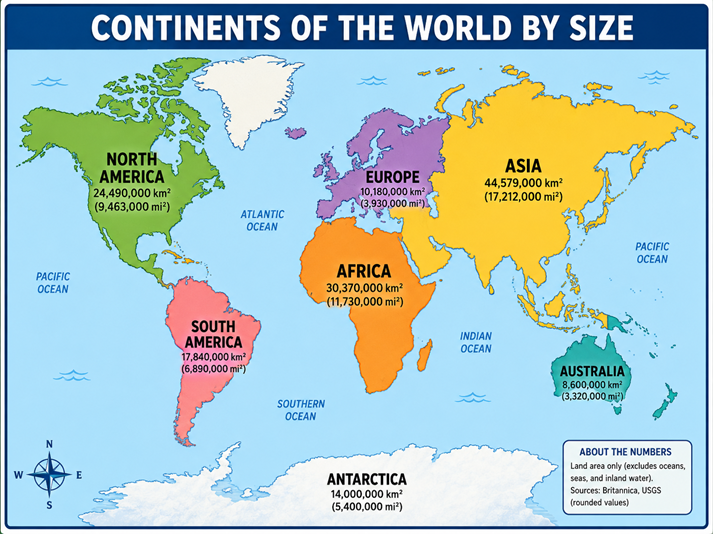
Find Europe (in red) on this world map:

Europe borders Asia to the east, the Arctic Ocean to the north, the Atlantic Ocean to the west, and the Mediterranean and Black Sea to the south.
The name Europe comes from Greek words meaning "broad face" and is also associated with the Phoenician goddess, Europa.
Population
Europe is the third most populous continent, after Asia and Africa. It has 742 million people.
Size
Europe is the second-smallest continent by total land area (the smallest is Australia).
Countries
Europe is made up of 51 countries!
We can't explore them all here, so let's take a look at a few:
Russia
Russia is so large that it spans two continents: Europe and Asia.
It covers 37% of the European continent and is almost twice the size of the United States. Though more of its land lies in Asia, more of Russia's population lives on the European side.
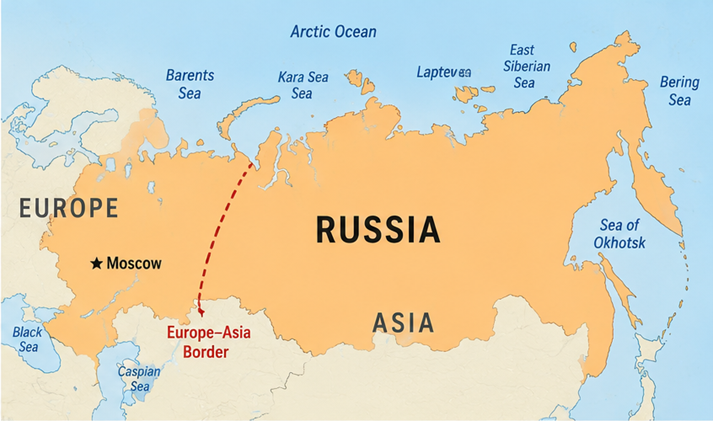
Moscow, the capital, is not only the largest city in Russia but in all of Europe.
The name Russia comes from the Kievan Rus, an empire in the Middle Ages.
Most people in Russia speak Russian; however, other languages are also spoken. About 20 percent of the population follows Russian Orthodoxy.
Russia is rich in natural resources such as oil, gas, and wood.

Vatican City
The Vatican is the smallest country. The Vatican is a country located inside the city of Rome, Italy!
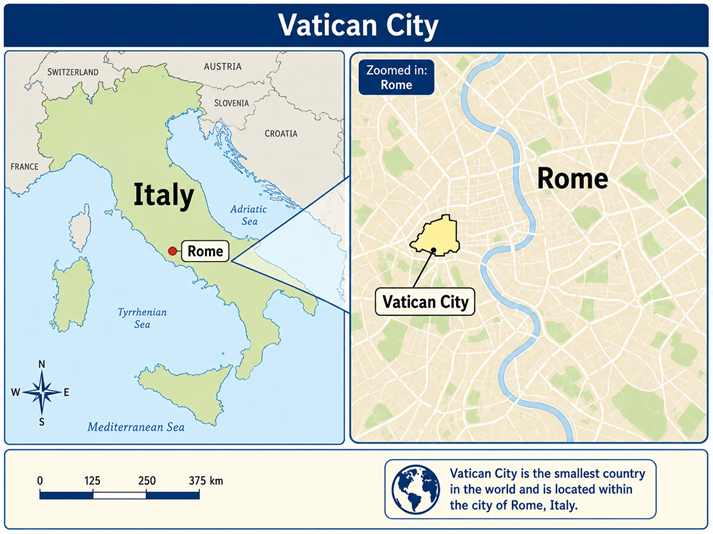
Even though Vatican City is tiny, it has a huge place in European history, religion, art, and culture.
After the Roman Empire fell, the pope gradually gained control of parts of Italy called the Papal States. Later, when modern Italy became one united country, most of that land became part of Italy.
In 1929, Italy and the pope signed the Lateran Treaty. This agreement made Vatican City its own independent country.
Today, Vatican City has its own government, postal service, and security force called the Swiss Guard. The Swiss Guard protects the pope and is known for its colorful uniforms.
Vatican City is also home to St. Peter’s Basilica, one of the largest and most famous churches in the world. It was built near the place where St. Peter, an important early Christian leader, is traditionally believed to have been buried.
Many visitors also go to the Vatican Museums, which hold famous paintings, sculptures, and other works of art. One of the best-known places there is the Sistine Chapel, whose ceiling was painted by Michelangelo.
Vatican City may be small, but it has had a big influence on religion, art, and history.
Now, travel northwest from Italy to visit one of Europe’s most popular countries for tourists: France!
France
France is one of the most visited countries in Europe. It is located in western Europe and borders several countries, including Spain, Italy, Germany, Belgium, and Switzerland.
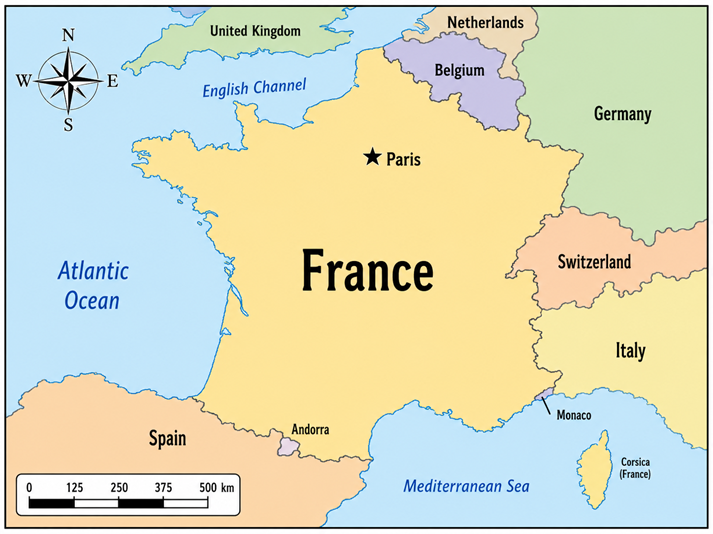
The capital of France is Paris, a city known for art, fashion, food, history, and famous landmarks such as the Eiffel Tower, Notre-Dame Cathedral, and the Louvre Museum.
France has played an important role in European history. During the Middle Ages, powerful kings ruled France, and castles, cathedrals, and walled towns were built across the country. Later, the French Revolution changed the country’s government and influenced ideas about rights, citizenship, and democracy in other parts of the world.
Most people in France speak French, and the French language has influenced many English words, especially those related to food, art, government, and fashion. Words like café, ballet, déjà vu, and menu all come from French.
France is also known for its regional differences. The snowy Alps rise in the east, beaches stretch along the Mediterranean Sea in the south, and farmland, vineyards, forests, and cities fill other parts of the country. Different regions have their own foods, traditions, architecture, and local history.
French culture has influenced the world through art, literature, music, science, cooking, and design. From famous paintings in museums to fresh bread in bakeries, France combines old traditions with modern life.
France is popular with travelers, but it is much more than a vacation spot. It is a country with deep history, diverse landscapes, and a culture that has shaped Europe and the world.
Next, travel north to explore the Nordic countries, some of Europe’s most scenic places!
Nordic Countries
The Nordic countries include Denmark, Sweden, Norway, Finland, and Iceland. These countries are located in northern Europe and are known for forests, mountains, islands, lakes, coastlines, and long winter nights.
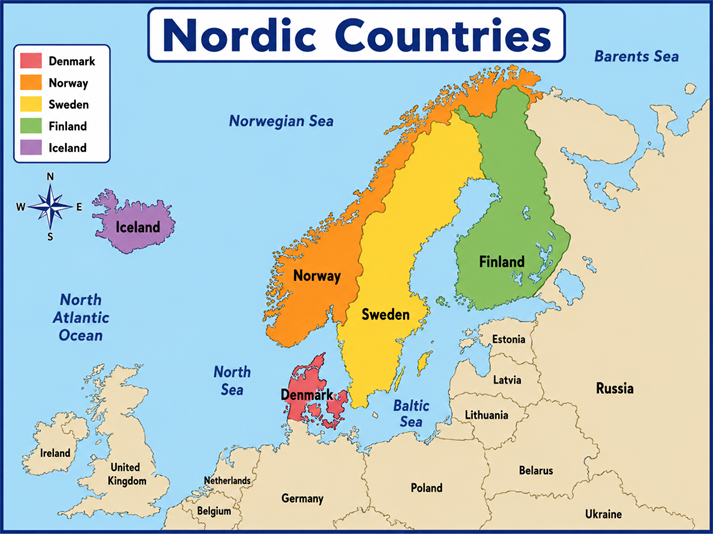
These countries are considered among the most beautiful places in the world.
The Nordic countries share some similarities, but each one is unique.
Denmark is the smallest Nordic country, excluding its island territories. It is known for its flat land, bicycle-friendly cities, colorful waterfronts, and many islands. Its capital, Copenhagen, is one of Europe’s well-known historic cities.
Sweden is the largest Nordic country by land area. It has thick forests, thousands of lakes, and busy modern cities. Stockholm, Sweden’s capital, is built across many islands, which gives the city a close connection to the water.
Norway is famous for its fjords, which are long, narrow sea inlets with steep cliffs on both sides. Norway also has mountains, waterfalls, and coastal villages. Because it stretches far north, parts of Norway experience the midnight sun in summer and very short days in winter.
Finland is sometimes called the “land of a thousand lakes,” although it actually has many more than that! Forests and lakes cover much of the country. Finland is also known for saunas, winter sports, and the northern lights, which can sometimes be seen in the sky.
Iceland is an island country in the North Atlantic Ocean. It has volcanoes, glaciers, hot springs, waterfalls, and dramatic landscapes shaped by fire and ice. Iceland sits near the boundary of two tectonic plates, which helps explain its volcanic activity.
Many Nordic countries are known for strong connections to nature, outdoor activities, and long histories of seafaring. The Vikings, who lived in parts of Scandinavia more than 1,000 years ago, traveled by ship, traded, explored, and settled across Europe.
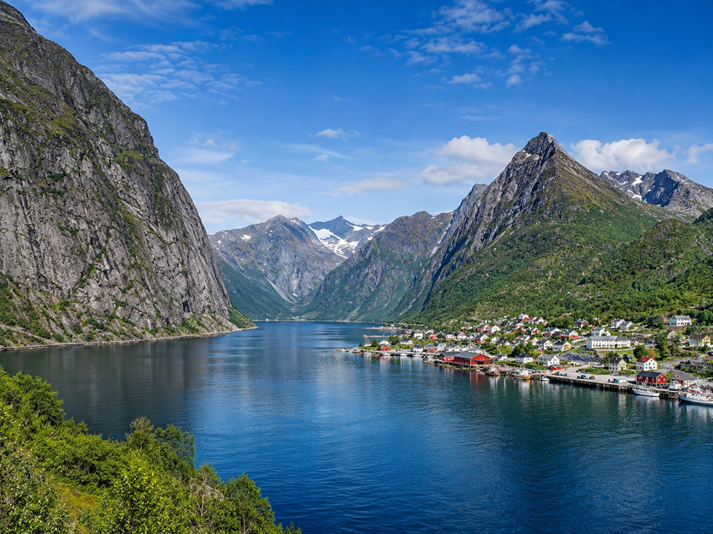
Today, the Nordic countries are modern nations with their own languages, governments, traditions, foods, and cultures. They are often recognized for beautiful landscapes, creative design, and a high quality of life.
After exploring the Nordic countries, take a look at the full list of European countries.
All the European Countries
Here's a list of the countries in Europe, in alphabetical order.
Languages
Listen as kids from different European countries sing in their own languages!
Now that you've been introduced to Europe, move on to the Got It? section to get acquainted with another European country of your choice!

Supplies
Resources Referenced in the Lesson
Suggested Reading
Europe (A True Book: The Seven Continents) by Joana Costa Knufinke


 FAVORITE
 Like
Like