Sign Up
School Account Sign Up

Lesson ID: 13703
Discover how writers use different paragraph patterns to organize ideas, explain information, and make their writing stronger.




You've probably heard of a rhetorical question.

A rhetorical question is one meant to make someone think about a specific idea rather than actually supply an answer.

A strategy is simply a plan of action.
Read on to find out!
Words With a Game Plan
Think about the last time you tried to convince someone of something.
Maybe you explained why a movie was worth watching, compared two games, described a wild moment from your day, or broke down why a rule felt unfair. You were not just throwing words into the air and hoping they landed. You were choosing a strategy.
Writers do the same thing.
A rhetorical strategy is a way of organizing ideas so readers can understand, follow, and respond to them. The word "rhetorical" relates to how language is used to communicate meaning, and "strategy" refers to a plan of action.
Put those ideas together, and a rhetorical strategy is a writer’s plan for presenting information clearly and effectively.
Rhetorical strategies may also be called rhetorical modes, rhetorical patterns, or rhetorical styles. The name may change, but the purpose stays the same: each strategy helps a writer shape information for a specific reason.

Why Writers Use Rhetorical Strategies
Strong writing does not usually follow one random path from beginning to end. Writers choose a structure based on what they want readers to understand.
For example, a writer might want to do one of the following.
Tell what happened
Explain how something works
Show why something happened
Compare two choices
Sort information into categories
Describe a person, place, object, or event
Define an idea clearly
Use examples to make an abstract idea easier to understand
Identify a problem and suggest a solution
A single paragraph, article, essay, post, review, or speech can use more than one strategy. A movie review might describe the setting, compare the film to another, explain why the acting works, and provide examples from key scenes.
Academic writing often blends strategies, too. The key is knowing what each strategy does, so you can recognize it when you read and use it when you write.
Meet the Main Strategies
Narrate: Tell What Happened
To narrate means to tell a story or explain events in an order that makes sense. Narration often follows chronological order, which means events are told in the order they happened.
A writer might use narration to describe a personal experience, explain how a historical event unfolded, or show how one moment led to another.
Example: A student writing about a first day at a new school might begin by describing arriving at the building, then meeting classmates, finding classrooms, and feeling more confident by the end of the day.
Look for signal words such as first, then, later, meanwhile, afterward, and finally.
Describe: Help the Reader Picture It
To describe means to create a clear picture of a person, place, object, event, or idea. Description often uses sensory details: what something looks, sounds, smells, tastes, or feels like.
Description is not just decoration. It helps readers understand what matters about the subject.
Example: A writer explaining a community garden might describe the rows of vegetables, the smell of damp soil, the buzz of insects, and the neighbors working together.

Strong description uses specific nouns, vivid verbs, and precise details. Instead of writing, “The room was messy,” a writer might say, “Sneakers, notebooks, snack wrappers, and tangled earbuds covered the bedroom floor.”
Define: Explain What Something Means
To define means to explain the meaning of a word, idea, or concept. A definition can include a basic meaning, but strong writing often goes further than a dictionary definition.
A writer may define what something is, what it is not, how people use the term, and why the meaning matters.
Example: A writer discussing courage might explain that courage is not the absence of fear. Instead, courage means taking action even when something feels difficult or uncertain.
Definition is especially useful when a word can mean different things to different people, such as success, fairness, identity, freedom, creativity, or leadership.
Exemplify: Show It With Examples
To exemplify means to use examples to explain or support an idea. Examples make broad or abstract ideas easier to understand.
Example: A writer claiming that technology affects communication might include examples such as texting, video calls, social media comments, voice messages, and collaborative online documents.
Examples can be brief or developed in detail. The stronger the example, the easier it is for readers to understand the writer’s point.

Explain: Make the Idea Clear
To explain means to help the reader understand how something works, why something matters, or what steps are involved. Explanation is common in textbooks, tutorials, news articles, essays, and everyday instructions.
Example: A writer might explain how a bill becomes a law, how photosynthesis works, how to organize a study schedule, or how a team prepares for a competition.

When explaining a process, order matters. The writer should present steps clearly so the reader does not feel as if step seven accidentally wandered in before step two. Nobody likes a confused parade.
Classify: Sort Ideas Into Groups
To classify means to group items, ideas, people, events, or details based on shared traits. Classification helps readers make sense of a large or complicated topic.
Example: A writer discussing social media content might classify posts into categories such as informational, entertainment, personal updates, advertisements, and opinion posts.
Classification works best when the categories are clear and useful. If the groups overlap too much, readers may get lost. A strong writer explains why each category belongs and how it differs from the others.
Compare and Contrast: Show Similarities and Differences
To compare means to show how things are alike. To contrast means to show how they are different. Writers often do both.
Example: A writer might compare online classes and in-person classes by discussing schedule flexibility, interaction with classmates, access to materials, and the learning environment.

There are two common ways to organize compare-and-contrast writing.
In block organization, the writer explains all the points about one subject first and then all the points about the other subject.
In a point-by-point organization, the writer moves back and forth between the subjects, comparing one feature at a time.
Compare-and-contrast writing is useful when readers need to understand choices, evaluate options, or see a familiar topic in a new way.
Cause and Effect: Show Why It Happened or What Happened Next
Cause-and-effect writing explains reasons and results. A cause is why something happened. An effect is what happened as a result.
Example: A writer might explain how lack of sleep affects school performance, mood, memory, and focus. Lack of sleep is the cause. Lower focus, weaker memory, and irritability may be effects.

Sometimes a writer begins with the cause and explains the effects. Other times, a writer begins with an effect and investigates the causes.
Cause-and-effect writing is useful for explaining events, trends, problems, decisions, and consequences.
Problem and Solution: Identify the Issue and Offer a Fix
A problem-and-solution strategy does two things. First, it clearly explains a problem. Then, it presents one or more possible solutions.
Example: A writer might identify food waste in a school cafeteria as a problem and suggest solutions such as shared tables, smaller serving options, composting, or student surveys about menu choices.
This strategy works best when the writer proves that the problem matters and explains why the solution is realistic.
How to Spot the Strategy
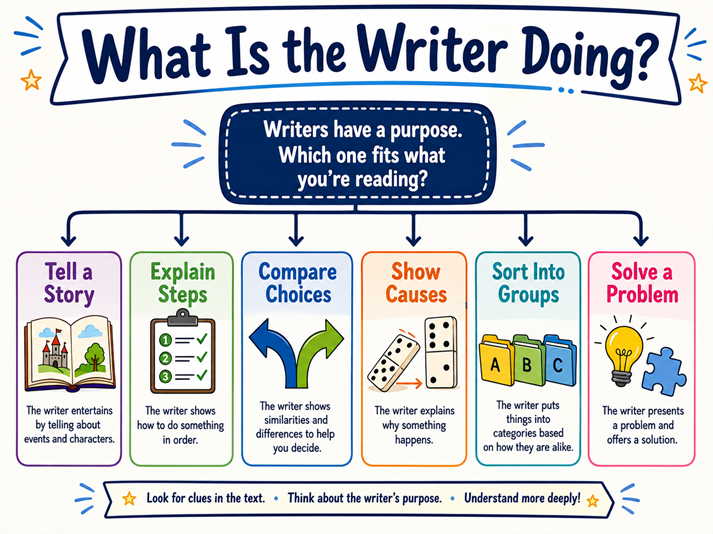
When reading, ask yourself what the writer is trying to do.
Is the writer telling a story? That is probably narration.
Is the writer helping you picture something? That is description.
Is the writer explaining a word or idea? That is definition.
Is the writer giving samples to make a point clearer? That is exemplification.
Is the writer showing steps or making something easier to understand? That is explanation or process analysis.
Is the writer sorting a topic into groups? That is classification.
Is the writer showing similarities and differences? That is comparison and contrast.
Is the writer showing reasons and results? That is cause and effect.
Is the writer identifying an issue and offering a fix? That is problem and solution.
Many writers use more than one strategy at a time, so do not panic if a paragraph seems to fit more than one category. Choose the strategy doing the most important work.
How to Use Strategies in Your Own Writing
Before choosing a strategy, think about your purpose.
If you want readers to understand an experience, narrate it.
If you want readers to see a scene clearly, describe it.
If you want readers to understand a tricky term, define it.
If you want readers to understand a broad idea, give examples.
If you want readers to follow steps, explain the process.
If you want readers to make sense of many details, classify them.
If you want readers to evaluate two or more options, compare and contrast them.
If you want readers to understand why something happened or what it caused, use cause and effect.
If you want readers to understand an issue and consider a response, use a problem and a solution.
Effective writing also requires a clear main idea, well-organized paragraphs, effective transitions, specific evidence, and a conclusion that leaves the reader with a final thought. Rhetorical strategies do not replace those writing tools. They help those tools work better.
Now that you know what these strategies do, get ready to practice identifying them in action.

Supplies


 FAVORITE
 Like
Like