Sign Up
School Account Sign Up

Lesson ID: 13625
Should federal judges serve for life? Explore the courts, debate judicial power, and create a project about justice in action.





This is not typical of other courts. However, because of the court system in the United States, the Supreme Court is able to vote on what cases they would like to hear or not.
The Constitution and the Federal Court System

Article III, Section 1 of the U.S. Constitution states:
“The judicial Power of the United States, shall be vested in one supreme Court, and in such inferior Courts as the Congress may from time to time ordain and establish.”
This means the Constitution created the Supreme Court and gave Congress the power to create lower federal courts.
Congress did exactly that with the Judiciary Act of 1789, which created a larger federal court system. Over time, this system developed into federal district courts, circuit courts of appeals, and the Supreme Court of the United States.
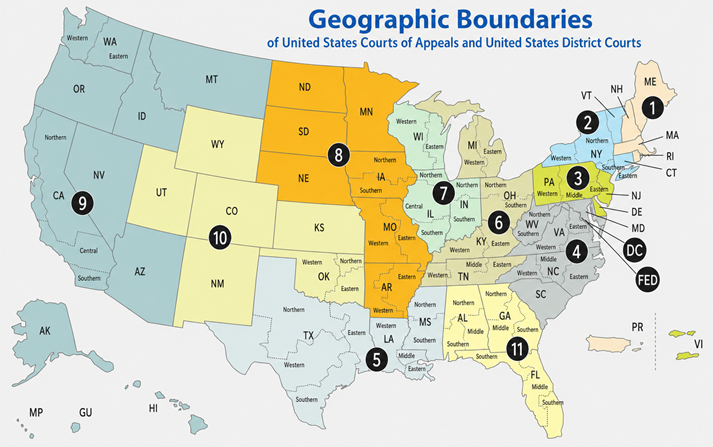
This map shows how the United States is divided into federal judicial circuits. Each numbered region represents a U.S. Court of Appeals circuit, which reviews cases from the district courts within that area.
Federal District Courts
A federal district court is usually the first federal court to hear a case. These courts hear both civil and criminal cases that involve federal law, the Constitution, or disputes between people or groups from different states.
For example, if a lawsuit involves only one state, that state’s laws usually apply. However, if people from different states are involved or the case depends on federal law, it may belong in federal court.
The case Dred Scott v. Sandford is one example of a case that moved through the federal court system. Dred Scott, an enslaved man in Missouri, sued for his freedom. Because the case involved questions about slavery, state boundaries, and federal law, it became a major federal case.
When a person loses in a district court, that person may be able to appeal.
What Is an Appeal?
An appeal is a request for a higher court to review the decision of a lower court.
An appeal does not usually mean the entire trial happens again. Instead, the higher court reviews whether the lower court made a legal mistake. For example, the appeal might argue that the lower court misunderstood the Constitution, misapplied federal law, or handled the case unfairly.
The person who appeals is asking the next court to review the decision and possibly change the outcome.
U.S. Circuit Courts of Appeals
The next level of the federal court system is the U.S. Circuit Court of Appeals.
There are 13 federal appeals courts in the United States. These courts review cases that have already been decided in district courts. They do not usually hear witnesses or consider new evidence. Instead, they focus on legal questions.
The circuit courts are important because most cases never reach the Supreme Court. For many people, the circuit court’s decision is the final decision.
One especially important appeals court is the U.S. Court of Appeals for the District of Columbia Circuit, often called the D.C. Circuit. This court hears many major cases involving the federal government, including challenges to actions by Congress, federal agencies, and government programs. Because of this, it is sometimes called the second-most-important court in the country.
Original Jurisdiction
Some courts have original jurisdiction over certain types of cases.
Original jurisdiction means a court has the authority to hear a case first, before any other court reviews it.
Federal district courts usually have original jurisdiction over many federal cases. The Supreme Court also has original jurisdiction in a few special situations, such as cases involving disputes between two or more states.

The Supreme Court of the United States
The Supreme Court of the United States, also called SCOTUS, is the highest court in the country.
If a person loses in a federal district court, that person may appeal to a circuit court. If the person loses again, that person may ask the Supreme Court to hear the case.
However, the Supreme Court hears only a small number of cases each year. Thousands of cases are appealed to the Supreme Court annually, but the Court chooses only a small portion of them.
Writ of Certiorari
When the Supreme Court is interested in reviewing a case, it may issue a writ of certiorari.
A writ of certiorari is a legal order asking a lower court to send the case records to the Supreme Court. This does not automatically mean the Court will hear the case. It means the justices want to review the case more closely.
At least four of the nine Supreme Court justices must agree to hear a case.

Why Does the Supreme Court Choose Certain Cases?
The Supreme Court does not take cases simply because one side is unhappy with the result. The Court usually chooses cases that involve major constitutional questions or important disagreements about federal law.
One common reason the Court accepts a case is to resolve a circuit split.
A circuit split occurs when different circuit courts interpret federal law or the Constitution differently. This means the same federal law may apply differently depending on where a person lives.
For example, in Obergefell v. Hodges, different circuit courts had reached different conclusions about same-sex marriage. Because federal constitutional law was applied differently across the country, the Supreme Court took the case and issued a single national ruling.
Why the Federal Court System Matters
The federal court system helps make sure federal law is applied consistently across the country.
District courts hear many cases first. Circuit courts review decisions from lower courts. The Supreme Court takes a smaller number of important cases, especially when constitutional questions or disagreements between lower courts need to be resolved.
Without this system, federal law could mean one thing in one state and something very different in another. That would make the Constitution about as useful as an umbrella in a hurricane—technically present, but not doing its job.

Supplies


 FAVORITE
 Like
Like