Sign Up
School Account Sign Up

Lesson ID: 13422
Blast off backstage! Learn how a musical goes from auditions to closing night with Space Cats.




The Curtain Is About to Rise!
The lights dim.
The audience gets quiet.
A curtain opens, music starts, and actors step onto the stage. Everything looks smooth, exciting, and almost magical.
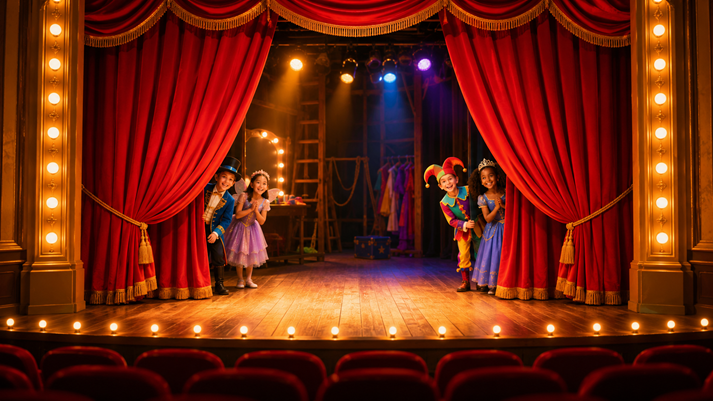
But a show does not appear by magic. Before the audience sees the first scene, many people spend weeks practicing, planning, fixing mistakes, and trying again.
Actors learn lines. Singers learn songs. Dancers learn steps. Crew members prepare lights, sounds, costumes, props, and sets.
That big opening moment is the end of a long journey.
In this lesson, you will follow a show from the first tryout to the final performance. Along the way, you will learn theater words that help actors, directors, and crew members talk about the rehearsal process.
Start Backstage
Imagine a theater group is putting on a new musical called Space Cats. It tells the story of a team of brave cats who blast off in a rocket to find the missing Moon Mouse.
Yes, it sounds silly. Theater can handle silly. Theater practically eats silly for breakfast.
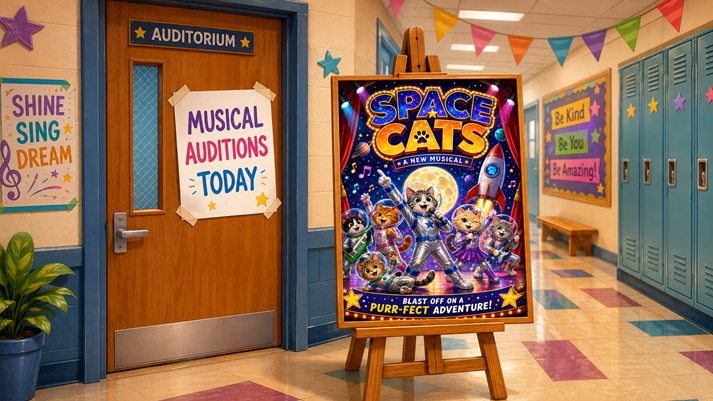
Before Space Cats can open for an audience, the show needs a cast, rehearsals, costumes, lights, music, and a lot of teamwork.
A cast is the group of actors who perform in a show. Some actors may sing. Some may dance. Some may speak lines. Some may do all three.
In a musical, actors often need to act, sing, and move safely onstage.
A crew is the group of people who help make the show happen offstage. Crew members may work with lights, sound, costumes, props, scenery, or backstage changes.
The audience may not always see the crew, but the show depends on them.
Now, follow the steps that take a show from an idea to opening night.
Step 1: Auditions
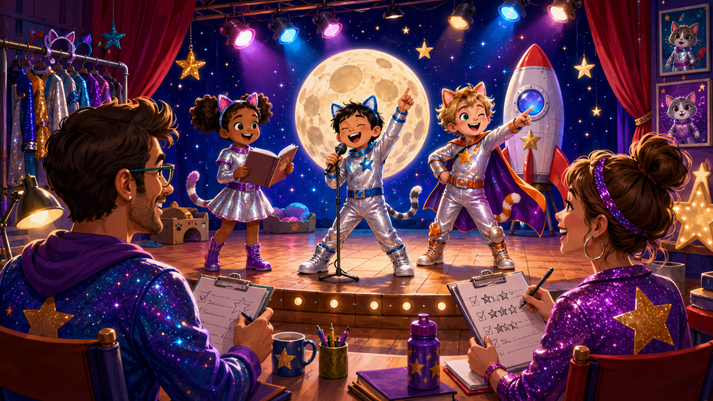
Auditions are tryouts for a show.
During an audition, actors show what they can do. They may read part of a script, sing part of a song, dance a short routine, or act out a scene.
The director watches carefully to see which role may fit each actor.
The director is the person who leads the creative work of the show. The director helps decide how scenes should look, how actors should say their lines, where actors should move, and how the whole story should feel.
Some shows also have a casting director. A casting director helps find actors who may be right for each role.
In Space Cats, one actor auditions by reading lines for Captain Whiskers. Another sings a song for the Moon Mouse. Another shows a funny robot dance for the role of Robo-Kitten.
The goal of auditions is not just to find the “best” performer. The goal is to find people who fit the roles and can work well together.
Step 2: Casting
Casting means choosing the actors for each role.
After auditions, the director and other leaders decide who will play each part. Once the roles are chosen, the cast list is shared.
In Space Cats, one actor becomes Captain Whiskers. Another becomes the Moon Mouse. Several actors become space kittens, stars, planets, and dancing asteroids.
Not every role is the same size, but every role matters. A show works best when the whole cast and crew support the story.
Step 3: Read-Through
A read-through is usually one of the first rehearsals.
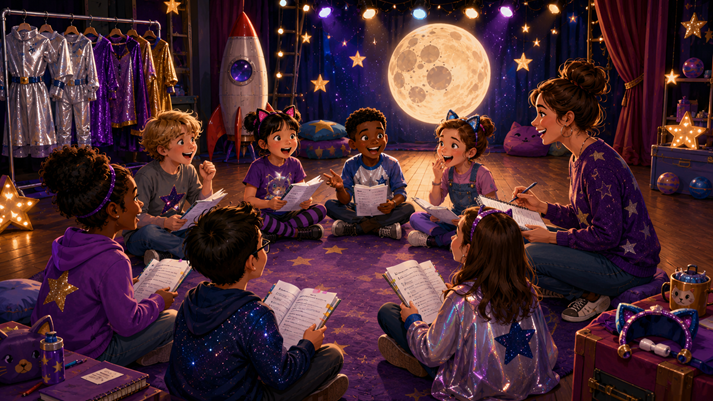
During a read-through, the cast sits together and reads the script out loud. This helps everyone hear the story from beginning to end.
Actors learn when their characters speak, enter, exit, sing, or react.
A script is the written version of a play or musical. It includes the words the actors say. It may also include stage directions, which tell actors when to enter, exit, move, or do something important.
During the Space Cats read-through, the actor playing Captain Whiskers reads, “Prepare the tuna rockets!”
The Moon Mouse actor squeaks, “Not without my cheese helmet!” Everyone gets a first feel for the story.
The read-through helps the cast understand the show before they add music, movement, costumes, or lights.
Step 4: Music Rehearsal
Music rehearsal is time spent learning the songs in a show.
A music director teaches the cast how to sing the songs. The music director may help actors learn the notes, rhythm, words, and feeling of each song.
In a musical, songs help tell the story. A song may show how a character feels, move the plot forward, or make an important moment bigger.
In Space Cats, the cast learns a song called “Zoom to the Moon.” At first, some singers come in too early. Some forget the words. Some sing too softly. That is normal.
Rehearsal is where mistakes get fixed.
By the end of music rehearsal, the cast should know the songs well enough to sing with confidence.

Step 5: Choreography
Choreography means the planned dance steps or movements in a show.
A choreographer creates and teaches the movement. Some choreography looks like a full dance. Other choreography may be simple, such as marching, turning, clapping, or moving as a group.
Actors practice choreography many times so they can move safely and stay together. This matters because stages can be busy places. Actors may need to dance near props, scenery, lights, or other performers.
In Space Cats, the space kittens learn a low-gravity dance. They step, spin, freeze, and pretend to float. The dancing asteroids roll across the stage in a careful pattern so they do not crash into Captain Whiskers.
Choreography helps the show look exciting and organized.
Step 6: Staging
Staging means planning where actors move and stand during scenes.
Staging helps the audience know where to look. It also helps actors stay safe and tell the story clearly.
An actor may cross the stage, sit on a bench, hide behind a door, enter from one side, or stand near another character.
Blocking is another word often used for planned stage movement. If a director says, “Cross to the table,” that instruction becomes part of the actor’s blocking.
In Space Cats, Captain Whiskers stands at the front of the stage during the big launch speech. The Moon Mouse hides behind a moon rock. Robo-Kitten enters from the side and bumps into a pretend control panel.
Good staging keeps the scene clear. Without staging, actors might wander around like confused penguins in a grocery store.
Step 7: Rehearsal
A rehearsal is a practice for a show.
During rehearsal, the cast and crew repeat scenes, songs, dances, and movements until they improve. Rehearsal helps everyone remember what to say, where to stand, when to move, and how to work together.
Rehearsals can focus on different parts of the show. One rehearsal may focus on music. Another may focus on choreography. Another may focus on one tricky scene.
In Space Cats, the cast practices the rocket launch scene again and again. At first, the song starts too soon. Then one actor forgets to enter. Then a moon rock lands in the wrong spot. Each mistake shows the team what to fix.
That is the point of rehearsal. You practice, notice problems, solve them, and try again.

Step 8: Technical Rehearsal
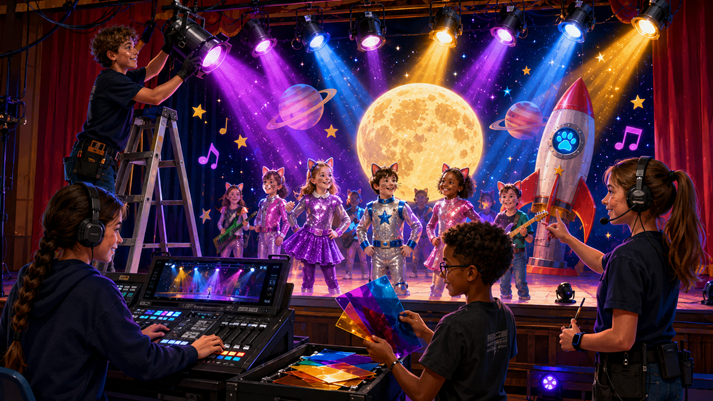
Technical rehearsal, often called tech rehearsal, is when the technical parts of the show join the acting.
This may include lights, sound effects, microphones, music cues, scenery, props, costumes, and backstage movement. A cue is a signal for something to happen.
For example, a light cue tells the lighting crew when to change the lights. A sound cue tells the sound crew when to play a sound effect.
Tech rehearsal can take time because many pieces must work together. Actors need to speak, sing, dance, and move while the crew changes lights, plays sounds, moves set pieces, and handles props.
In Space Cats, tech rehearsal adds blinking stars, rocket sounds, glowing moonlight, and a puff of stage fog when the rocket launches.
The first try may not work perfectly. Maybe the rocket sound comes too early. Maybe the lights change too late. Maybe the fog machine gets a little too excited and turns the moon into soup.
That is why tech rehearsal matters. It gives the cast and crew time to practice the whole show with all its parts.
Step 9: Dress Rehearsal
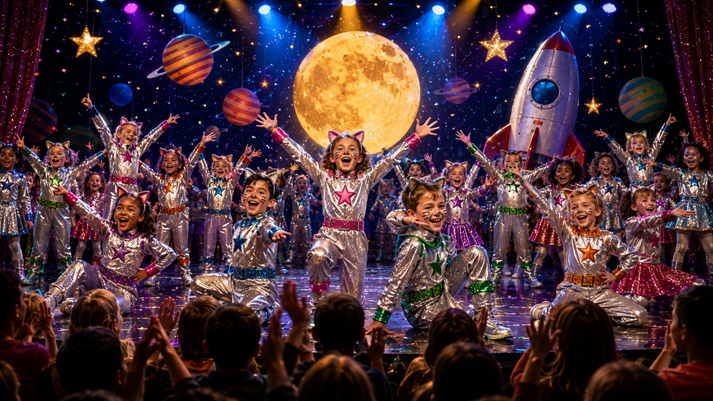
A dress rehearsal is a practice session in which the cast wears costumes and uses many or all of the show's pieces.
Dress rehearsal helps actors get used to costumes, props, lights, sounds, and scene changes. A costume may change how an actor moves. A hat might fall off. A long cape might drag. A giant cat tail might knock over a moon rock.
Better to find that out before opening night.
In Space Cats, the actors wear space-cat helmets, shiny jackets, moon boots, and asteroid costumes. They practice moving, dancing, and speaking while dressed like their characters.
A dress rehearsal helps the show feel closer to a real performance.
Step 10: Opening Night
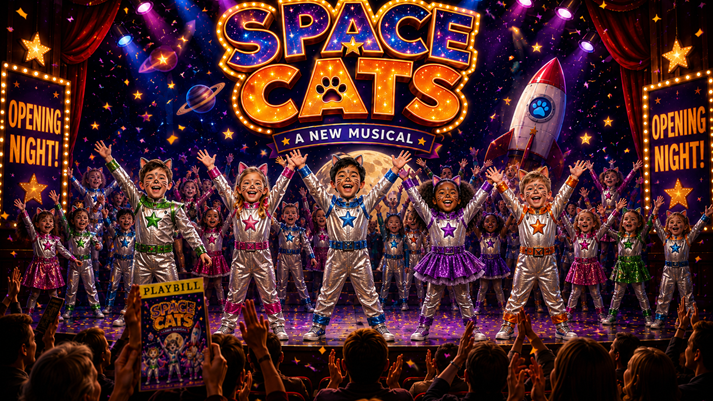
Opening night is the first performance for an audience.
This is the moment when the cast and crew finally share the show. The audience laughs, claps, listens, and reacts. That energy can make the show feel new and exciting.
In Space Cats, opening night begins with glowing lights, rocket sounds, and Captain Whiskers shouting, “Crew, prepare for paws-off!”
Opening night can feel thrilling, but it can also feel nervous. That is normal. Rehearsal helps performers and crew members feel ready.
Step 11: Performances
A performance is when the show is presented to an audience.
Some shows have one performance. Other shows run for days, weeks, months, or even years. During each performance, the cast and crew try to tell the story clearly and safely.
Even after opening night, performers keep paying attention. They listen, react, and stay focused. Crew members keep watching for cues. Everyone works together each time the curtain rises.
Step 12: Closing Night
Closing night is the final performance of a show.
After closing night, the show ends. Costumes, props, and scenery may be cleaned, stored, returned, or taken apart. The cast and crew may feel proud, tired, happy, sad, or all of those at once.
In Space Cats, closing night ends with one final bow. Captain Whiskers salutes the audience. The Moon Mouse waves a cheese helmet. Robo-Kitten probably does one last robot dance, because of course Robo-Kitten does.
Closing night reminds everyone that theater is live. Each show happens in the moment, and each performance is a little different.
The Big Rehearsal Timeline
Here is the usual path from tryouts to the final show.
Auditions: Actors try out for roles.
Casting: The director chooses actors for each role.
Read-through: The cast reads the script out loud together.
Music rehearsal: The cast learns the songs.
Choreography: The cast learns the dances and planned movement.
Staging: The cast learns where to move and stand during scenes.
Rehearsal: The cast and crew practice scenes, songs, movement, and timing.
Technical rehearsal: Lights, sound, props, scenery, and other technical pieces join the show.
Dress rehearsal: The cast practices in costume, with many or all of the show pieces.
Opening night: The show's first performance to an audience.
Performances: The cast and crew present the show to audiences.
Closing night: The show has its final performance.
Why These Words Matter
Theater uses special words because many people need to work together quickly and clearly.
If someone says, “Start at the choreography before the second song,” the cast needs to know what that means.
If the director says, “Take your place for the opening night scene,” actors need to know where to go.
If the stage manager calls a light cue during tech rehearsal, the crew needs to be ready.
A stage manager helps organize rehearsals and performances. During a show, the stage manager often helps keep everything on track. This person may call cues, help solve problems, and make sure the cast and crew know what comes next.
Theater is a team activity. Actors, directors, designers, crew members, stage managers, and many others work together to bring one story to life.
Now you know the main steps that help a show move from auditions to closing night. Next, you will practice matching these theater terms to their meanings and putting the rehearsal process in order.

Supplies
Additional Resources



 FAVORITE
 Like
Like