Sign Up
School Account Sign Up

Lesson ID: 13220
Did you know that millions of people get the common cold every year? It's true! The common cold is very common. Learn all about colds and what causes them.




Imagine your throat is sore, and your nose is runny and stuffy. You start to sneeze. Uh oh! You're probably coming down with a cold!
Let's learn about the common cold and what causes it.
Colds are very common, which means they happen a lot! In fact, according to the CDC (Center for Disease Control and Prevention), there are millions of cases of the cold each year! Wow!
A cold is an illness or sickness. You will know you have a cold because you develop something called symptoms. Symptoms are like hints or clues that tell us something isn't quite right with our bodies.
Some symptoms of the common cold are:
Why do these symptoms happen?
Colds and the flu are caused by viruses. Viruses are extremely tiny—so small that they can’t be seen without special tools. Even though they are tiny, they can still make a big impact on your body.
These viruses enter your body through your nose, mouth, or eyes. Once inside, they begin making copies of themselves very quickly. That’s when your body steps in to fight back.

Your body has several ways to defend itself.
Even though these symptoms can feel uncomfortable, they are actually signs that your body is working hard to protect you.
To help your body recover, it’s important to:
You can also help prevent getting sick by:
Colds are caused by viruses. Viruses are very small particles that invade the body and attack healthy cells.
A helpful way to think about a virus is to compare it to a computer virus. A computer virus sneaks into a computer and keeps making copies of itself, causing problems. A virus in your body does something similar—it spreads and makes it harder for your body to work properly.
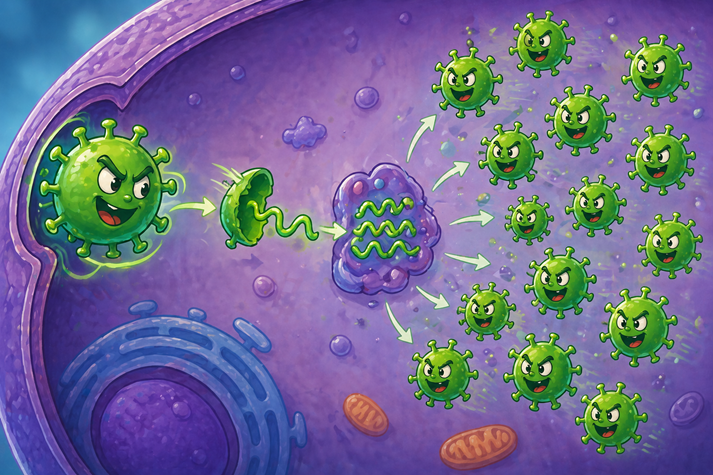
When a virus enters your body:
This is how you start to feel sick.
Luckily, your immune system is ready to fight back. The immune system is like a tiny army inside your body.
It uses white blood cells to:
Sometimes your body raises its temperature (fever) to help kill the virus. Other times, it creates antibodies that remember the virus so your body can fight it faster in the future.
Fortunately, the immune system is very effective. Most colds last about 7 to 10 days before your body clears the virus.
You might be wondering what you can do to avoid getting or spreading a cold.

One of the best ways is to practice good hygiene:
Small habits like these make a big difference in keeping you—and others—healthy.
Nice work in the Get It! section. Now, move on to the Got It? section to see what you learned.

Supplies


 FAVORITE
 Like
Like