Sign Up
School Account Sign Up

Lesson ID: 12880
Learn how to write strong body paragraphs that prove your ideas and make your writing clear and convincing.




The Part Where Your Essay Actually Proves Something
Imagine reading an essay that says, “This story shows that friendship is important”… and then never explains why.
No examples. No details. Just… vibes.

That’s what happens when body paragraphs are weak.
Your introduction tells your idea. Your conclusion wraps it up.
But your body paragraphs? That’s where you prove your point.
This is where your writing either works… or falls apart.
What Is a Body Paragraph, Really?
A body paragraph is one complete piece of your argument.
Each paragraph focuses on one supporting idea and answers this question:
A strong body paragraph includes four key parts.
If one part is missing, your paragraph feels incomplete.
Step 1: Start Strong with a Topic Sentence
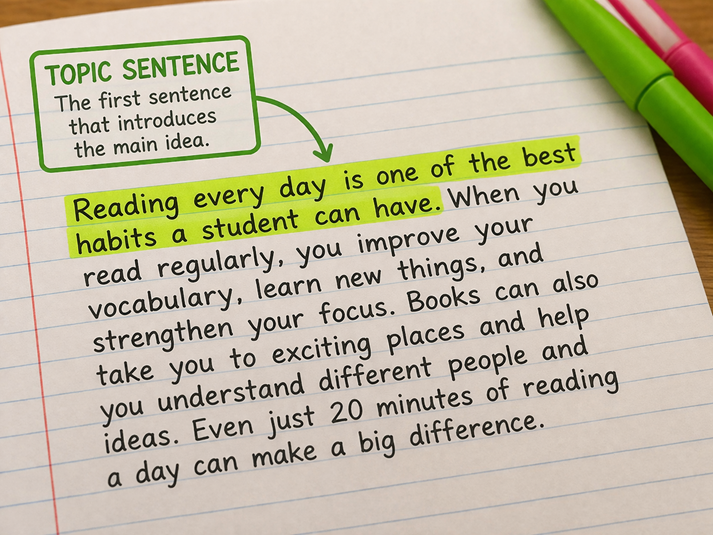
Your topic sentence is the first sentence of your paragraph. It tells the reader what this paragraph will prove.
It should:
Example:
Claim: The story shows that teamwork leads to success.
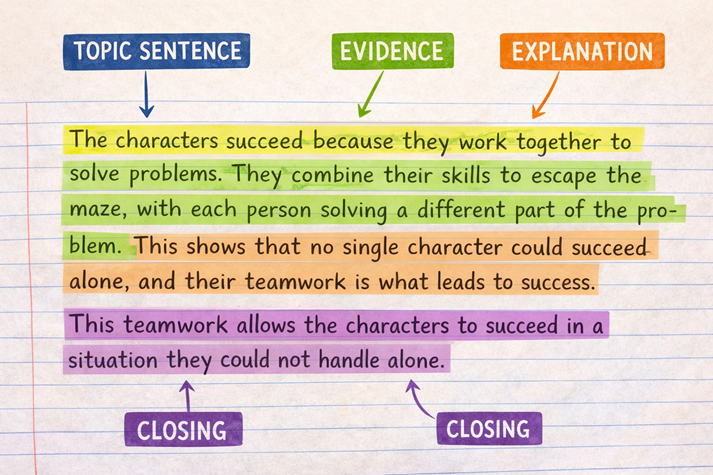
Topic Sentence: The characters succeed because they work together to solve problems.
This works because it clearly connects to the claim and sets up the paragraph.
Step 2: Add Evidence That Actually Matters
Evidence is what proves your idea.
This can include:
Example:
Weak evidence: The characters did things together.
Strong evidence: The characters combine their skills to escape the maze, with each person solving a different part of the problem.
Strong evidence is specific and connected to your idea.
Step 3: Explain Your Evidence (This Is the Game-Changer)
This is where many writers struggle.
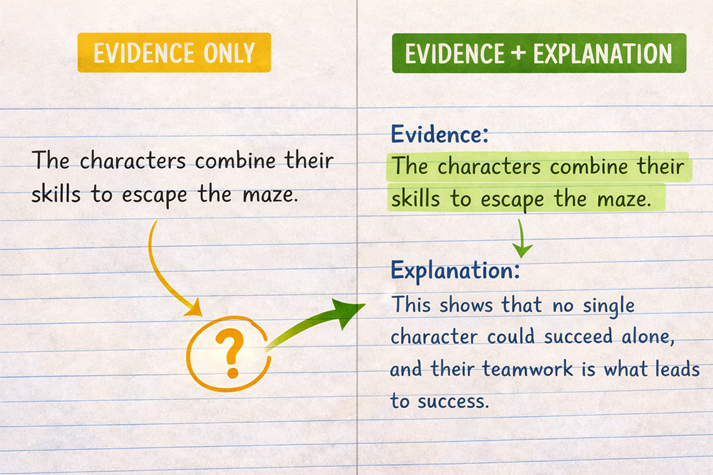
Don’t just drop in evidence and move on. Explain it.
Ask yourself:
Example:
Evidence: The characters combine their skills to escape the maze.
Explanation: This shows that no single character could succeed alone, and their teamwork is what leads to success.
Without explanation, your reader is left guessing.
With explanation, your argument becomes clear and convincing.
Step 4: Stay Focused
Each body paragraph should focus on one idea only.
Watch out for:
If your paragraph starts talking about something new, that probably belongs in a new paragraph.
Think of each paragraph as one clear step in your argument.
Step 5: Use Transitions to Keep Things Smooth
Transitions help your writing flow from one idea to the next.
Examples:
You can also use transitions within a paragraph to connect ideas.
Good transitions make your writing easier to follow.
Step 6: End with a Strong Closing Sentence
Your closing sentence wraps up the paragraph and connects back to your main idea.
It should:
Example:
This teamwork allows the characters to succeed in a situation they could not handle alone.
Now your paragraph feels complete.
The Big Picture: One Paragraph = One Clear Proof
A strong body paragraph:
Do this well, and your essay becomes clear, logical, and convincing.
Skip these steps, and your writing starts to feel confusing or unfinished.
You now know how to build a paragraph that actually proves something.
Next, it’s time to practice breaking down and building body paragraphs so your writing holds up under pressure.

Supplies
Additional Resources



 FAVORITE
 Like
Like