Sign Up
School Account Sign Up

Lesson ID: 12500
What happens when atoms fall apart? Discover how radioactive decay transforms matter and powers real-world technologies.




From Power Plants to PET Scans
They rely on the invisible power of radioactive decay. In fact, much of our modern world is powered, protected, or monitored by the energy released from the nuclei of unstable atoms.
But that same energy—if uncontrolled—can melt reactors, harm living cells, or leave behind toxic waste for thousands of years.
Explore what radioactive decay really means—and why it’s one of the most powerful and controversial forces in science.
What Is Radioactive Decay?
Radioactive decay is a natural process in which unstable atomic nuclei release energy and particles to become more stable. This release is what we call radiation.
The atom that decays is called the parent nucleus, and the result is a daughter nucleus, which is often a different element or isotope.

Why Are Some Atoms Unstable?
Atoms are made of protons, neutrons, and electrons. The protons and neutrons live in the nucleus at the center.
A stable nucleus has the right balance of protons to neutrons. But when this balance is off—especially in large atoms with more than 83 protons—the nucleus becomes unstable and starts to break down.
This process happens spontaneously. Nothing causes it. It just happens.
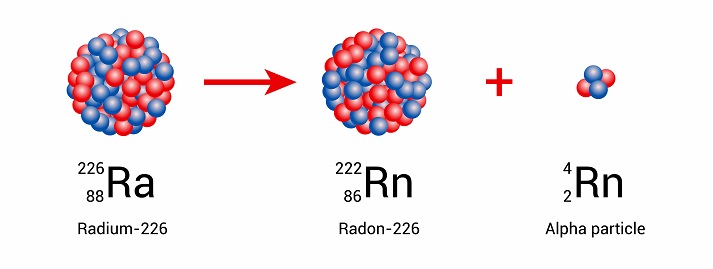
The Three Types of Radioactive Decay
When an unstable nucleus decays, it releases one of three types of radiation.
Alpha Decay (α)
The nucleus emits an alpha particle—2 protons and 2 neutrons (just like a helium nucleus).
This causes the atomic number to drop by 2 and the mass number by 4.
Example: Uranium-238 → Thorium-234 + Alpha Particle
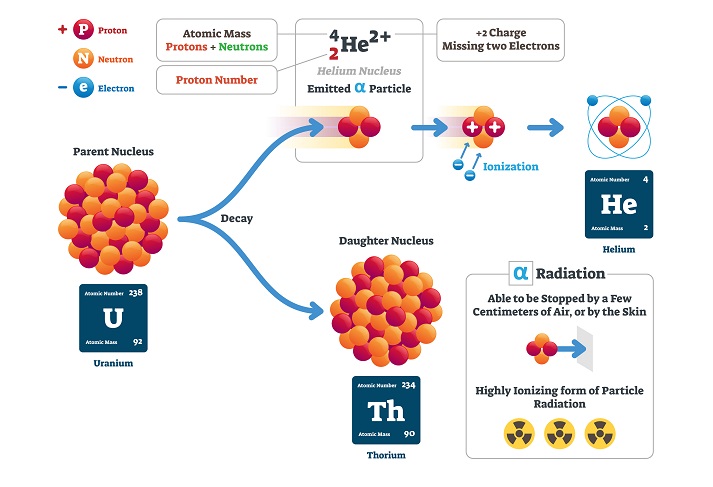
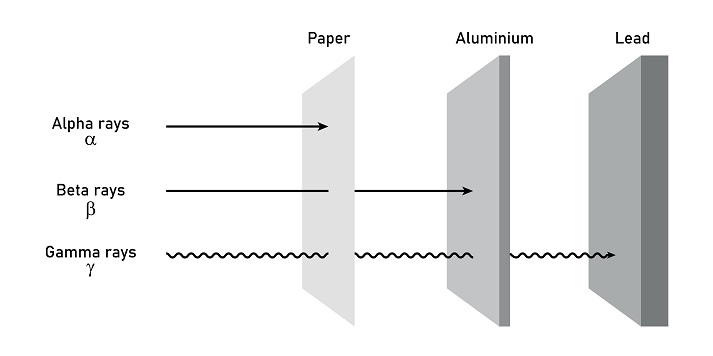
Blocked by: Paper, clothing, skin
Ionizing Power: Very high
Penetration Power: Very low
Beta Decay (β)
A beta particle is a high-speed electron emitted when a neutron turns into a proton.
This increases the atomic number by 1 but doesn’t change the mass number.
Example: Iodine-131 → Xenon-131 + Beta Particle
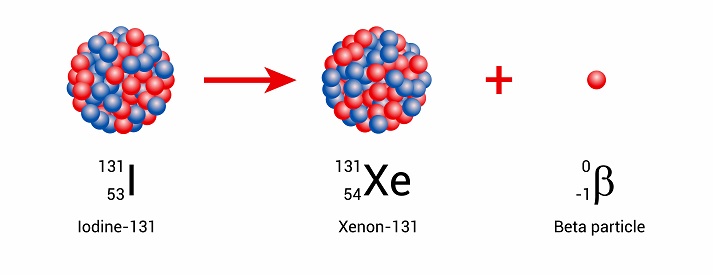
Blocked by: Thin metal (like aluminum)
Ionizing Power: Medium
Penetration Power: Medium
Gamma Decay (γ)
A gamma ray is pure energy with no mass and no charge.
It is often released alongside alpha or beta decay.
It does not alter the element, but rather releases energy.
Blocked by: Thick lead or concrete
Ionizing Power: Low
Penetration Power: Very high
The Half-Life: Timing the Breakdown
Each radioactive isotope has a half-life—the amount of time it takes for half of a sample to decay. This measurement helps scientists understand how quickly or slowly radioactive materials change over time.
Some isotopes decay in seconds, while others take thousands—or what some scientists interpret as millions or even billions—of years. Here are some examples.
Carbon-14: Half-life of about 5,730 years (often used in dating once-living materials)
Uranium-238: Commonly assigned a half-life of 4.5 billion years in scientific models
Radium-226: Half-life of about 1,600 years
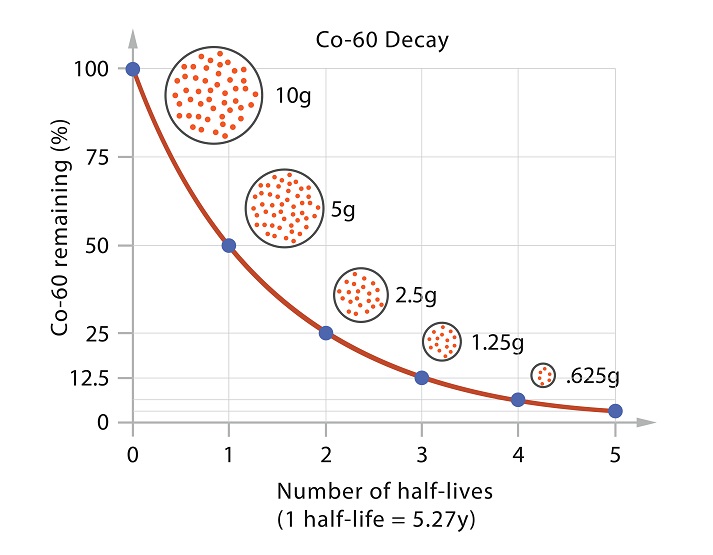
Regardless of your view of the earth’s age, the concept of half-life is essential for predicting how long a radioactive substance remains active and for applying that information in medicine, industry, and environmental science.
Real-World Effects of Radioactive Decay
Benefits
Medical Imaging & Cancer Treatment: Radioactive isotopes like iodine-131, technetium-99m, and samarium-153 help doctors diagnose and treat diseases with pinpoint accuracy
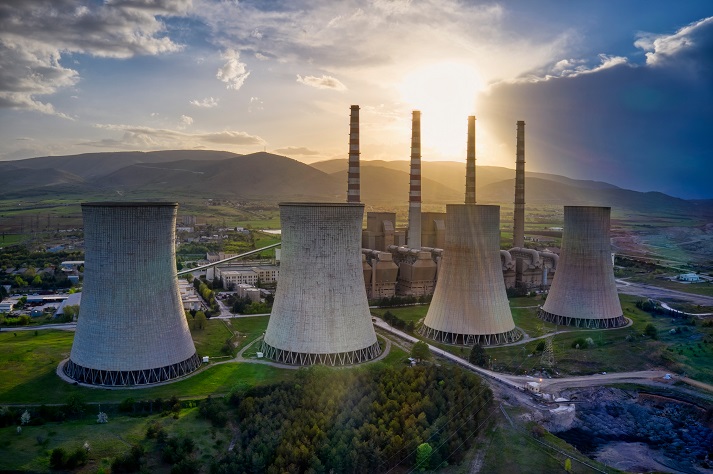
Power Generation: Nuclear reactors use uranium to generate clean electricity with no greenhouse gas emissions.
Scientific Research: Carbon dating allows archaeologists to accurately date ancient artifacts and fossils.
Food & Equipment Sterilization: Gamma rays from cobalt-60 are used to kill bacteria on food and medical tools.
Industrial Use: Radioisotopes detect leaks, test welds, and measure material thickness.
Risks
Health Hazards: Exposure to ionizing radiation can damage DNA and lead to cancer or radiation sickness.
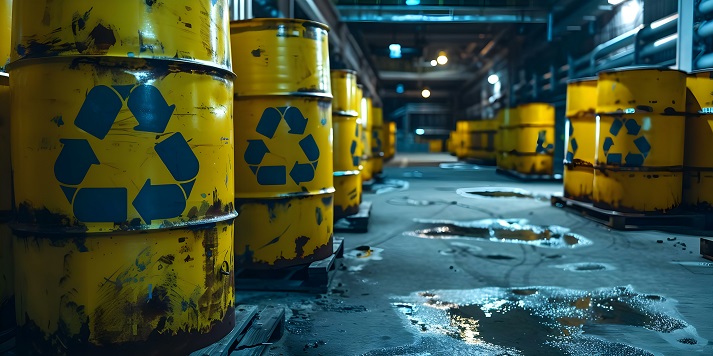
Radioactive Waste: Some waste stays radioactive for thousands of years and must be stored securely.
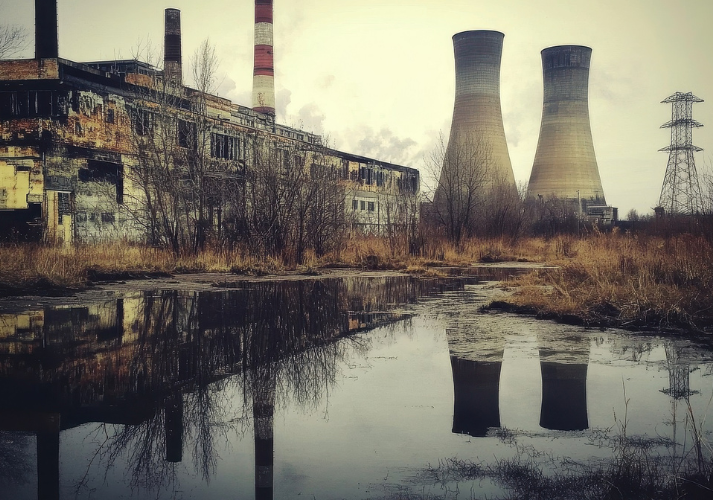
Nuclear Accidents: Events like Chernobyl and Fukushima released radioactive materials into the environment, causing long-term damage.
Nuclear Weapons: The same process that powers a reactor can also power a bomb.
Radioactive decay has transformed medicine, industry, and science, but it has also created dangers that require strict safety and regulation.
Now that you understand how radioactive decay works and why it matters, put your knowledge to the test with some hands-on thinking and challenges in the Got It? section.

Supplies
Additional Resources


 FAVORITE
 Like
Like