Sign Up
School Account Sign Up

Lesson ID: 11303
Measure the outside of shapes, solve perimeter puzzles, and design real-world spaces like parks and fenced yards!




If you walked all the way around the outside, you were finding the perimeter!
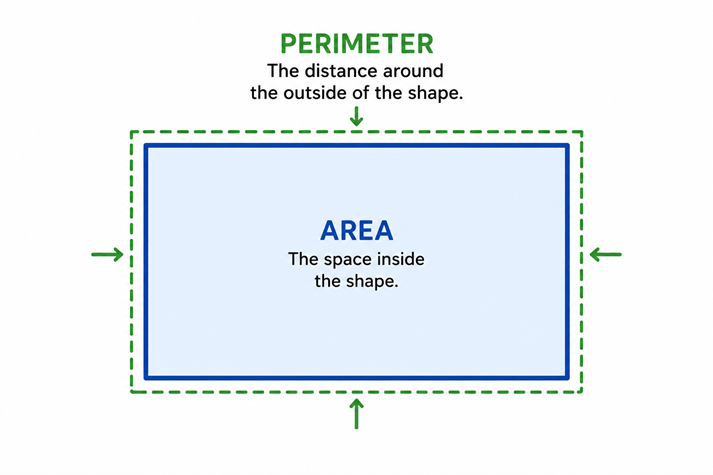
Perimeter is the distance around the outside of a shape. You can think of it as the border or edge of a shape.
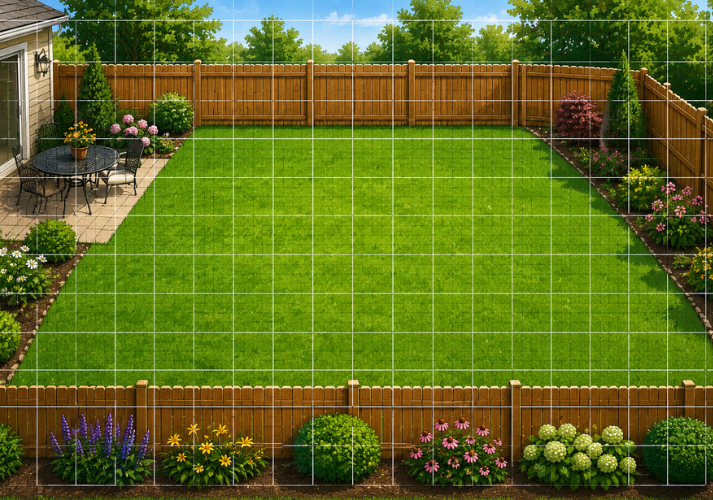
Imagine a big wind knocks down the fence around a yard.
You would need to measure the perimeter of the yard!

In this lesson, you will learn:
You only need to remember one big idea:
To find the perimeter, add all the side lengths together.
Polygons and Non-Polygons
Before learning more about perimeter, it helps to know about polygons.
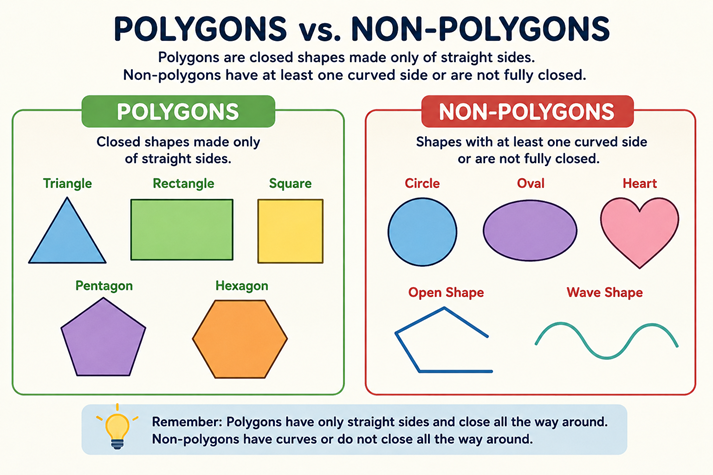
A polygon is a closed shape made only of straight sides.
Examples of polygons:
A non-polygon has at least one curved side or is not fully closed.
Examples of non-polygons:
This lesson focuses only on polygons because their straight sides make perimeter easy to measure.
What Does Perimeter Mean?
Perimeter is a measurement of length. That means perimeter must always include units.
For example:
Writing only “12” is not enough. You must include the unit.
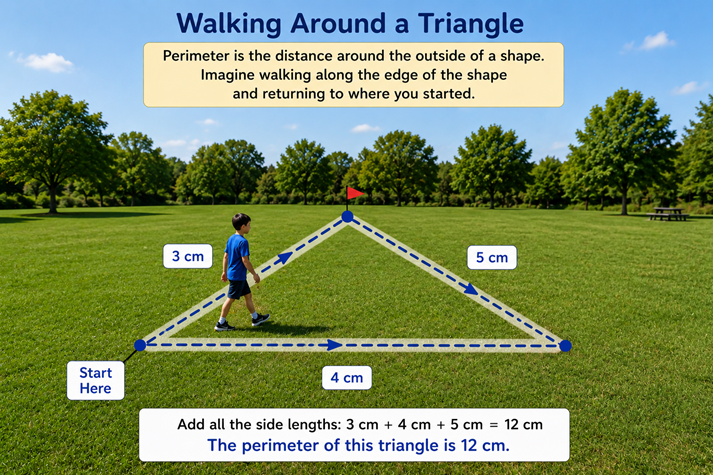
One way to picture perimeter is to imagine walking along the edge of a shape until you return to your starting point. The total distance you travel is the perimeter.
Finding the Perimeter of a Triangle
Look at this triangle:
Add the side lengths:
3 + 4 + 5 = 12
The perimeter is 12 cm.
Finding the Perimeter of a Rectangle
Rectangles have two long sides and two short sides.
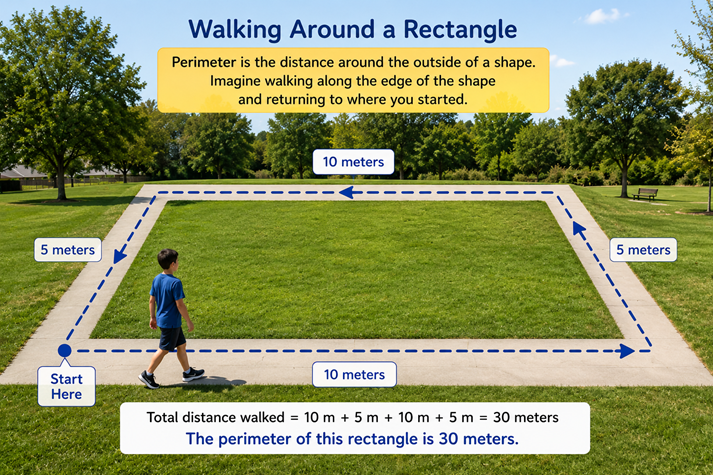
Example:
Add all four sides:
10 + 5 + 10 + 5 = 30
The perimeter is 30 m.
There is also a rectangle perimeter formula:
P = 2L + 2W
This formula means:
You may use the formula or simply add all the sides together. Both methods work.
Finding the Perimeter of Regular Polygons
A regular polygon has sides that are all the same length.
For example, a regular hexagon has:
Instead of adding 4 six times, multiply:
6 × 4 = 24
The perimeter is 24 cm.
You can use this shortcut for any regular polygon:
number of sides × side length = perimeter
Finding Perimeter on a Grid
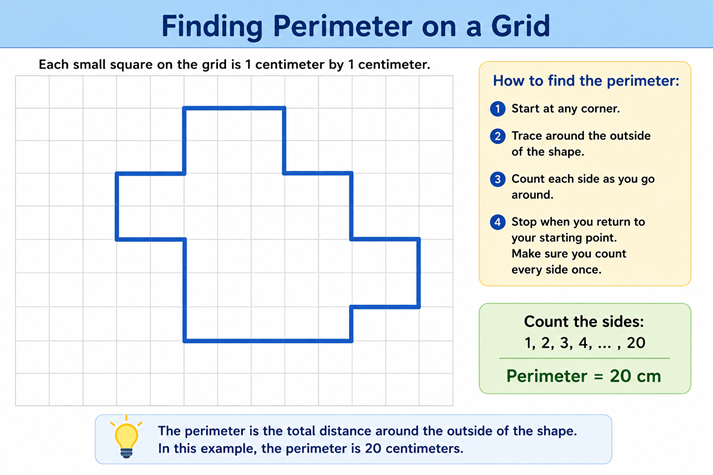
Sometimes shapes appear on square grids.
If each side of a square equals 1 centimeter, count the outside edges carefully. Only count each edge once.
A good strategy:
This helps you avoid missing sides or counting sides twice.
Finding Missing Side Lengths
Sometimes a problem gives the perimeter but leaves out a side length.
For example, a rectangle has:
Use the rectangle formula:
P = 2L + 2W
Substitute the numbers:
20 = 2(4) + 2W
Multiply:
20 = 8 + 2W
Subtract 8:
12 = 2W
Divide by 2:
W = 6
The missing width is 6 cm.
You can also solve some missing-side problems by thinking carefully about matching sides in rectangles. Opposite sides of a rectangle are always equal in length.
Common Mistakes to Avoid
Remember:
Perimeter measures the OUTSIDE of a shape.
Area measures the INSIDE of a shape.
Quick Check
Answer these questions out loud.

Nice work! Now that you know how perimeter works, you are ready to practice finding the perimeter of different shapes in real-life situations.

Supplies
Additional Resources


 FAVORITE
 Like
Like