Sign Up
School Account Sign Up

Lesson ID: 11243
Figure out when numbers stay between or go beyond using compound inequalities.




Stuck in the Middle… or Way Outside?
You’re setting a rule for your phone screen time.
You want to spend more than 1 hour but less than 3 hours a day.
That means:
Too little? Not allowed.
Too much? Also not allowed.
So what does work?
Only the values in between.
Now imagine a different rule.
You want less than 1 hour OR more than 5 hours.
Now you’re not in the middle—you’re on the outside.
Welcome to compound inequalities, where you’re solving more than one rule at the same time.

What Is a Compound Inequality?
A compound inequality combines two inequalities into one statement.
Instead of solving one rule, you’re solving two at once.
There are two types.
“And” statements
“Or” statements
Each one works differently, so knowing which one you’re dealing with is key
“And” Inequalities: Stay Between
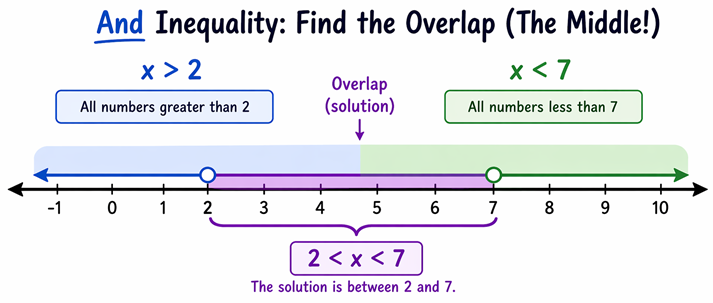
An “and” inequality means:
Both conditions must be true at the same time.
Example:
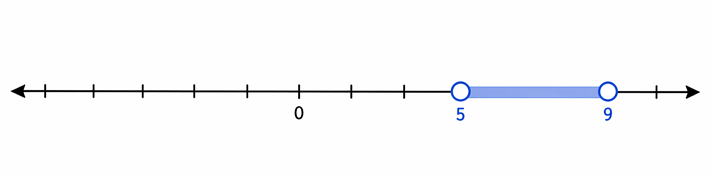
x > 5 and x < 9
This means:
x must be greater than 5 AND less than 9
So the solution is everything between 5 and 9.
You can write it as:
5 < x < 9
Visualizing “And”
Think of it like a safe zone.
Only the overlap counts.
If the two parts don’t overlap, there is no solution
Example:
x > 3 and x < 1
There are no numbers that can do both.
So:
No solution
Solving “And” Inequalities (Two Ways)
Method 1: Split and Solve
Example:
4 < x + 2 < 10
Split it.
4 < x + 2 and x + 2 < 10
Solve each part.
4 < x + 2 ? 2 < x
x + 2 < 10 ? x < 8
Combine:
2 < x < 8
Method 2: Solve All Three Parts Together
Instead of splitting, you can do the same step to all three parts.
Example:
-6 < 2x + 4 < 10
Step 1: Subtract 4 from all parts.
-10 < 2x < 6
Step 2: Divide all parts by 2.
-5 < x < 3
Same answer—faster method.
Watch Out: Negatives Change Things
If you multiply or divide all parts by a negative number:
Flip both inequality signs.
Or switch the outside numbers to keep the order correct.
Example:
-8 < -2x < 6
Divide all parts by -2.
4 > x > -3
Rewrite.
-3 < x < 4
“Or” Inequalities: Go Beyond
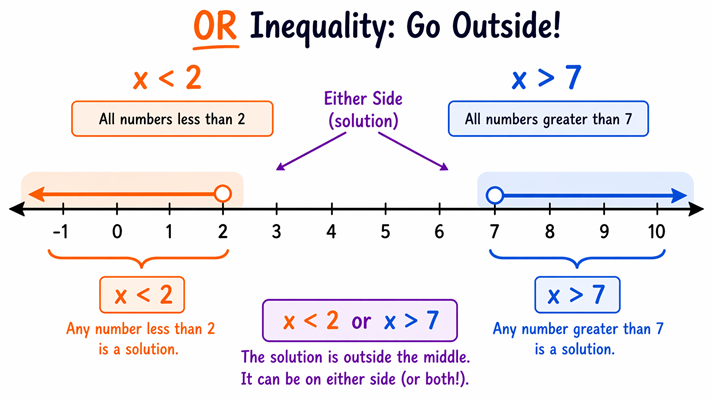
An “or” inequality means:
Only one condition needs to be true.
Example:
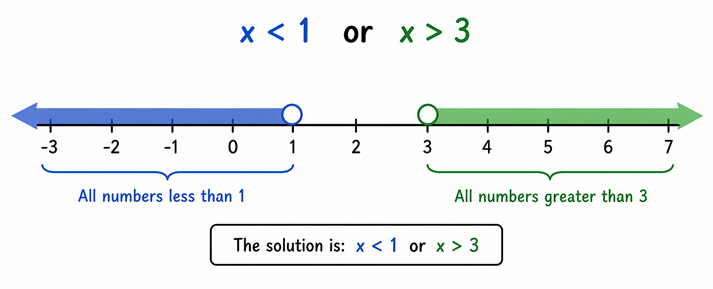
x < 2 or x > 6
This means:
Values less than 2 work.
Values greater than 6 work.
You’re outside the middle.
Visualizing “Or”
Instead of overlap, you get two separate regions.
Solving “Or” Inequalities
Example:
x - 3 > 5 or x - 3 < -2
Solve each side.
x > 8
x < 1
Final answer:
x > 8 or x < 1
You do NOT combine these into one statement.
Quick Comparison
“And” = Between (overlap)
“Or” = Outside (either side)
What You Can Do Now
You can:
Tell the difference between “and” and “or."
Solve compound inequalities step by step.
Recognize when solutions overlap—or don’t.
Write answers in combined form or separate parts.
Get Ready to Practice
Now it’s your turn to decide—are you staying in the middle or heading beyond?

Supplies
Additional Resources



 FAVORITE
 Like
Like