Sign Up
School Account Sign Up

Lesson ID: 11241
Solve multi-step inequalities by breaking them down and tackling each step like a pro.




Start Here: More Than One Step… Now What?
You’re saving money for something that costs more than $80.
You already have $25, and you earn $5 each time you do a chore.
That’s not a one-step problem anymore. You have to:
Add
Multiply
Compare
Welcome to multi-step inequalities.

One Step at a Time (Seriously)
Multi-step inequalities might look complicated, but they follow the same idea as one-step inequalities.
The goal stays the same: Get the variable by itself.
You just have more than one step to get there.
Think of it like untangling a knot. You don’t yank everything at once—you loosen it piece by piece.

The Game Plan
Follow this order every time.
Simplify both sides (combine like terms, distribute if needed).
Move constants away from the variable.
Move coefficients (multiply/divide).
Flip the sign if you multiply or divide by a negative.
That’s it. Same rules—just more steps.
Example 1: Break It Down
Solve.
4x + 5 > 13
Step 1: Subtract 5.
4x > 8
Step 2: Divide by 4.
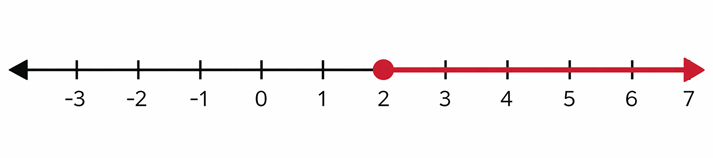
x > 2
Now interpret it.
x can be 2 or any number greater than 2.
Graph it.
Closed circle at 2.
Shade to the right.
Example 2: Watch for the Flip
Solve.
-2x - 3 < 5
Step 1: Add 3.
-2x < 8
Step 2: Divide by -2.
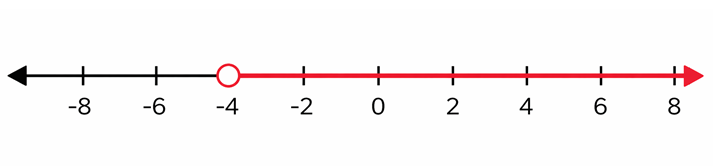
x > -4
Notice what happened.
The sign flipped.
Graph it.
Open circle at -4.
Shade to the right.
Example 3: Distribute First
Solve.
-3(x + 4) > 3
Step 1: Distribute.
-3x - 12 > 3
Step 2: Add 12.
-3x > 15
Step 3: Divide by -3.
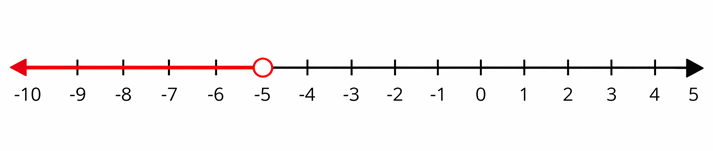
x < -5
Graph it.
Open circle at -5.
Shade to the left.
Example 4: Combine Like Terms
Solve.
x + 8 - 4x > 20
Step 1: Combine like terms.
-3x + 8 > 20
Step 2: Subtract 8.
-3x > 12
Step 3: Divide by -3.
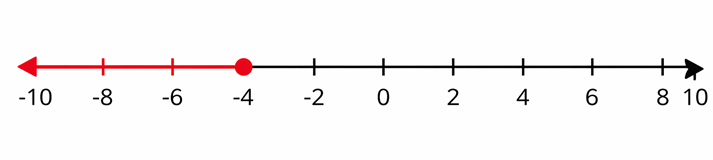
x < -4
Graph it.
Closed circle at -4.
Shade to the left.
Read the Graph Like a Pro
Take a look at this graph.
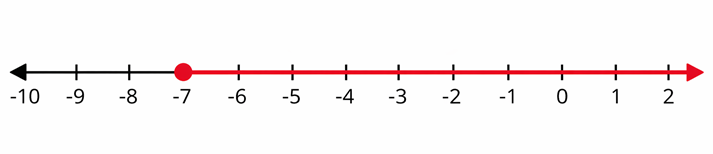
This means: x > -7
Now this one.
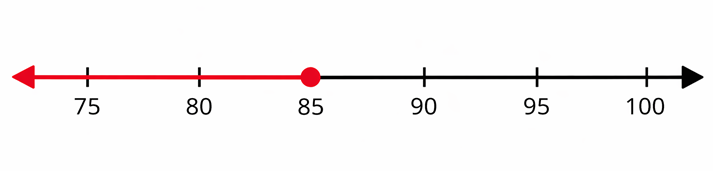
This means: x < 85
Graphs are just another way to show your solution.
Real-World Example
A student tracks time spent on homework.
They have already worked 20 minutes and want the total time to be at least 60 minutes.
Set up the inequality.
20 + 10x > 60
Solve it.
Step 1: Subtract 20.
10x > 40
Step 2: Divide by 10.
x > 4
That means at least 4 more study sessions are needed.
Quick Reminders
Solve in steps—don’t rush.
Keep both sides balanced.
Flip the sign when dividing or multiplying by a negative.
Graph your answer to show the solution.
Get Ready to Practice
You now know how to take apart multi-step inequalities and solve them step by step.
Next, you’ll try solving them yourself and see how quickly you can break down even the trickiest problems.

Supplies
Additional Resources



 FAVORITE
 Like
Like