Sign Up
School Account Sign Up

Lesson ID: 10957
Discover how segments, rays, parallel lines, and planes shape the world around you, from folded paper designs to sports fields and city streets.



Geometry in Motion: Cartwheels, Cubes, and Compass Moves
You may not realize it, but geometry is happening all around you—and even inside your own body.
Every time you strike a pose in gymnastics, fold an origami cube, spin a football through the air, or leap over a hurdle, you're using the shapes and lines that make up the backbone of geometry.
Today, you're going to meet four important geometric terms that help make sense of how objects move and sit in space: segments, rays, parallel lines, and planes.
By the end of this lesson, you’ll be spotting them everywhere—from the lines on a football field to the folds in an origami model.
Dive in and build some brain-flex!
Line Segments: The Edges of Action
A line segment is part of a line that has a clear beginning and end. It doesn’t stretch forever—just like the edge of a table, the side of a cereal box, or the balance beam in gymnastics.
Imagine a gymnast doing a split. Her legs stretch out in a straight line—but not endlessly. Her body begins and ends the segment.

You can find line segments everywhere.
The edge of a folded origami cube
The white lines on a football field
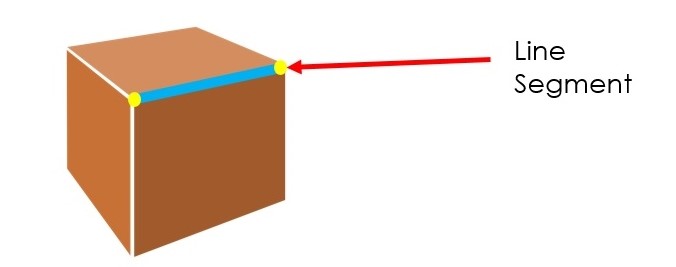
The top of a box, like the one shown below
A line segment connects two points, just like the edges of a box connect one corner to another.
Rays: Halfway to Infinity
A ray starts at one point and shoots off forever in one direction—kind of like a laser pointer or a sunbeam. It’s got a starting point but no end.
Picture someone getting ready to throw a football. The ball leaves their hand (the starting point) and flies endlessly in the direction it’s aimed—that’s a ray in action.

In geometry, a ray is shown as a line with one endpoint and an arrow on the other end. You’ll see rays when drawing angles and measuring direction.

Parallel Lines: Always Together, Never Touching
Parallel lines are two lines that never cross. They stay the same distance apart, no matter how far they go.
Look down a running track—each lane runs beside the others but never intersects. That’s parallel. Or take the opposite edges on the top of a cube: they don’t touch, and they’re the same distance apart. That’s also parallel.
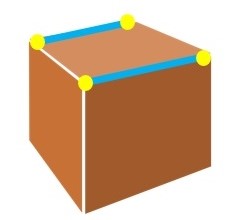
Here are some more real-life examples.
Railroad tracks
Notebook lines
The sides of a rectangular screen

Parallel lines help us build symmetry, plan cities, and even fold perfect origami shapes.
Planes: Flat Surfaces Everywhere
A plane is a flat surface that goes on forever in all directions—like an endless sheet of paper. Even though you can’t see a full plane in real life, you can see parts of them.
Look at the side of a cube, the floor in your room, or the surface of your desk—each of these is a small piece of a giant, invisible plane.

Planes can also be parallel. Take the top and bottom of a box or cube—those two flat surfaces never touch and face the same direction. They’re parallel planes.
Skew Lines: Not Parallel, Not Touching, Just Confused
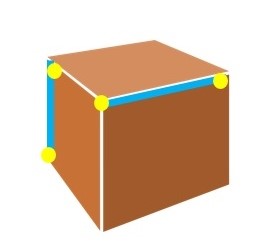
Now here’s a tricky one: skew lines. These are two lines that don’t intersect AND are not parallel. They’re going in completely different directions and don’t even exist on the same plane.
Think of a hurdle runner in motion. His legs, arms, and the hurdle bar might each form lines that don’t cross and don’t match up direction-wise. They’re skew!
You’ll see skew lines in 3D figures—like across different edges of a cube.
Geometry is Folded into Everything
You’ve now explored the backbone of spatial design: segments, rays, parallel lines, skew lines, and planes. These aren’t just textbook words—they’re the hidden language behind your hobbies, your sports, your designs, and even your math models.
Up next, you'll try out some activities to practice what you’ve just learned.
Move to the Got It? section like a geometry pro!

Supplies



 FAVORITE
 Like
Like