Sign Up
School Account Sign Up

Lesson ID: 10948
Add, subtract, and line up decimals like a pro! Solve money problems and use math in real life.




Line It Up to Win!

Think about a marching band. Every person must stand in the correct spot. If one person is out of place, the whole show looks messy.
Numbers work the same way.
When you add or subtract decimals, every number must line up in the right place. If they do not line up, the answer will be wrong. But when everything is in place, solving becomes simple.
What Is a Decimal?
A decimal is a number with a point. The decimal point separates whole numbers from smaller parts.
Here is what each place means.
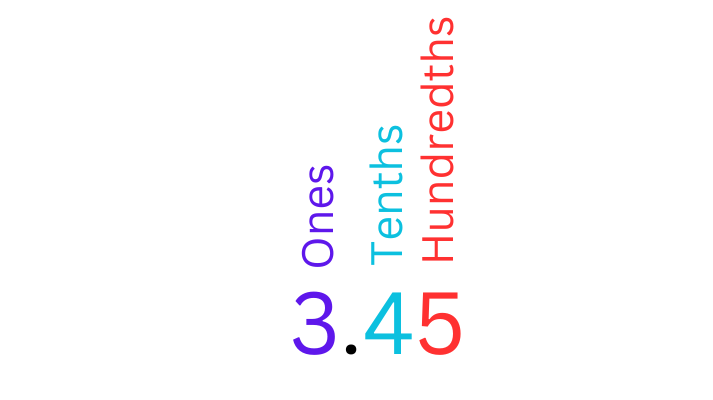
The number to the left of the decimal is the ones place.
The first number to the right is the tenths place.
The next number is the hundredths place.
Example:
3.45
This means 3 whole ones, 4 tenths, and 5 hundredths.
Decimals help you show parts of a whole. You use them when you measure, share, or count money.
Why Lining Up Matters
The decimal point is your guide. It tells you where each place value belongs.
When adding or subtracting decimals:
Always line up the decimal points.
This keeps ones with ones, tenths with tenths, and hundredths with hundredths.
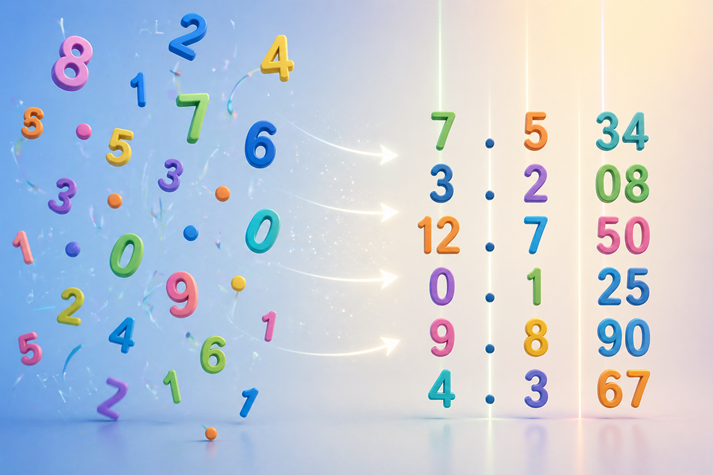
If the numbers are not the same length, add zeros to fill in missing places.
Example:
| 4 | . | 5 | becomes | 4 | . | 50 | |
| 22 | becomes | 22 | . | 00 |
Adding zeros does not change the value. It just helps you stay organized.
How to Add Decimals
Follow these steps.
Example:
| 10 | . | 80 | ||
| + | 5 | . | 34 | |
| 16 | . | 14 |
The decimal point stays in the same place in the answer.
How to Subtract Decimals
Follow these steps.
Example:
| 9 | . | 21 | ||
| - | 4 | . | 75 | |
| 4 | . | 46 |
The order matters in subtraction. The larger number goes on top.
Decimals and Money
Decimals are used every day when you count money.
The ones place shows dollars.
The tenths and hundredths places show coins.
Example:
$2.96 means 2 dollars and 96 cents.
When the coins add up to 100 cents, you get 1 more dollar.
Example:
| $ | 0 | . | 34 | ||
| + | $ | 2 | . | 62 | |
| $ | 2 | . | 96 |
Subtracting money works the same way:
| $ | 9 | . | 21 | ||
| + | $ | 4 | . | 75 | |
| $ | 4 | . | 46 |
It is just decimal subtraction with dollar signs.
A Helpful Rule to Remember
Line up the decimals.
Add zeros if needed.
Start from the right.
Bring the decimal down.
If you follow these steps, your answers will stay on track.
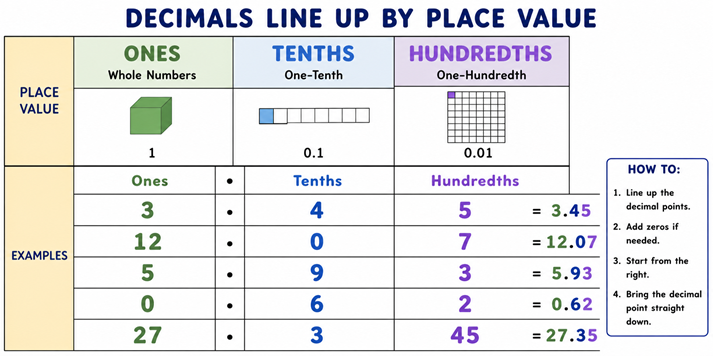
You now know how to line up, add, and subtract decimals. You also know how this helps when working with money and real-life numbers.
Get ready to try it yourself. The Got It? section will help you practice step by step and check your thinking as you go.

Supplies


 FAVORITE
 Like
Like