Sign Up
School Account Sign Up

Lesson ID: 10774
Crack the function machine! Find number rules, test your clues, and build your own real-world input-output machine.




The Mystery Machine
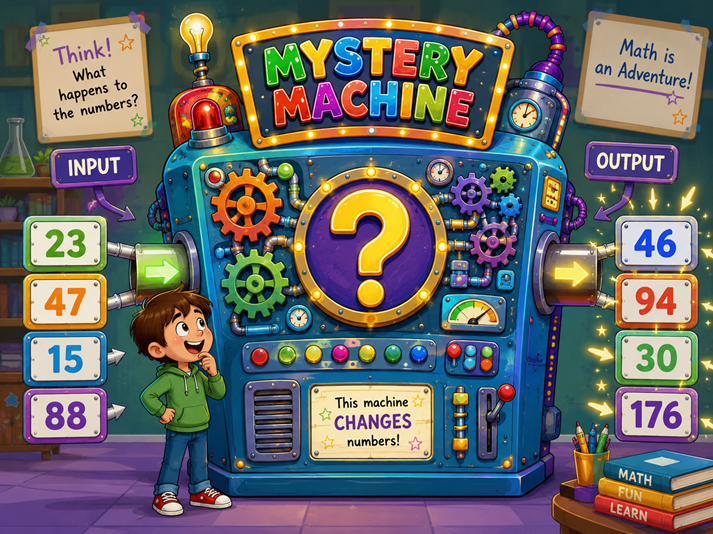
Imagine you find a strange machine in a math lab. You drop in the number 4. Out pops 16.
Then you drop in 7. Out pops 19.
What is this machine doing?
Is it multiplying? Adding? Using a secret robot brain?
Good news: it is not magic. It is a function machine!
A function machine follows a rule. Your job is to figure out that rule by looking closely at the numbers that go in and the numbers that come out.
What Is a Function Machine?
A function machine has three main parts.
First, a number goes in. This number is called the input.
Next, the machine follows a rule. The rule might add, subtract, multiply, divide, or use more than one step.
Last, a new number comes out. This number is called the output.
Here is a simple example.
Input: 5
Rule: add 3
Output: 8
The machine takes 5, adds 3, and gives back 8.
You can write this as:
5 — add 3 — 8
The input is 5.
The rule is add 3.
The output is 8.
Tiny Machine, Big Pattern
Function machines are really pattern machines.
A pattern is something that follows a rule. You see patterns in music, art, games, sports scores, and numbers.
Look at this number pattern.
2, 4, 6, 8, 10
The rule could be “add 2 each time.”
It could also connect to multiplication, since these are the numbers you say when counting by 2s.
2 x 1 = 2
2 x 2 = 4
2 x 3 = 6
2 x 4 = 8
2 x 5 = 10
Patterns help you notice what is happening. Function machines work the same way. When the input changes, the output changes by following the same rule each time.
Do Not Trust One Clue
One common mistake is stopping after checking only one input and output.
Look at this machine.
Input: 4
Output: 16
You might think the rule is multiply by 4 because:
4 x 4 = 16
That works for this one number, but one correct answer does not prove the rule.
Now check another pair.
Input: 7
Output: 19
Try multiply by 4.
7 x 4 = 28
That does not match 19. So multiply by 4 is not the rule.
To prove a function rule, test it with more than one input and output. Three or four checks are even better. A rule must work every time.
Use a Vertical Table
A vertical table can help you organize your clues.
A vertical table lists the input numbers in one column and the output numbers in another column. The numbers go down the page, so you can compare them easily.
Here is an example.
| Input | Output | |
| 7 | 35 | |
| 8 | 40 |
Ask yourself, “What happens to the input to get the output?”
Try common operations.
Could it be addition?
7 + 28 = 35
8 + 28 = 36
That does not work for both numbers.
Try multiplication.
7 x 5 = 35
8 x 5 = 40
That works for both numbers. The rule might be multiply by 5.
Now test more numbers.
| Input | Output | |
| 4 | 20 | |
| 5 | 25 | |
| 6 | 30 | |
| 7 | 35 | |
| 8 | 40 |
Each output is 5 times the input.
4 x 5 = 20
5 x 5 = 25
6 x 5 = 30
7 x 5 = 35
8 x 5 = 40
The outputs also grow by 5 each time. That makes sense because the inputs grow by 1, and each input is multiplied by 5.
So the rule is multiply by 5.
Crack the Opening Mystery
Now return to the mystery machine.
| Input | Output | |
| 4 | 16 | |
| 7 | 19 |
At first, multiply by 4 may seem right because:
4 x 4 = 16
But check the second pair.
7 x 4 = 28
The output should be 19, not 28. So multiply by 4 is not the rule.
Try addition.
4 + 12 = 16
7 + 12 = 19
That works!
Now add a few more inputs to see whether the pattern makes sense.
| Input | Output | |
| 4 | 16 | |
| 5 | 17 | |
| 6 | 18 | |
| 7 | 19 |
The inputs go up by 1 each time.
4, 5, 6, 7
The outputs also go up by 1 each time.
16, 17, 18, 19
That makes sense because adding 12 keeps the same distance between each input and output.
The rule is add 12.
You can write it this way:
input + 12 = output
Quick Rule-Finding Steps
When you need to find the rule for a function machine, follow these steps.
Write the input and output numbers in a vertical table.
Look for how the numbers change.
Try addition, subtraction, multiplication, or division.
Test the rule with every input and output pair.
Add extra numbers to the table when it helps you prove the pattern.
Remember, a real rule works for every pair, not just one lucky pair.
Ready to Test the Machine?
You now know how to find a function machine rule by using a vertical table, checking patterns, and proving your rule with more than one number.
Next, you will practice spotting rules, testing your ideas, and proving which rule makes the machine work.

Supplies


 FAVORITE
 Like
Like