Sign Up
School Account Sign Up

Lesson ID: 10759
Turn basic sentences into powerful paragraphs that grab attention and actually make people want to read more.




Say More Than “Stuff Happened”
Imagine trying to explain your favorite movie using only three words. Tough, right?
You might say “action,” “hero,” and “battle”… but that barely scratches the surface. Your brain knows way more—you just need the right words and structure to show it.
That’s exactly what strong paragraphs do.
A strong paragraph takes one clear idea and builds it so your reader can see it, understand it, and maybe even feel it. Instead of “blah blah blah,” your writing becomes something people actually want to read.
Let’s break down how to make that happen.
What Is a Paragraph, Really?
A paragraph is a group of sentences that all work together to explain one main idea.
Think of it like a mini-story.
Every sentence has a job. If a sentence doesn’t help the main idea, it doesn’t belong.
Why Strong Paragraphs Matter
Any time you write—whether it’s an essay, a story, or even a post online—you are communicating your thoughts to someone else.
Strong paragraphs help you:
Weak paragraphs confuse readers. Strong ones guide them.
The 3 Key Parts of a Strong Paragraph
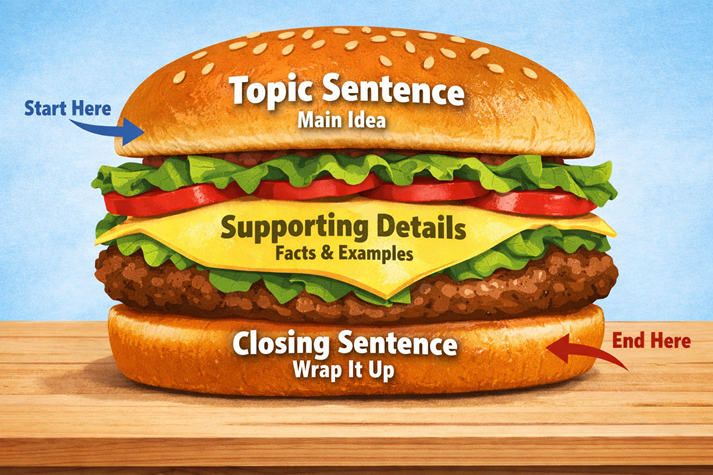
This is usually the first sentence. It tells your reader exactly what the paragraph is about.
Example: Cotton candy became wildly popular at the 1904 World’s Fair.
These sentences explain, describe, or give examples related to your topic sentence.
Strong supporting details:
Example: Inventors sold thousands of servings using a new electric machine. Visitors were amazed by the fluffy texture and sweet taste.
This sentence ties everything together and reminds the reader why the idea matters.
Example: Because of this success, cotton candy quickly became a favorite treat across the country.

Word Choice: Say It Like You Mean It
Strong paragraphs don’t use boring, general words.
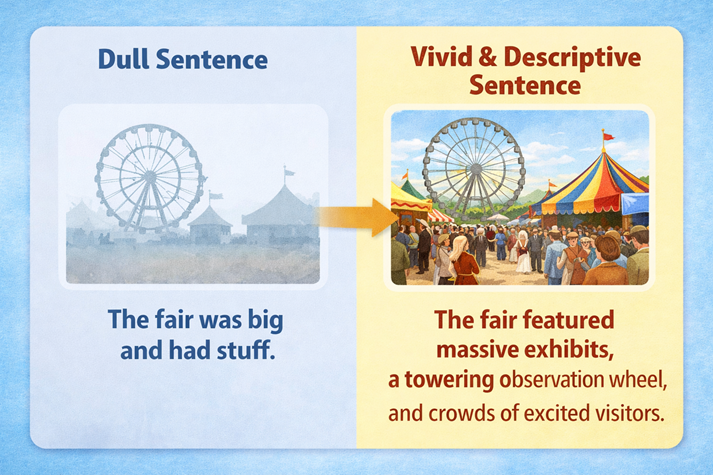
Weak: The fair was big and had stuff.
Stronger: The fair featured massive exhibits, a towering observation wheel, and crowds of excited visitors.
Notice the difference? Specific words paint a picture.
Also, use strong verbs instead of forms of “to be” (is, was, were).
Weak: The machine was used to make cotton candy.
Stronger: The machine spun sugar into light, airy strands of cotton candy.
Organization: Make It Flow
A strong paragraph doesn’t jump around. Each sentence connects smoothly to the next.
Ask yourself:
Here’s a simplified example of good flow:
The World’s Fair attracted millions of visitors. Many stopped to try a new sugary treat called cotton candy. Vendors sold thousands of boxes during the event. This success helped make cotton candy popular nationwide.
Each sentence builds on the one before it. No confusion. No randomness.
Focus on One Idea
One paragraph = one main idea.
If a paragraph tries to do too much, it becomes messy. Keep it focused.
For example:
Clear writing comes from clear thinking.
Bringing It All Together
A strong paragraph:
When all of that comes together, your writing becomes powerful instead of forgettable.
Now that you know what makes a paragraph strong, it’s time to test your skills by organizing and building one yourself.

Supplies



 FAVORITE
 Like
Like