Sign Up
School Account Sign Up

Lesson ID: 10388
Learn fun new words and make your writing stronger using synonyms, word maps, and a thesaurus!




Words That Mean the Same Thing? Yes, Please!
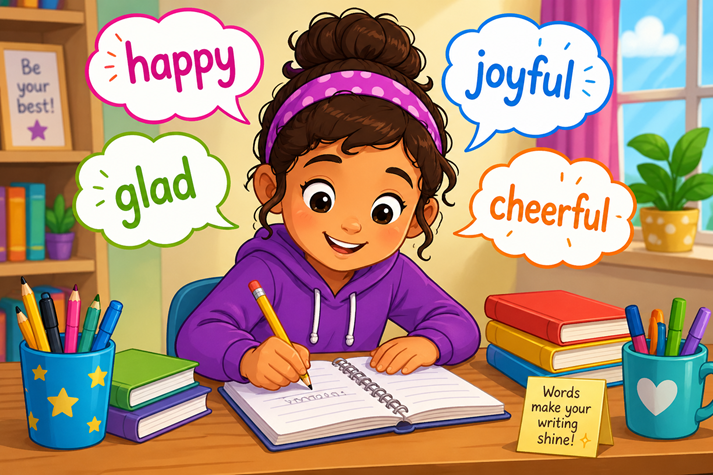
“I was happy. It was a happy day. I felt very, very happy.”
Yikes. That gets boring fast.
You can. It’s called using synonyms.
What Are Synonyms?
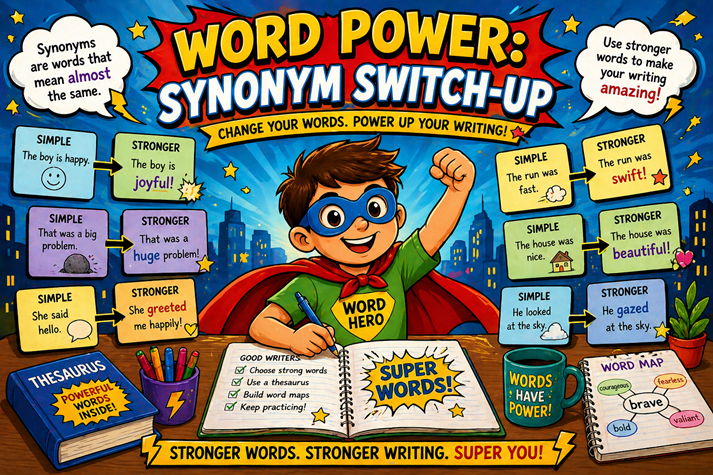
Synonyms are words that have the same or almost the same meaning.
Here are some examples.
happy — glad, joyful, cheerful
big — large, huge, enormous
fast — quick, speedy, rapid
Using synonyms makes your writing more interesting and easier to read. It also helps you sound like a strong, confident writer.
Think of synonyms as tools in your writing toolbox. The more tools you have, the better your writing becomes.
A Quick Story: The Day Everything Changed
Read this short story. Pay attention to the words in bold (you will use them soon).
Milo loved to draw, but he always worried about what others thought.
One morning, Milo felt nervous about sharing his art at school. He stared at his picture and thought, “What if it’s not good enough?”
At school, his teacher smiled and said, “Your work is amazing!”
Milo felt shocked. Amazing? His drawing?
Soon, other students gathered around. “This is awesome!” one said. “It’s incredible!” said another.
Milo blinked. Amazing. Awesome. Incredible.
All those words meant something like good… but they sounded stronger and more exciting.
Milo grinned. Maybe his drawing really was special.
That day, Milo stopped worrying so much. He started trying new words and new ideas. And guess what?
His art—and his confidence—grew bigger every day.
Why Synonyms Matter
Did you notice how the story used different words instead of repeating good?
amazing
awesome
incredible
These are all synonyms for good, but each one adds a little more feeling and detail.
When you use synonyms, you can:
Avoid repeating the same word.
Make your writing more exciting.
Show clearer ideas and feelings.
How to Find Synonyms
You already have a powerful tool: your brain.
You can also:
Think of similar words you already know.
Ask, “What else could this mean?”
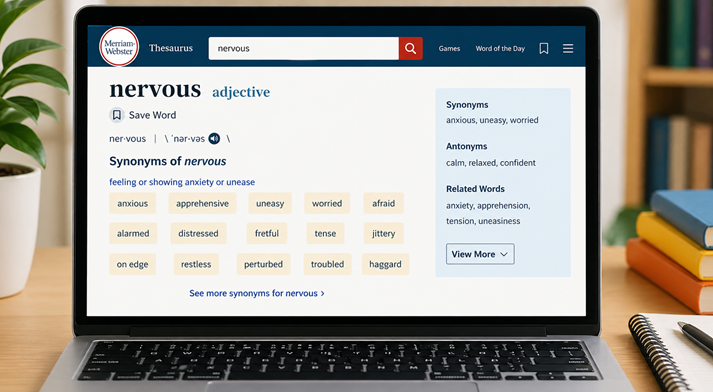
Use an online thesaurus to look up words and find synonyms. A thesaurus is a tool that shows words with similar meanings.
Use a word map to explore the word more deeply.
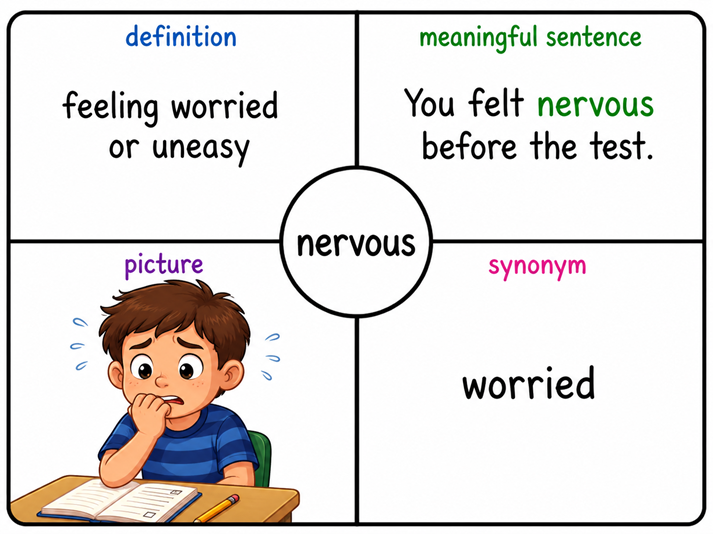
Your Vocabulary Word Map
Take a look at a vocabulary word map.
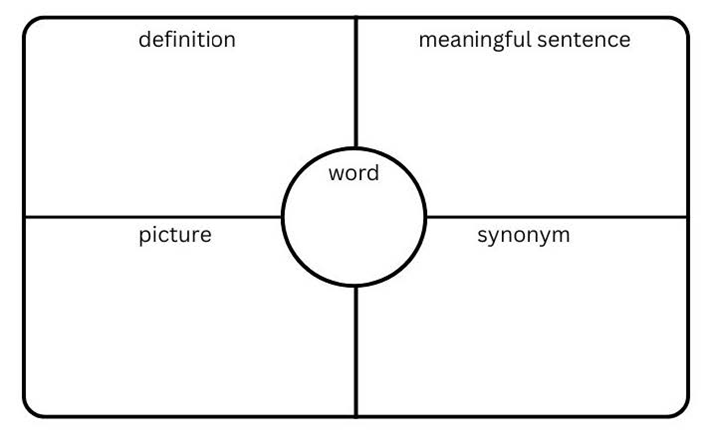
This map helps you understand a word in four ways.
Definition: What does the word mean?
Sentence: How do you use it?
Picture: What does it look like?
Synonym: What is a similar word?
Example:
Word: nervous
Definition: feeling worried or uneasy
Sentence: You felt nervous before the test.
Picture: A student biting their nails
Synonym: worried
This simple tool helps you remember words better and use them correctly.
Using Synonyms in Sentences
Look at this sentence.
You felt nervous before the test.
Now switch the word nervous with a synonym.
You felt worried before the test.
You felt anxious before the test.
Same idea. Different words. Stronger writing.
That’s the power of synonyms.
Get Ready to Try It
Now you know what synonyms are, why they matter, and how to use a word map to explore them.
Next, it’s time to practice. You will find synonyms, use them in sentences, and start building your own powerful word collection.
Let’s move on and put your new skills to work in the Got It? section.

Supplies




 FAVORITE
 Like
Like