Sign Up
School Account Sign Up

Lesson ID: 10027
Experience what it was like to be a traveler on the ancient Silk Road. Complete your experience with a journal entry sharing your time on the Silk Road.



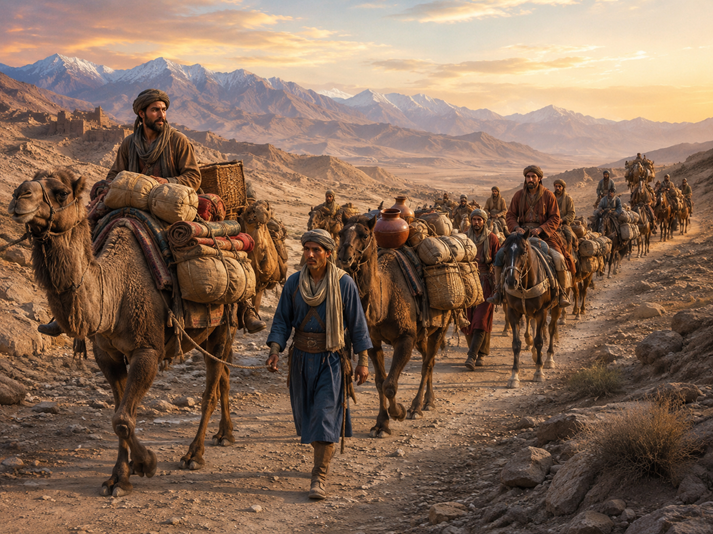
What Would You Pack?
Imagine you are about to travel 4,000 miles.
You cannot take a plane, train, bus, or car. Your phone will not help you find directions. There are no gas stations, rest stops, fast-food places, or cozy hotels waiting every few miles.
A camel.
Whatever your caravan can carry.
Deserts, mountains, rivers, busy markets, and places where you may not speak the same language as anyone around you.
Before you begin, choose three things you would bring.
Now think about this.
That question leads straight to one of history’s most important trade networks: the Silk Road.
Keep reading to discover how this ancient route connected people, places, goods, and ideas across thousands of miles.
Imagine a long, winding network of paths stretching across deserts, mountains, forests, cities, and seas.
This network is known as the Silk Road.
The Silk Road was not one single road. It was a system of trade routes that connected parts of eastern Asia, central Asia, India, the Middle East, northern Africa, and Europe. People used these routes to trade goods, share ideas, and learn from cultures far from their own.
What Was the Silk Road?
The Silk Road got its name because silk from China was one of the most valuable goods traded along it. Silk is a soft, shiny fabric that many people in Europe and the Middle East highly prized.
However, silk was only one of many goods that traveled along these routes. Traders also exchanged spices, tea, precious stones, glassware, carpets, paper, ceramics, metalwork, and horses.
The Silk Road was used for centuries. It became especially important around 130 BCE during the Han Dynasty in China. It remained an important trade network until the 1450s, when sea trade routes became more popular.
That means the Silk Road helped connect people for more than 1,500 years!
How Far Did the Silk Road Stretch?
The Silk Road covered an enormous distance. It stretched about 4,000 miles (6,400 kilometers) from China in the east to the Mediterranean Sea in the west.
The routes passed through or near places that are now China, India, Iran, Turkey, and several other countries. Some routes crossed land. Others connected to sea routes that helped goods move by ship.
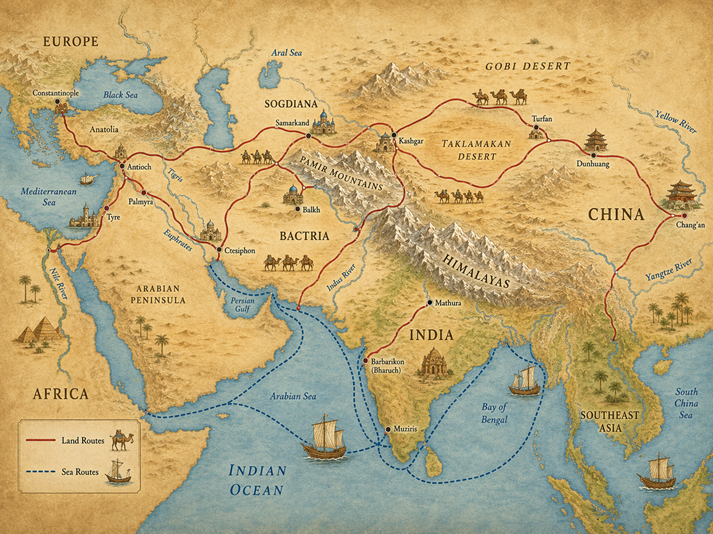
Look closely at the map.
Notice how the routes branch in different directions. That is one reason the Silk Road is better described as a network than as one road. Travelers could follow different paths depending on their destination, the season, the landscape, and the goods they were carrying.
A Trip Along the Silk Road
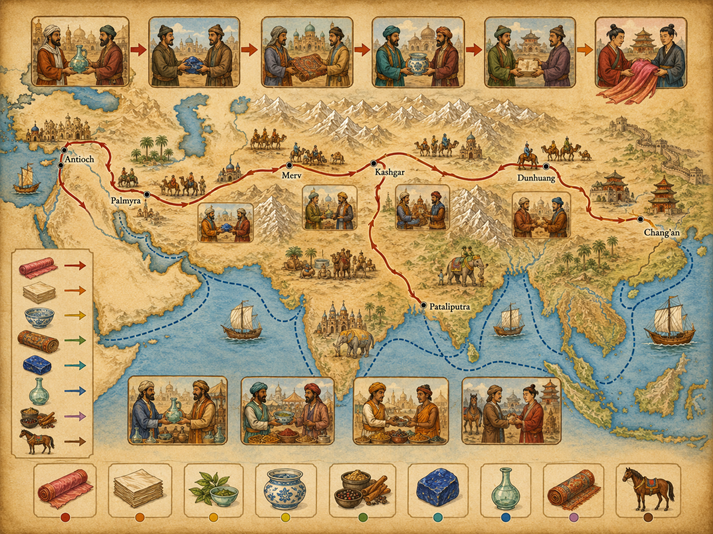
To understand how the Silk Road worked, picture one item beginning a long journey.
Maybe it is a roll of silk made in China. Maybe it is a small bag of cinnamon, a piece of glassware, a bundle of paper, or a beautiful blue stone called lapis lazuli.
That item probably did not travel with one person from beginning to end. Instead, it may have passed from trader to trader, market to market, and caravan to caravan.
The Silk Road worked a little like a relay race. One group of traders carried goods across part of the route. Then another group took them farther. A merchant in one city might trade silk for horses. Another trader might carry that silk across a desert. Someone else might sell it in a crowded market far to the west.
By the time the item reached its final buyer, it may have crossed thousands of miles and changed hands many times.
What Was the Journey Like?
Traveling on the Silk Road was difficult and risky.
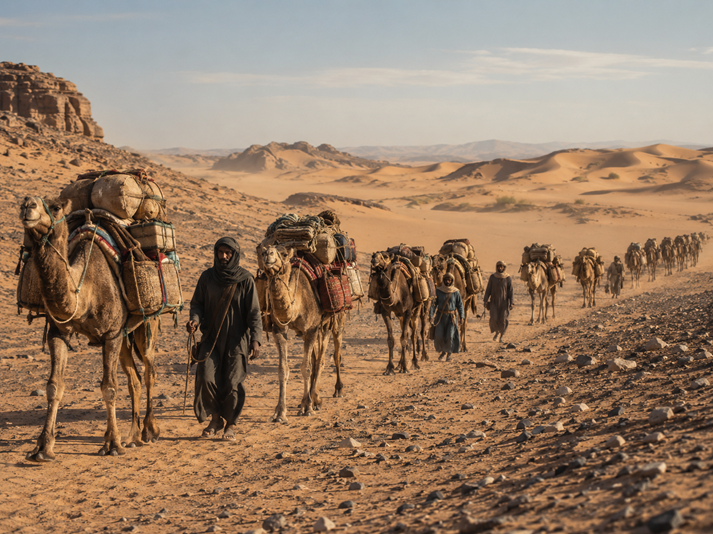
Merchants and travelers crossed harsh deserts, such as the Gobi Desert and the Taklamakan Desert. They climbed high mountains, such as the Pamirs. They faced freezing passes, scorching heat, sandstorms, illness, hunger, and thieves.
Many travelers moved in caravans. A caravan is a group of people, animals, and goods traveling together. Caravans helped make travel safer because people could share supplies, protect one another, and help care for the animals.
Camels were especially useful because they could carry heavy loads and survive difficult desert conditions better than many other animals. Horses were also important, especially in cooler or less sandy regions.
Still, travel was never simple. A successful journey required planning, patience, courage, and probably a strong ability to not complain every time sand got in your shoes.
Why Were Oases Important?
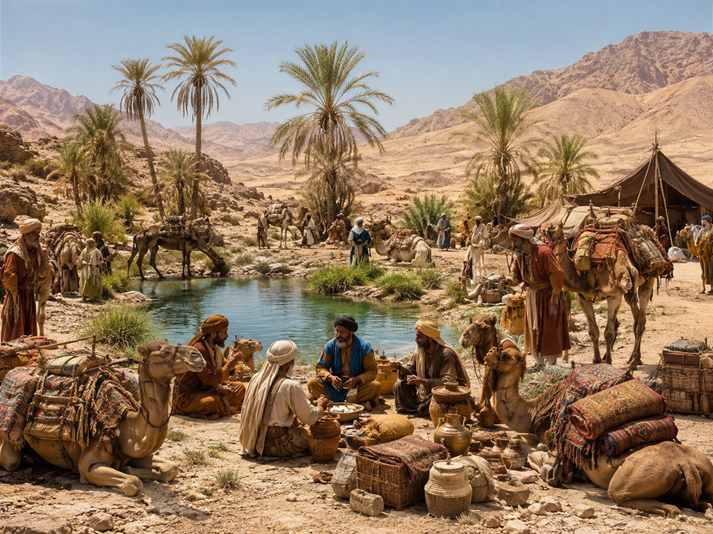
Oases were some of the most important stopping places along desert routes.
An oasis is a place in a desert where water is available. Travelers could rest, refill water supplies, feed animals, repair equipment, and exchange news.
Without oases, crossing huge deserts would have been nearly impossible. These places often grew into busy trading stops where travelers from different regions met one another.
Who Used the Silk Road?
The Silk Road was used by merchants, traders, caravan drivers, craftspeople, religious travelers, and explorers from many places.
Two famous travelers connected to Silk Road history were Marco Polo from Italy and Ibn Battuta from Morocco. They traveled through parts of Asia and wrote or shared stories about the places, people, and goods they encountered.
However, the Silk Road was not built by only famous travelers. Most of its history came from everyday merchants, guides, workers, and local communities who helped goods and ideas move from place to place.
Trading Cities Became Meeting Places
Cities along the Silk Road became busy centers of trade and culture. Their markets were filled with goods from many regions. A traveler might see Chinese silk, Indian spices, Persian carpets, Roman glass, Central Asian horses, and Middle Eastern metalwork.
These cities were not just places to buy and sell. They were places where people heard new languages, tasted unfamiliar foods, learned new skills, and shared stories about faraway lands.
A merchant might arrive to sell spices and leave with a new idea about astronomy. A traveler might bring home a new style of art, a new religious belief, or a new way to make paper or glass.
Why Was the Silk Road Important?
The Silk Road changed history because it connected people who lived far apart.
Trade
The Silk Road allowed people to buy and sell goods they could not find in their own regions. Europeans wanted silk and spices from Asia. People in Asia traded for horses, glassware, and other goods from the west.
Ideas
Along with goods, people exchanged ideas. Knowledge about science, medicine, math, art, and technology moved across the routes. Paper-making, for example, began in China and eventually spread westward.
Religion also traveled along the Silk Road. Buddhism spread from India into central Asia and China through trade routes and traveling communities.
Culture
As people traveled, they shared languages, foods, music, clothing styles, building designs, stories, and traditions. This cultural exchange made many societies richer, more creative, and more connected.
Not everything traded on the Silk Road could fit into a saddlebag. Some of the most powerful things that traveled were ideas.
How Is the Silk Road Similar to Today?
Today, goods and ideas move much faster than they did on the Silk Road.
A product can cross an ocean by ship or plane. A message can travel around the world in seconds. You can buy something made in another country without leaving home. You can also learn about music, food, art, and traditions from many cultures online.
The Silk Road no longer exists in the same way, but its spirit of connection and exchange continues.
People still trade.
People still share ideas.
People still learn from cultures beyond their own.
The Silk Road reminds us that connection can change what people eat, wear, believe, build, study, and imagine.
Continue to the Got It? section to keep learning about the Silk Road.

Supplies
Suggested Resources


 FAVORITE
 Like
Like